
Case Study: Compliance Training Services Supporting Regulatory Awareness and Organisational Readiness
Background on Case Study Compliance Training Services
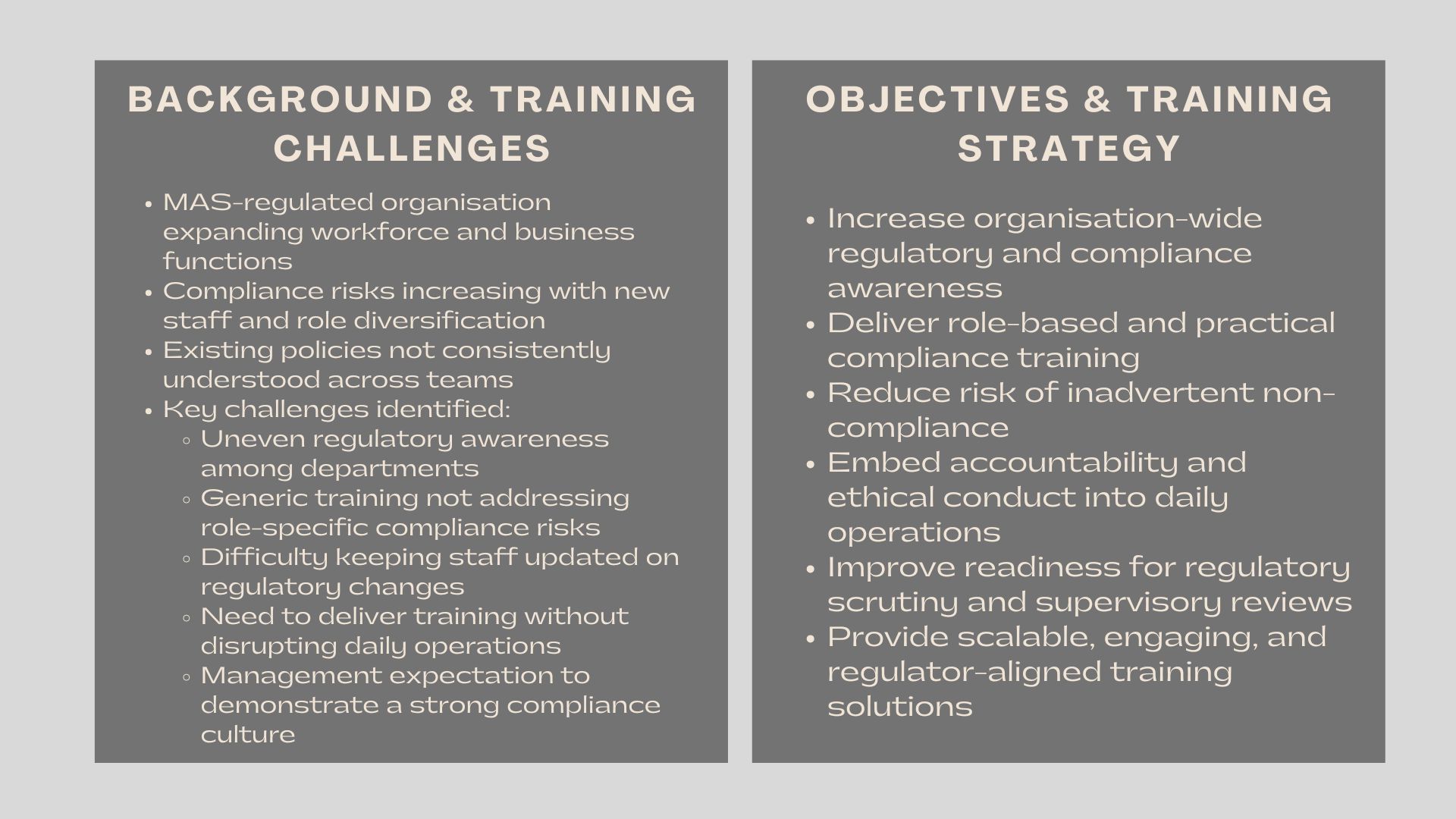
One of the regulated organisations based in Singapore was increasing their workforce and presence on various business functions. As additional staff joined and additional responsibilities were introduced, the senior management realised that regulatory compliance was not merely a matter of policy and control but equally a matter of the knowledge of the staff of their regulatory obligation and expected behaviour.
Although compliance policies and procedures existed, the management noticed that different teams had different levels of regulatory knowledge. It was also necessary to make certain that the staff on various levels were aware of the way in which compliance requirements were relevant to their job and day-to-day operations.
As a response to the issues, in order to reinforce the organisational compliance culture, the organisation has hired our Compliance Training Services, whereby, structured, role-based training is designed and provided, which is in line with regulatory requirements.
Issues and Challenges
There are a number of issues that arose and led to the necessity of a well-organised compliance training programme in the organisation.
Poor awareness of regulations was one of the challenges. The different departments did not have the same understanding of regulatory requirements, and there was a high chance of inadvertent non-conformity.
Relevance of training was another challenge. Risk exposure: There was a lack of generic training material to deal with role specific compliance risks. There was a need to have personalized content to the front-line staff, the management, and the control functions based on their duties.
Complexity was further increased due to regulatory change. With the changing regulatory requirements, the organisation required a way to change the training content in a scalable manner and make sure that new requirements are disseminated in time.
There were also constraints of operational requirements. Training had to be provided in an efficient way without interfering with the daily operations, but at the same time provide significant engagement and knowledge retention.
Lastly, the management was aimed at presenting a powerful compliance culture. Regulators are increasingly demanding that the firms demonstrate the presence of efficient training programmes that can encourage accountability and ethical conduct.
Objectives
The main aim of the engagement was to increase regulatory awareness and ability to comply across the organisation using organised training.
In particular, the organisation set the goal of:
- Enhance employees’ awareness of regulatory and compliance requirements.
- Provide job-related and realistic training material.
- Minimise Non-compliance with policies.
- inculcate a compliance and accountability culture.
- Enhance preparedness to regulatory scrutiny and oversight.
The interaction was meant to provide viable, interactive and viable training solutions.
How We Helped
We embraced an organized and audience based compliance training advisory and delivery.
Our interaction was initiated by a training needs assessment. Together with management, we have determined areas of concern, regulation priorities, and target audiences so that the content of training could be tuned towards the regulatory profile of the organisation and realities of its operations.
On the grounds of this analysis, we created a modular training framework. Different groups of staff were trained on specific modules, including, but not limited to, regulatory requirements, awareness of AML/CFT, professional code of conduct, escalation, and personal responsibility.
Development of content was practical based. The training material included policy and role-related examples and real-life scenarios, process walkthroughs to assist in bridging between policy and practice.
We encouraged the adaptable forms of training delivery, such as face-to-face workshops, Web-based classes, or briefings, and enabled the organisation to strike the right balance between learning and business operation.
We helped in creation of training documentation and tracking systems to help with sustainability. This involved attendance logs, training plans and refresh plans to assist in continuous oversight of compliance and regulatory evidence.
During the engagement, we collaborated with the management to build the important messages, answer questions and align the training goals with the overall compliance and risk management efforts.
Value Delivered
The case study demonstrates that professional Compliance Training Services may reinforce the awareness of regulations and instill compliance within the culture of the organisation.
The engagement aided in enhancing staff compliance understanding and enforcing the policies consistently, as well as the overall regulatory preparedness, through a structured and role based training programme.
The framework of compliance training that was formed as a result of this engagement could offer the scalable basis of the regular staff education, alignment of these practices with regulations, and the compliance practices that would stay sustainable.