

Double Taxation Agreements (DTAs) and Their Benefits in Singapore
Singapore is a global business hub with a rich economic system, open legal system, and a competitive tax regime that makes the city have a great reputation as a business destination. The nation has also been very proactive in developing a system of tax treaties that do not allow the same income to be taxed in more than one country. This framework does not only appeal to the foreign investors but also attracts multinational corporations to set their regional headquarters in Singapore.
Tax implications may get more complicated as companies operate internationally. Companies can also be subjected to two taxation, i.e. same income taxed in the country of origin and in the country of residence without proper planning of taxes. In a bid to overcome this hurdle, Singapore has adopted a broad approach to the issue through the use of a system of Double Taxation Agreements (DTAs) in order to encourage equitable taxation and to promote international trade, while also emphasizing the importance of understanding Singapore Financial Reporting Standards (SFRS) for accurate reporting and compliance.
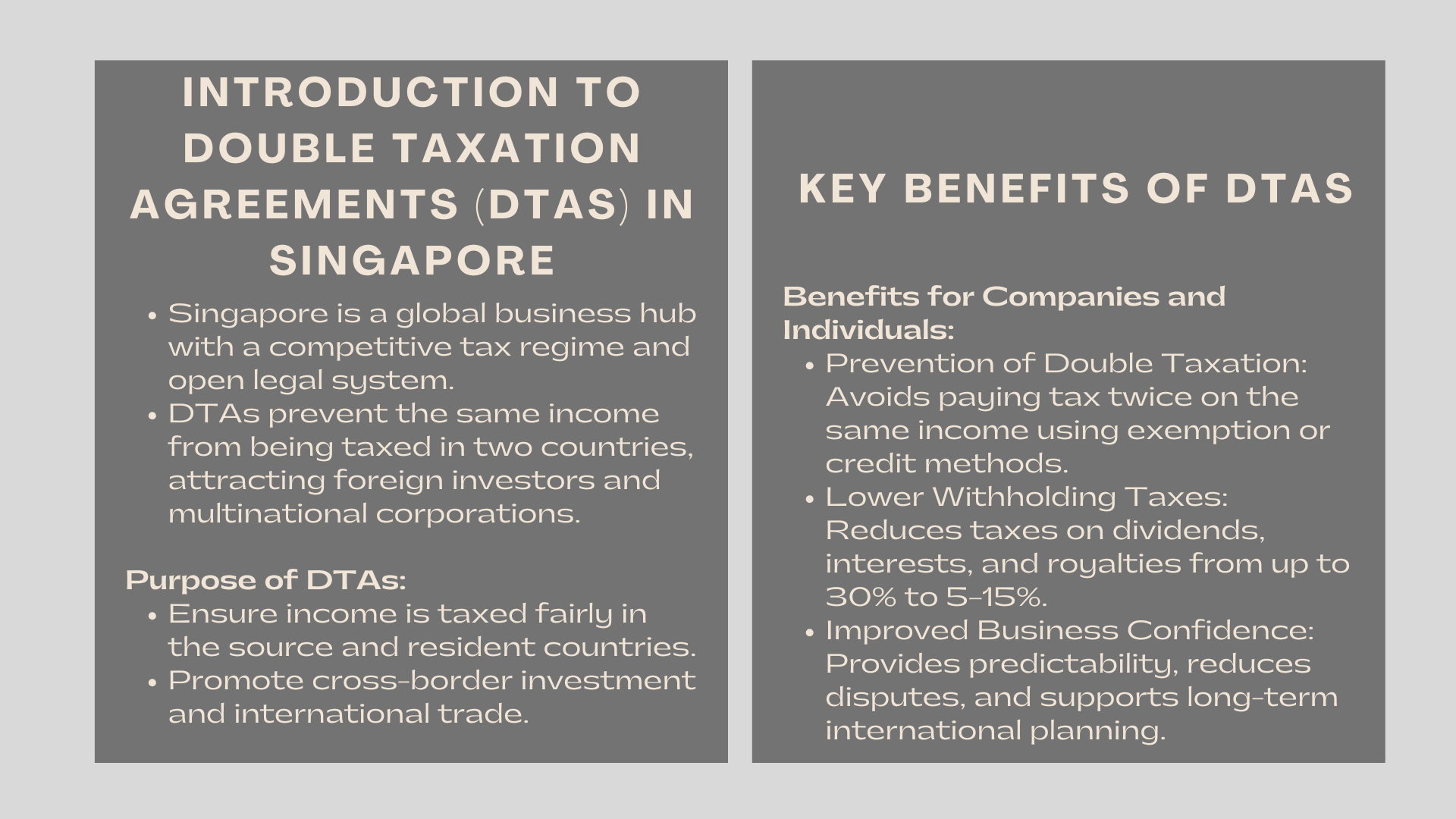
Knowledge on the Double Taxation Agreement Framework in Singapore.
Purpose of DTAs
Fundamentally, a DTA is a contract between two nations according to which the level of income earned by the residents of one nation due to the source in another nation is destined to be taxed. These treaties guarantee that taxation of income does not occur in the source country and resident country therefore promoting cross- border investments and global cooperation.
The DTAs in Singapore relate to a broad spectrum of income such as dividends, interests, royalties, and employment income. These deals clarify the rights of each nation in taxation and the tax exemptions.
Scope and Coverage
The Double Taxation Agreements (DTAs) and Their Benefits in Singapore extend to more than 90 jurisdictions worldwide. All treaties are specific to the economic and political engagement that Singapore has with its treaty partners.
Although the majority of the DTAs follow the OECD Model Convention, the Singaporean treaties usually have more specific provisions, which are tailored to meet the common economic interests. The key advantages are decreased withholding taxes rates, tax exemption options, and a refund of taxes paid abroad credits.
Treaty Eligibility
In order to receive DTA benefits, a taxpayer has to be a tax resident of Singapore. A company is described as a tax resident when its control and management are exercised in Singapore the country that is, it means that the key decisions and board meetings are held within the country.
Individuals, in turn, are tax residents in case they have been physically present or worked in Singapore at least 183 days during a calendar year. Certificates of the Inland Revenue Authority of Singapore (IRAS) are regarded as a certificate of tax residency in claiming tax treaty benefits in other countries.
Some Advantages of Double Taxation Agreements.
Prevention of Tax on a Tax.
The best benefit of DTAs is prevention of double taxation. Individuals and companies which are operating at the cross-border level will not be taxed twice on a similar stream of income. This is done by giving tax exemption or credit mechanisms depending on what a particular treaty has to offer.
A case in point is when a company in Singapore earns revenue in a nation that holds a DTA with Singapore it is possible that it does not pay taxes in Singapore or gets a credit to pay taxes abroad. This provides equitable allocation of taxing rights by both nations.
Lower Withholding Taxes
The DTAs generally lower the rate of withholding tax on income like dividends, interests and royalties. Indicatively, foreign jurisdictions might increase withholding tax rates (up to 30) without a treaty. These rates can be left at 5-15 percent under a DTA, which is much better in raising net returns in business.
This tax cut is of direct good to multinational companies operating abroad, which will improve cash flow and improve profitability.
Improved Business Confidence.
The international investors enjoy predictability and stability through DTA. Reasonable tax treatment under a DTA also ensures that companies are able to make long-term plans without having to fear the unforeseen liabilities due to taxes. It also reduces conflict with the foreign tax authorities by implementing clear taxation guidelines and mutual agreement procedures (MAPs).
Using and Accommodating DTA Provisions.
Claiming Tax Relief
The companies have to present claims to IRAS using the relevant forms and documents in order to receive the benefits of DTA. In case of foreign-sourced income, the taxpayer should provide evidence of tax paid abroad and valid Certificate of Residence.
Under its DTAs, Singapore permits two avenues of relief, namely:
- Exemption Method: Foreign earned income is exempted to taxation in Singapore.
- Credit Method: Taxes paid in the foreign jurisdiction would be credited and allow the Singapore tax on the same income to be paid.
Avoiding Tax Evasion
DTAs are not made in a way that only serves the interests of the tax payers; they also contain the clauses that stave off evasion and avoidance of tax. The exchange-of-information clauses allow the tax authorities to exchange relevant information to identify discrepancies of fraudulent reporting.
The DTAs in Singapore are in line with the Base Erosion and Profit Shifting (BEPS) standards recommended by the OECD, which assure transparency and equity in the area of cross-border taxation.
Dispute Resolution Mechanisms.
In case of differences among tax authorities on the interpretation of provisions of the treaty, there should be the Mutual Agreement Procedure (MAP). In MAP, both countries have a competent body that negotiates with the view of solving disputes, to make sure that there is taxation in line with the spirit of the agreement.
The mechanism offers companies an extra point of defense against the unfairness of tax treatment across jurisdictions.
Strategic Advantage of DTAs to Businesses.
The Benefits of Cross-Border Structuring.
Multinational enterprises have an opportunity to effectively use DTAs, strategically to organize their investments in an efficient way concerning taxes. Repatriation Companies can lower overall costs incurred in taxation and increase the effectiveness of repatriation by directing revenues through Singapore, where DTA programs provide good withholding rates.
As an example, a holding company in Singapore can be given dividends by its subsidiaries in countries where Singapore has entered into DTAs and being subject to reduced or zero withholding tax.
Risk aversion in international operations.
In a time of growing transparency of taxation and transatlantic oversight, legal assurance would be offered by DTAs that prevents companies to unwittingly fumble. These agreements lower the chances of duplication of taxations and punishment that may occur due to multiple taxations that may be experienced because of tax overlapping.
Companies that frequently trade internationally, provide services, or finance their operations ought to be part of DTA planning in its tax strategy to ensure that profits remain intact and that it remains compliant.
Practical Guidance for Companies
Singapore’s tax authority provides clear guidelines on how companies can use DTAs in Singapore to avoid being taxed twice on the same income. Companies should:
- Get and renew a valid Certificate of residence on an annual basis.
- Check DTA provisions in every jurisdiction they are operating in.
- Maintain record of income and taxes paid which are of foreign source.
- Seek the advice of the tax advisors with a view of maximizing the benefits of the treaties and to ensure that the requirements of the IRAS are met.
Through such measures, companies can effectively deal with their global taxation liabilities and reduce the chances of being taxed on the same.
Conclusion to Double Taxation Agreements DTAs and Their Benefits in Singapore
Singapore boasts of a large number of Double Taxation Agreements with various countries around the world providing it with the status of one of the most tax efficient jurisdiction of international business. Such treaties do not just remove the heavy hand of the taxation inflicted on people but they also enhance economic ties with the countries of partners.
To the businesses with international operations, the knowledge and the implementation of the advantages of DTAs is a critical aspect of strategic tax planning. Correct documentation, compliance, and professional advice can ensure that the benefits of the treaty are maximized, companies gain competitive advantages on the global market, and the continuous growth is possible in the context of the trusted and transparent tax system of Singapore.