
What Are the Rules Regarding the Segregation of Client Monies and Assets?
Introduction to Rules on Segregating Client Money and Assets
One of the main tasks for any Licensed Fund Management Companies (LFMCs) is making sure clients’ funds and assets are handled correctly. As a result of MAS’s strict rules, companies are not allowed to use, misuse, or mix funds from clients with their own. Following these rules keeps investors’ confidence and ensures the stability of how funds are managed. The MAS client asset segregation requirements in Singapore are central to maintaining transparency and protecting investors’ money under all financial conditions.
This article talks about the separation of client’s money and how it affects Singapore’s fund management companies.
Regulatory Framework and Legal Basis
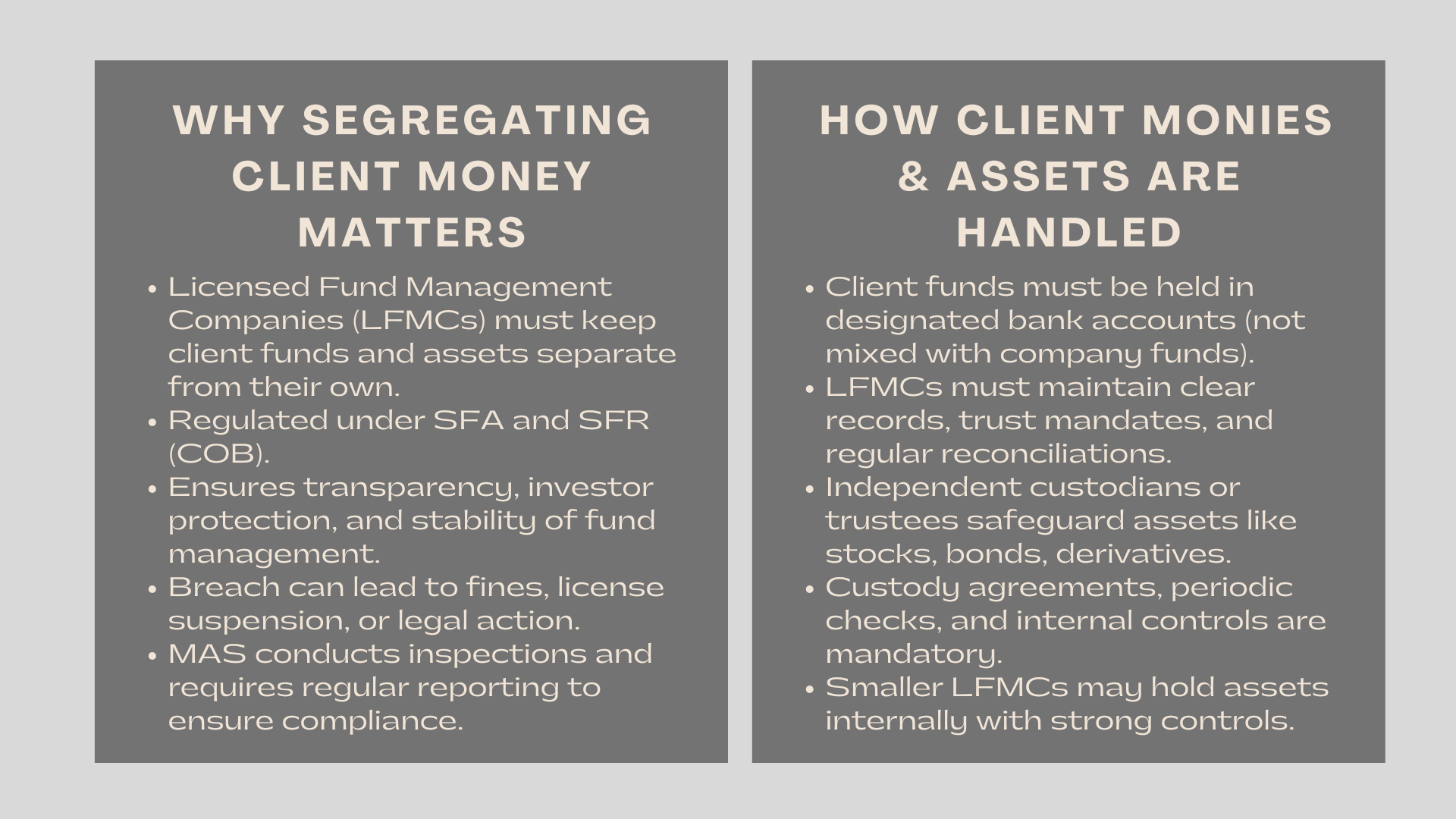
It is required by law under the regulations of the SFA and the SFR(COB) to segregate client money and assets from the firm’s money. All fund management companies (licensed and exempt) are subject to these regulations, even the institutional and retail ones.
The simple idea is that any client money or property must be separated from the company’s own resources or assets by keeping them in segregated accounts. Therefore, a fund manager may not use a client’s money for running their business, clearing internal trades, or putting it into investments that belong to the firm.
The rule serves to ensure that company operations are clean and legal protection becomes available if the company fails financially. In case the fund manager goes bankrupt, the organization’s assets are no longer accessible to the company’s creditors through segregation.
MAS ensures regulators work according to these rules by giving licenses, conducting regular inspections, and requiring them to provide a lot of reports. When a company does not follow the law, the results may be tough penalties such as fines, losing a license, or facing prosecution in cases of fraud or misusing company money.
How Client Monies Must Be Handled
The term client monies is used for money that comes from clients and will be invested by the firm. In Singapore, all these monies have to be transferred to a client bank account designated by the law.
- Newly created SGD will be kept in a licensed SGD account at a bank in Singapore (made with MAS approval).
- It is obvious that the account is a client account.
- Not part of the fund manager’s corporate money
When a client account is created, the LFMC should make sure that the mandate states clearly why the account exists and that its purpose is to hold clients’ funds in trust. They should also keep detailed and recent records to show how every client’s money is handled and invested within the segregated account.
There are instances where a fund manager can work with a custodian or trustee to look after clients’ accounts. In this case, these firms must confirm that these third parties are honest, financially steady, and also adhere to the requirements of MAS.
It is necessary for LFMCs to use proper controls and internal audits so as to find discrepancies and avoid accidental or fraudulent transfers between a client’s record and their own records.
Segregation of Client Assets: Custody and Oversight
Besides money from investors, licensed fund managers commonly take care of clients’ investments in stocks, bonds, derivatives, and other types of financial instruments. Like client funds, these types of assets ought to be separate from the company’s own assets.
MAS requires that client assets are looked after by independent custodians in retail fund management by the fund managers it oversees. Usually, the main custodians are trust companies or banks that legally hold and oversee securities belonging to someone else.
There are important rules for LFMCs concerning the way client assets must be separated.
- It is important to have custody agreements written.
- Doing recurring checks to find if their internal records are accurate to those from the banks
- Ensuring there are rules and procedures within the company to stop unauthorized movements of clients’ assets
- Keeping clients safe from the possibility of credit risk put forth by the fund manager
MAS can permit smaller fund managers or those dealing with accredited investors to keep their assets internally if the firm applies proper and strong controls and rules.
Segregating information is important in the process of reporting and disclosing. Every client must be told where their assets are being kept and should get regular updates on the status of their portfolio.
Common Compliance Challenges and Best Practices
Even though MAS sets clear rules, several fund management companies, mainly the smaller ones, have a hard time putting proper segregation in place.
There is usually a struggle with record-keeping, mainly when handling several client portfolios in pooled form. Each fund manager has to make sure that the ownership of clients is easily identifiable in every group investment. The best practices for safeguarding client funds in fund management include using reliable technology, independent audits, and detailed documentation to ensure every transaction remains transparent and compliant.
There are more problems when using foreign custodians or banks, since their regulations may differ from those used in your country. Managers should undertake the required checks to see if offshore entities pass the MAS standards and clients’ interests are not undermined.
The following are the best practices that MAS requests from LFMCs:
- Making technology available for real-time tracing of clients’ money and positions
- Auditors should undertake independent reviews of how segregation is being carried out.
- Providing ongoing staff training on compliance policies
- Making a document that sets out each employee’s position, duties, and escalation steps
Required preparations for fraud, failures of systems, and the possible bankruptcy of custodians ensure that clients are given special protection at all times.
Implications of Non-Compliance
Anyone who loses separate client money and meddles with assets faces heavy legal consequences. According to MAS, violations in this area are examples of governance negligence and breaking the law. Offenses against the law may lead to penalties. The compliance risks of failing client asset segregation rules include severe fines, license suspension, reputational damage, and even criminal prosecution for serious breaches.
- Steps by the authority like reprimands, imposing fines, or instructing to correct the mistakes
- Breaching the law on driving several times may lead to a license being suspended or taken away.
- When someone is charged with misappropriation or fraud, it is called criminal prosecution.
- Financial problems experienced by clients because of the firm’s neglect
Reputation can be very badly harmed if it is found out that a firm does not properly handle client assets. Such secrecy can lower client trust, cause some clients to withdraw funds, file a lawsuit, and lose contacts in the business world.
In the past years, MAS has started inspecting and applying stricter enforcement to ensure that LFMCs hold financial transactions separately. Businesses are supposed to disclose any breaches, and the ones that deal with problems upfront are handled more kindly by authorities.
Conclusion
Keeping client money apart from a firm’s assets is vital in the local rules for fund management companies. It takes care of clients’ funds, so they are safe even if the fund manager cannot pay or acts improperly, and mirrors the main principles of reliability and accountability in the financial sector.
Fund managers need to follow these rules since it is important for clients to trust their business with their money. By separate accounting for all assets, taking extra care to vet every client, and using good security practices, Limited Fund Management Companies meet what MAS expects and help maintain their reputation years later.