
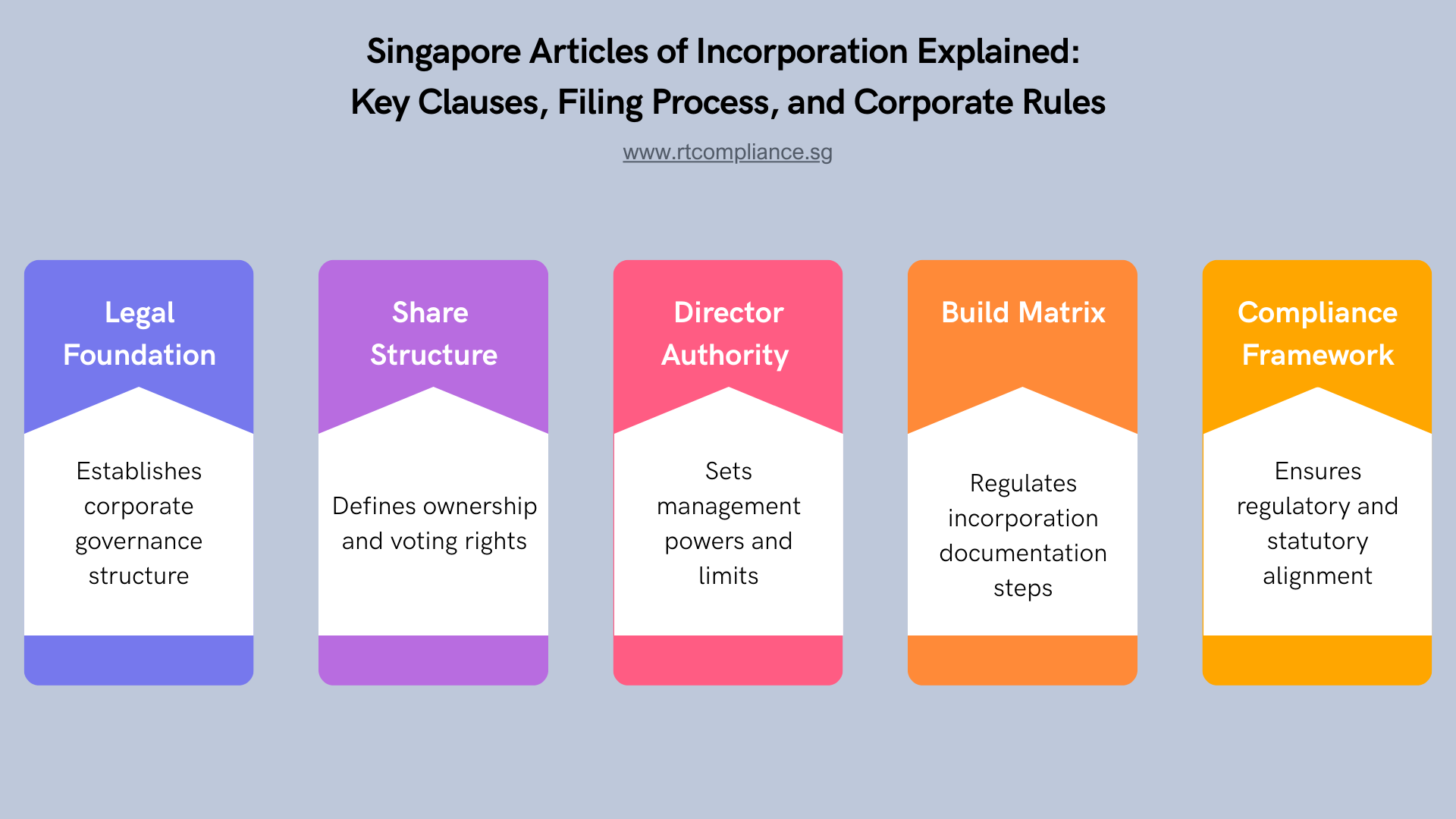
Singapore Articles of Incorporation Explained: Key Clauses, Filing Process, and Corporate Rules
Introduction to Singapore Articles of Incorporation Explained
Singapore articles of incorporation are among the very basic forms of legal documents needed to form a company in Singapore. These articles are the constitutional foundation of the company that stipulates the rules of its inner governance, the decision-making process, the rights of shareholders, the power of directors. In a region like Singapore, where the compliance in the corporations is highly controlled and where the global corporate system admired, the articles of incorporation are not just a piece of paperwork. Rather, they are a legally binding corporate document that affect the identity of the company, its legal personality and long-term legitimacy of operation.
The incorporation system in Singapore is internationally renowned as a fast, digitalised and highly organised system. Nevertheless, even being efficient, incorporation process remains to be based on strict statutory requirements. The companies will be required to provide correct information when making an application under company incorporation, comply with the correct sequence of uploading the company incorporation form and complete incorporation under the simplified structure that is normally linked to the company incorporation form SPICE process. All these procedural steps are present to make sure that the corporate entities are not just made in an efficient way but are also provided with a sense of governance responsibility and transparency of regulation.
A non-corporate company can also be highly risky where its articles are not well organized, hence, shareholder conflict, uncertainty in its governance, and complexities in its regulations. This has made the singapore articles of incorporation critical in approval of incorporation, sustainability of operations in a business, and its expansion in the future. These articles are often demanded by investors, banks, and corporate partners when they perform due diligence as they indicate the structure, control and legal protection of a company.
The paper will give a comprehensive insight into the purpose, structure and strategic significance of the singapore articles of incorporation and how it fits into the company incorporation application, how it is incorporated in the company incorporation form upload sequence and its functionality within the wider digital incorporation system known as the company incorporation form SPICE.
Singapore Articles of Incorporation Legal Purpose
The constitution of a company is built on the singapore articles of incorporation. They are the paper that gives the way a company should run its internal affairs, how the power is spread, and how the corporate decisions should be adopted. The articles become binding on the company and also to the company members upon adoption and registration during incorporation, that is, the shareholders and directors are required to adhere to the rules of governance establish within the articles.
Articles of incorporation are usually found in the form of company constitution in Singapore, that is a set of rules that were formerly divided into memorandum and articles. This constitution is considered to be a legally enforceable governing tool and serves as an internal company manual. Its purpose is not symbolic. It has real legal implications since the shareholders can challenge, overturn, or use corporate actions that are against the constitution against their shareholders.
Legally, the articles give the outline, which holds the corporate accountability. They control the issue of shares, the manner in which voting takes place, appointment of directors, as well as the way in which important corporate activities like capital restructuring or dividend distribution ought to be undertaken.
Singapore articles of incorporation are mainly used to serve the following legal purposes:
- Setting up the company governance structure.
- Delineating shareholder rights and voting rights.
- Establishing director powers, responsibilities and decision making authority.
- Controlling share issues, transfer and capital amendments.
- Developing procedures of meetings, resolutions, and corporate approvals.
- Enhancing regulatory adherence by promoting in-house regulations.
The articles also act as a significant benchmark point to regulators, banks, and investors. When the external parties assess the legal stability of a company they tend to look through the articles to determine whether the company is well governed or not.
Practically, knowledgeable and well prepared articles minimize internal conflicts as they bring clarity. They also make sure that the company does not act on informal ground but in a legal ground which can be enforced. This is particularly essential with firms that have more than one shareholder or foreign ownership structure, or investment fundraising plan.
Correlation of Articles of Incorporation and Company Legal Identity
Articles of incorporation in singapore are also not solely governing documents. They also play a major role in defining the legal existence of the company. Incorporation of a company in Singapore makes it a separate legal person with its own legal personality independent of its shareholders and directors. This business entity enables the company to be the owner of assets, to sign contracts as well as to take liabilities on its own name.
But the capacity to act as a distinct corporate individual is assisted in internal rules of governance. The company has no specified authority distribution without articles of incorporation. This leaves it unclear who has the right to enter into a legal agreement with the company, give consent to any transaction or to enter into significant commercial deals on behalf of the company.
The legal identity that is facilitated by the articles of incorporation enables the company to:
- Sign business agreements on own.
- Open and keep corporate bank accounts.
- Buy or rent property in the company name.
- Recruit workers and execute the employment contracts.
- Request business licences and regulatory approvals.
- Guard shareholders by providing limits of liability.
That is the reason why the articles of incorporation are demanded by many corporate institutions in order to prove that the internal governance of the company is lawful. The articles are commonly ordered as a part of the corporate documentation in cross-border transactions.
To the foreign investors and multinational partners, the articles will assure them that the company is not doing business in its capacity as an informal company. They ensure that there is a definition of corporate authority and internal approvals are made in line with legal procedures.
Correlation between Company Incorporation Application and Articles of Incorporation
The company incorporation application is the official legal process in which a business entity attempts to be recognized as a corporate person in Singapore. This is done by enlisting the ACRA registration system and it involves application of detailed information of ownership, management and corporate structure by the applicants.
The singapore articles of incorporation have direct relationship with the company incorporation application since they offer the constitutional governance framework that undergirds the corporate information as announced during incorporation. Details that are normally included in the incorporation application are shareholder identity, appointment of directors, share capital structure and activity of the company. These aspects should be consistent with the articles of governance.
In case there is any information in the incorporation application that does not agree with the articles, regulators may seek clarification, postpone the approval or amendments. This is due to the fact that the corporate registration should depict a consistent governance structure.
Articles of incorporation are supportive during the company incorporation application and they:
- Shareholder rights should be defined in relation to proclaimed shareholding structures.
- Aligning the powers of directors with announced appointments of directors.
- Favoring governance procedures that are necessitated by statutory compliance.
- Developing a legal basis of the internal operational structure of the company.
- Formalising corporate decision making processes.
Registration approval is not the only issue concerning incorporation application. It is also regarding the establishment of legitimacy of corporations. The articles serve as evidence that not only is the company legally incorporated, but it is also ready to conduct its operations with integrity of governance.
The articles and incorporation application should be professionally congruent to the companies that intend to fund or conduct business in a foreign country. Document mismatch can also be an issue in the due diligence process especially to the banks and investors.
A Structure of Singapore Articles of Incorporation and Major Contents
The singapore articles of incorporation are structured to encompass the governance and the operational issues. Although Singapore offers standardised templates of constitutions, the articles are usually tailored to the requirements of the shareholders structure, approach to investment and business objectives.
The articles tend to have elaborate clauses in the management of the company, directors, the decision making, the exercise of the rights by the shareholders and also the dispute resolution. They also formulate procedural guidelines of meetings and resolutions.
Flexibility Compared to the articles which are drafted flexibly, companies are unable to conflict with the Singapore statutory requirements. In case of a conflict between a provision in a constitution and the Companies Act, then the statutory law will prevail over the articles. This makes sure that the regulation standards of the society are not compromised by the private governance.
Articles of incorporation in Singapore usually contain the following provisions:
- Name of the company, legal form and business goals.
- The rules of issuance and share capital structure.
- Shareholder rights, voting process and entitlements to dividend.
- The manner of appointment of directors, their dismissal, and jurisdiction.
- Rules and quorum requirement of board meetings.
- Procedures and resolution structures of shareholder meeting.
- Shares transfer and prohibition of disposal of shares.
- Auditor appointments and approvals on financial statements.
- Corporate filing requirements and appointment of the company secretary.
- Systems of corporate dispute resolution and enforcement of governance.
The quality of the articles is of paramount importance as it has a direct impact on the corporate stability. Badly written articles can bring about gaps, inconsistency, or contradictions. As an illustration, ambiguous share transfer provisions can cause tensions in the process where shareholders desire to leave or sell shares.
Articles that are well organized, on the other hand, offer clarity of the law. They help the company to shield against uncertainty in governance, enhance the consistency of decision making, and create greater credibility by the company among the stakeholders.
Significance of articles of incorporation in the capital of share and control of ownership
The singapore articles of incorporation play one of the greatest roles in controlling the share capital and ownership rights. As Singapore companies are run under a share-based structure, ownership is based on the proportion of shareholdings. The articles stipulate the way of issuing, transferring and managing shares.
The features of share capital are vital to the startups, SMEs, and investment-driven business since the ability of the share to be structured is a major determinant of future raising of capital. Articles can establish conditions of the possibility of the company to issue new shares, pre-emption rights of shareholders and how to cope with dilution.
Articles of incorporation impact on share capital and share ownership by:
- Regulations on the issue of new shares and sanctioning allotments.
- The rights of pre-emption that safeguard the existing shareholders against dilution.
- Limitation on share transfer to avoid undesired change of ownership.
- Distribution of voting rights by share classes.
- Dividend policies and distribution policies.
- Capital reduction or share buyback guidelines.
Share capital clauses are usually tailors made in companies with foreign investors. Protections that the investors might need include the veto rights, preferred shares, or management decision restriction. These are the protections of governance which are usually incorporated in articles.
That is why fundraising is something articles of incorporations can be sent to with a big bang. Not only business potential but also governance security will be of concern to investors. The articles are evidence that the rights of shareholders are secured and decision-making is organized correctly.
Company Incorporation Form Upload Sequence explained
The sequence of uploading company incorporation form is the systematic series of submitting incorporation documents in the course of registration. The incorporation system is digitalised so that the documents are uploaded electronically using the BizFile+ platform of ACRA.
The order of upload is there to provide efficiency and accuracy. All the documents are interconnected with certain compliance requirements and to make the facts of verification effectively, regulators require the documents in the logical order.
The articles of incorporation are among the most important papers in this sequence. They are sent along with other major incorporation forms like identification of directors, shareholder statements, and consent.
The documents that are commonly uploaded in the sequence of company incorporation form are:
- Confirmation of approval of proposed name of company.
- Name and address of the shareholders and directors.
- Form of consent to become a director and company secretary.
- Affirmation of registered office address.
- Capital of shares and proprietorship statements.
- Filing of articles of incorporation in a company.
- Compliance eligibility regulatory statements.
The upload process involves minimal errors since it will remove the chances of applicants neglecting essential filings. Lack of a document can lead to the rejection or re-submission of the incorporation application.
In the case of foreign entrepreneurs, the order of upload is the most crucial as more documents might be needed, e.g. copies of passports, residential address, nominee directors approvals.
The incorporation delays will be caused by failure to adhere to the correct order of upload. That is the reason why a lot of companies prefer professional incorporation service firms to make sure that the documentation has been presented in an appropriate way.
The reason why the Company Incorporation Form upload sequence is important when being approved
The process of incorporation is very organized since the Singaporean corporate structure attaches importance to transparency and accountability. The upload sequence will make it easy to check corporate information by regulators.
Missequencing of documents can lead to a lapse in compliance. As an illustration, whereby the shareholding declarations are filed without the backing of the articles of incorporation, the governance plan will be unfinished.
The upload sequence is significant as it aids the regulators to check:
- Minimizing directors and shareholders to qualify.
- Compliance of the company constitution with proclaimed corporate structure.
- Legal consistency of share capital and information on ownership.
- Conformity with compliance requirements.
- The ability of the company to run without regulatory risk or not.
It is not just about incorporating a company which takes a short time. It is also concerning proper organization of the company at the beginning. The upload sequence of articles of incorporation is the basis of a governance review.
Role of Company Incorporation Form SPICE in Digital Incorporation system of Singapore
The simplified incorporation structure, which is abbreviated as SPICE, is a company incorporation structure that is created to simplify corporate registration processes. The implementation of SPICE is linked with a more systematic process in which the incorporation requirements are integrated into a process, thus simplifying the intricacy of paperwork and enhancing efficiency.
The SPICE framework is aimed at making the incorporation not cumbersome to the entrepreneur and at the same time retaining the legal standards. Rather than having to make separate manual submissions of each element of the corporation, SPICE integrates statutory requirements into a single digital system.
In this process, the articles of incorporation are vital since they avail the constitutional foundation on the governance information that is advanced in SPICE forms.
The company incorporation system SPICE facilitates the incorporation of the company by:
- Digitally converging incorporation requirements.
- Additional complexity of administration to new companies reduced.
- Making sure that there is governance and compliance information that is always realized.
- Combining statutory declarations in a single simplified process.
- Favouring expedited turnaround times and compliance.
The articles of incorporations serve as the governing document that authenticates structured information provided under SPICE. The SPICE system cannot be able to fully verify internal governance clarity without properly drafted articles.
The national strategy of digital governance of Singapore is also represented in the SPICE approach. Through incorporation, Singapore enhances its appeal to external investors and multinational firms as it becomes easier to adopt it.
Articles of Incorporation of Singapore Governance Implications
Singapore articles of incorporation imply both direct and long term implication to the corporate governance. The governance entails the way the company is run, making decisions, and enforcing accountability. The articles are the internal law system which provides consistency in governance.
Good governance is particularly significant in Singapore since corporate compliance is well monitored. In its management structure, companies need to exercise transparency, proper reporting and accountability.
The authority limits are described in articles of incorporation. They explain the things that directors may undertake without the approval of the shareholders and those that fit into the category of decisions that must be made by the shareholders. They also stipulate voting thresholds of significant corporate actions.
- Articles of incorporation have important governance implications including:
- Setting up a decision making power between directors and shareholders.
- Establishing guidelines of board resolutions and shareholder resolutions.
- Developing in-house policies to curb abuse of corporate authority.
- Voting and consent with the aim of protecting minority shareholders.
- Limiting the number of governance conflicts by ensuring there are procedural rules.
Governance clarity is required in the multi-shareholder companies. Devoid of articulate articles, shareholders can settle on divergent dividends policy, director disqualifications or expansion plans. The articles avoid these conflicts through offering legally binding rules.
In the companies that have complex ownership structure like holding companies or joint ventures, the articles have typically governance provisions that are tailored in such a manner as to guarantee fairness and stability in control.
Complianting Regulation and the Continuing Survival of Articles of Incorporation
The articles of incorporation are also not only applicable during registration. They are important at all stages in the lifecycle of a corporation. When the articles are amended, Singapore regulators might also force the companies to update and submit the amendments.
As the example, in case the company modifies its share structure, opens some new classes of shares or adjusts the regulations of the director authority, the constitution has to be modified in the same way. Shareholder approval of the amendments typically involves a formal resolution of the shareholders which may need be filed with ACRA.
Articles of incorporation are up to date in regard to compliance since they are used to:
- Subsidize corporate governance reviews and regulatory inspections.
- Authenticate director powers in event of corporate conflicts or enquiries.
- Authenticate the rights of shareholders in statutes or enforcement.
- Give testament to company decision-making process.
- Make sure that corporate activity is in compliance with the law.
During the process of corporate banking, articles are also often examined by banks and other financial organizations. Take the example of a corporate bank account that has been opened; the bank may ask the constitution to document the persons who have the authority to sign.
During due diligence, the investors also explore articles to verify the governance protections and shareholder rights.
In case the articles are old, or do not reflect the activities of the company, the compliance risk would be high. Firms can encounter governance conflicts, penalty fines or delays in their transactions.
Articles of incorporation: Operation in the daily running of the business
The articles of incorporation are used as a working tool in addition to the compliance. Numerous daily corporate operations need approvals and process stipulated in the constitution.
As an example, the directors might be under statutory obligations to comply with certain quorum conditions or they might be unable to pass resolutions of the board. There has to be shareholder meetings on a basis of notice. Some of the business resolutions can be special resolutions.
The rules make sure that corporate actions are conducted in a similar way but in a legal way. This cushions the company against controversies and no one can have the decisions overruled based on an irregular course of action.
Governance procedures that are affected by articles include:
- Board meeting and minute taking rules.
- Shareholder meeting and resolution procedure.
- Contract signing and binding the company policies.
- Loan approval regulations, financing approvals, or disposal of assets.
- Auditor appointment and accounts approval systems.
Firms that do not pay attention to their articles might end up committing governance violations unwillingly. As an illustration, when a director is signing a big deal without seeking the shareholders consent, the shareholders can question the deal.
Thus, articles are not the only legal documents, but they are functional protections as well.
Articles of Incorporation and Strategic Significance of Articles of Incorporation to Growth and Investment
The articles of incorporation have a high influence on the growth of a company, which is strategic. They dictate the ability of a company to raise capital easily, attract investors, and reorganize the ownership. Articles developed without extended development might limit the possibility to grow.
As an example, in case the constitution has clauses which restrict transfer of shares, it will deter investors. Venture funds may be hard to raise in case the articles do not permit the issue of preferred shares.
Articles are frequently examined by investors and acquirers when they are undertaking a merger, acquisition or fundraising. Articles should have an indication of professional governance standards, investor protections and scalability.
Articles contribute to the development of a business in the long term as they allow:
- Effective issue of shares in raising and growth.
- Well-defined rights of investors and shareholders.
- Reorganisation and flexibility of corporates.
- Protection measures of minority and majority shareholders.
- Enhanced valuation confidence in the due diligence review process.
Firms that have good articles are perceived to be more investment prepared. They show the maturity in their governance, which enhances the trust of the financial institutions and prospective business partners.
It is due to this that incorporation planning must not merely be concerned with instant registration but also business orientation in the future.
Threats of Weak Incorporation Documentation
Articles of incorporation are poorly written and even ill-written articles may have severe long-term effects. Articles that are not written in clear language, which contain contradictory points or lack governance procedures are likely to cause controversy and compliance risk.
A company can be registered, but proper rules in governance might be lacking and the decisions on operations would not be consistent. This enhances the likelihood of shareholder conflict, misuse of the directors powers and violation of regulations.
Moreover, the incorporation documentation mistakes can also be aggravated in case of inconsistencies in the company incorporation application. Using the wrong sequence of upload the company incorporation form or failing to be conformable to the company incorporation form SPICE-based structure may slow down the registration process and spoil corporate credibility.
Significant threats of weak singapore articles of incorporation are:
- Unclear dividend or voting rights in the shareholders.
- Stalemate in governance where there is lack of certainty in decision making.
- Regulatory risk in case the constitution contradicts the statutory law.
- Challenges associated with fund raising due to the need by investors to know who governs the company.
- Delay in transactions during banking, licensing or corporate restructuring.
- Risk of litigation in case the corporate practices are disputed in court.
In the worst scenario, poor incorporation reporting can cause reputational harm in the long term. Companies that do not possess governance discipline may be reluctant to be associated with corporate partners.
It is the reason why many Singapore companies hire professional corporate secretarial firms to make sure that the articles are drafted.
Articles of Incorporation and Transactions in Business across Borders
Singapore businesses tend to engage in international business and cross border dealings. In such occasions, the articles of incorporations contribute significantly towards demonstrating corporate legitimacy and authority.
The company constitution might be required by foreign banks, regulators and counterparties internationally to verify who is legally entitled to bind the company and have corporate decisions duly approved.
This is especially relevant to the companies that open overseas bank accounts, set up subsidiaries or sign key international contracts.
Articles of incorporation are usually needed in cross-border transactions in the following:
- International bank opening corporate accounts.
- International subsidiary formation and organizational planning.
- Checking on authority of signing in foreign contracts.
- Legal due diligence of foreign investors and acquisitions.
- Cross-border regulatory approval compliance inspections.
Firms that do not have clear or well-written articles might have to wait to be involved in international transactions due to the need of the counterparties to have certainty over governance.
It is thus not only articles that are relevant in Singapore but they also serve as global corporate documentation.
The support of Articles of Incorporation to the credibility of the corporation
Long term success in Singapore requires corporate credibility. Due to the high compliance level in Singapore, the businesses will be supposed to be transparent and professional. Articles of incorporation also help in credibility showing that formal governance structure exists in the company.
Banks, other investors and business partners will be more open to doing businesses with such companies that demonstrate discipline in governance. Articles can be taken as evidence that corporate decisions are made according to systematic rules and not legal agreements.
Singapore articles of incorporation are credible in that they:
- Offer official document of governmental organization.
- Minimize the perceived business risk among investors and lenders.
- Show readiness of compliance with the law.
- probably help corporate reputation in business transactions.
- Enhance due diligence preparation of future dealings.
Any company with clear documents on governance is perceived to be more stable and sustainable. This reputation has the potential to affect directly access to funding, partnerships and long-run market opportunities.
Conclusion
The articles of incorporation of Singapore are the basis of the Singaporean formation and governance of corporations. They state the internal regulations that govern the operations of the company, authority of decision making, shareholder rights as well as responsibilities of the directors. These are not merely incorporation paperwork. They are legally enforceable corporate documents that influence the integrity of the governance of the company in the long run.
Their role is so incorporated in company incorporation application such that the reported company structure and governance systems are legally congruent. The incorporation process is done by submitting the appropriate company incorporation form through its upload sequence, and the incorporation documentation is checked efficiently and with precision. Moreover, the fact that they have been integrated into the streamlined company incorporation body SPICE, warrants how Singapore is integrating regulatory discipline with digital efficiency.
An effective set of articles offers the companies the stability of the governance, protection of compliance, standardization of operations, and investment preparedness. On the other hand, poor or incoherent incorporation documentation may cause the shareholder conflicts, regulatory threats, and business inefficiencies.
The articles of incorporation are not just a legal requirement in the highly regulated domestic business environment in Singapore that is respected internationally. They are also a strategic corporate resource which assists in credibility, compliance and long-term growth of the business.