
Singapore Company Incorporation Costs 2026: Government Fees, Service Fees, and Hidden Expenses
Introduction to Singapore Company Incorporation Costs
In depth knowledge of Singapore Company Incorporation Costs is a mandatory prerequisite among any entrepreneur, foreign investor, SMEs and multinationals that are intending to set up legal business presence in Singapore. Despite the fact that Singapore is internationally known in terms of pro-business environment, regulatory transparency, and high-level corporate governance practices, the incorporation process incorporates a number of financial commitments, which need to be planned.
Singapore company incorporation fees do not confine to minimum filing fee. In its place, the actual cost base would consist of government registration expenses, name reservation expenses, professional service provider expenses, compliance related expenses and statutory maintenance expenses. The reason these costs are so is due to the fact that the incorporation regime in Singapore is designed to be more about legal certainty, corporate responsibility and sustainability in the long run than administrative registration.
Under business planning, company will usually make the first financial commitment in Singapore at the incorporation stage. It preconditions the corporate identity, bank preparedness, tax, investor credibility, and compliance with regulations. Thus, it is no mere accounting operation to gain insight into the entire spectrum of costs linked to incorporation: it belongs to strategy business preparation.
The incorporation in singapore cost is also well covered in a proper overview to avoid unpleasant surprises after incorporation. Most founders make the wrong assumption that the incorporation fee is all that it costs to create a company. Factually, the government charges are the minimum in the statutory government charges. The overall incorporation in singapore cost is due to the complexity of corporate structure, shareholder nationality, nominee requirement and compliance setup.
This paper presents a full breakdown of Singapore Company Incorporation Costs including statutory fees, professional service fees, non-publicly disclosed compliance fee and other factors that affect the cost as well as post-incorporation monetary obligations. It also describes how companies can balance and streamline their singapore incorporation cost and at the same time be sure of staying on the right of the law and stability in the long-term governance.
Singapore Company Incorporation Costs Synopsis
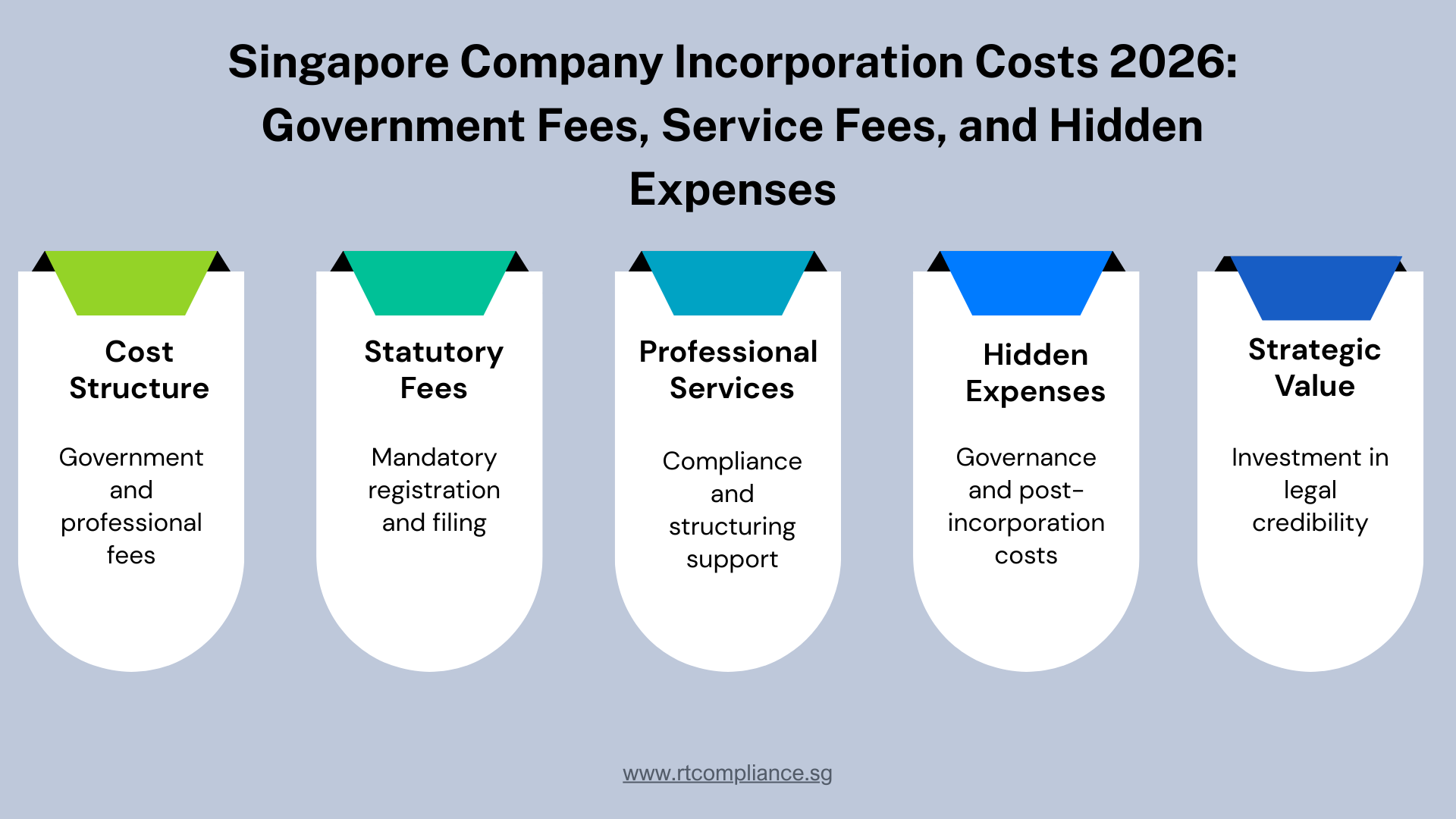
The total Singapore Company Incorporation Costs is categorised into two general groups; government statutory fees and professional service costs. These are the fundamental financial requirements that would be needed to set up a company in Singapore as stipulated by the Companies Act.
The cost structure of Singapore is said to be transparent due to the fact that statutory fees are set and publicly accessible. Nevertheless, the actual cost of incorporation to a company might be still different due to differences in the professional fee and compliance requirements which depend on the nature of business and the complexity of the company.
In order to get a comprehensive grasp of the environment of incorporation cost, the business ought to not only look at the cost that is paid at the incorporation period, but also what is needed at the incorporation period so as to be in compliance as well as operational.
The total breakdown of Singapore Company Incorporation Costs generally includes:
- Reservation fee in government names.
- Application fee to incorporate the government.
- Corporate secretarial service fee.
- Registered address service cost (in case of outsourcing)
- Service cost of nominee director (where necessary)
- Adherence and due diligence charges.
- Support expenses in setting up corporate bank accounts
- Costs of post-incorporation filing and maintenance.
Also by examining the cost structure in an organized fashion, the business will be able to budget appropriately and save any unforeseen costs that normally come about after incorporation.
Government Fees and Statutory Fees
The fundamental part of Singapore Company Incorporation Costs is made up of government fees. These are compulsory payments that have to be paid to ACRA (Accounting and Corporate Regulatory Authority) to have the company registered legally.
The statutory fees are predictable and constant. They are equally applicable to the local entrepreneurs and foreign investors due to the non-discriminatory attitude of Singapore towards corporate formation.
The Significant Statutory Fees Incorporation Fees Singapore
Among the statutory fees usually contained are:
- Reservation fee on the name of the company.
- Registration filing cost in the company.
- Issue fee Business profile (when requested)
- Official documentation costs (optional) Certified extracts.
These are the legal fees that signify the official expenses of incorporating a firm into the Singaporean company registry.
The rationale of why Statutory Fees are required
The reason why statutory fees exist is due to the fact that the incorporation is a legal recognition process. Upon approval, the company is incorporated as an independent legal entity having rights and liabilities under the Singapore law.
This statutory recognition gives the company an opportunity to:
- Sign legally binding contracts.
- Open corporate bank accounts.
- Own property upon the company name.
- Somebody can sue and be sued in corporate name.
- Registered as a legal corporate entity.
Statutory fees are mandatory and therefore any failure to pay them in the right way means delays or rejection. These fees are mandatory before the businesses can incorporate.
The role of Government Fees on Corporate Credibility
Though statutory fees are in most cases a little percentage of the overall incorporation price, they help in the corporate dependability of Singapore. This is due to the effect of the structured incorporation system that enhances international confidence in Singapore entities.
Strategically speaking, statutory fees are not administrative fees. They symbolize access to one of the best corporate jurisdictions in the world.
Advisory Costs and Professional Service Fee
Professional service charges take up a significant share of Singapore Company Incorporation Costs particularly to foreign entrepreneurs or those companies whose ownership is complex.
Even though Singapore does permit self-registration via ACRA, the larger part of the business tends to use professional incorporation service providers as incorporation is beyond filling out a form. It involves compliance planning, structuring governance and document preparation as well as regulatory coordination.
Professional incorporation Services are normally included in what
The services of professional incorporation are usually packaged to include:
- Reservation and name search assistance of the company.
- Corporate structuring consultancy.
- Incorporation application forms preparation.
- Writing or choosing of company constitution.
- Directors and shareholders resolutions preparation.
- The due diligence and due diligence KYC verification processes.
- Connection with ACRA to file and seek clarifications.
- Registered address provision (Optional)
- Support to secretarial appointment by corporations.
Such services made the administrative workload less and provided the accuracy of regulations.
The reason to increase the Professional Costs to the Incorporation in Singapore Cost
Professional fees are adding to the incorporation in singapore cost as it involves time and skill on the part of service providers in ensuring compliance. In controlled settings such as Singapore, it is not a matter of choice to prepare compliance but it is a matter of necessity.
The factors affecting professional fees are normally:
- The number of shareholders and directors.
- Complexity in foreign ownership.
- Shareholder engagement in corporate initiatives.
- Industry risk level
- Nominee director services requirements.
- Further compliance documentation preparation.
In most instances, incorporation is not complicated hence businesses pay more professional fees, but the compliance risk is high should errors be made.
Professional Costs as one of the Compliance Investments
Professional support raises company incorporation charges singapore, but at a long-run, it is likely to be cheaper. Incorporation may be improper resulting in:
- Regulatory penalties
- Making corrections and resubmission expenses.
- Delayed business launch
- Poor documentation Banking rejection.
- Distrust in investors during due diligence.
This, the concept of professional incorporation expenses needs to be considered a risk avoidance and governance investment as opposed to discretionary expenditure.
Company Incorporation Price Influencing Factors
In Singapore, the final company incorporation price depends on a number of factors. Statutory government charges are constant whereas the overall Singapore Company Incorporation Costs fluctuate with the business conditions.
The knowledge of these influencing factors makes businesses better estimate the costs and prevent under-budgeting.
Foreign Participation and Ownership Structure
The ownership composition is one of the largest determinants of costs. Foreign ownership normally adds to the cost of incorporation since it needs:
- Greater due diligence examinations.
- Further identity authentication.
- Favorable ownership recordings.
- Potential nominee director qualifications.
Expatriate investors are also likely to need guidance to their regulatory needs, which raises the cost of professional services.
Board of Directors and Shareholders
The larger the number of people involved, the greater the administration workload. Every extra director or shareholder will raise cost because of:
- Further preparation of documentation.
- The increasing number of identity verification requirements.
- Specifically, increased compliance and KYC workload.
- Corporate structuring complexity.
This implies that the incorporation cost of a company having two shareholders is relatively lower compared to the cost of incorporating a company that has ten shareholders.
Business licensing and Industry licensing
Cost structure depends on business activities to a great extent. The firms in the controlled industries could find the cost of incorporation and compliance to be higher because of the licensing and other regulatory checks.
The industries that tend to raise the cost are:
- Financial advising services.
- Fintech and payment machineries.
- Healthcare services
- Education institutions
- Recruitment agencies
- Travel agencies
- Manufacture of food and importation/export.
In case of the need to license, incorporation cost increases due to the need to budget the application fees, compliance documents, and professional assistance.
Shareholder Corporate Structures
A separate corporation must provide extra documentation of companies owned by it like:
- Corporate registration certificates.
- Corporate shareholder profiles.
- Resolutions of the board to welcome investment.
- Ownership chain disclosure
This raises professional and administrative expenses.
Corporate Governance Requirement and Cost of incorporation
Corporate governance has a direct relationship with Singapore Company Incorporation Costs since the phase of incorporation is where governance is formed.
The legal framework in Singapore emphasizes a high degree of accountability and transparency, and that is why the governance statements and formal reporting are merged in the incorporation.
Elements of Governance that are set in the time of incorporation
During incorporation stage, businesses have to define:
- Responsibilities and authority of directors.
- Shareholder voting rights
- Share transfer rules
- Here, the procedures of appointment and removal.
- Major resolutions decision-making process.
- Corporate compliance structure.
Such rules of governance can be written in the company constitution or in the general governance packages.
Other hidden Costs of Governance
Governance expenses do not necessarily manifest themselves in the form of direct fees, but they frequently occur in the form of professional assistance services.
Costs associated with governance are:
- Fees on drafting or amendment of the constitution.
- The drafting of the agreement of shareholders (non-obligatory but usual)
- Legal advisory ownership organization.
- Company compliance planning services.
These are expenses that raise the cost of incorporating the company, but give stability in the long term.
The rationale behind why Governance Costs Lessens Long-Term Financial Risk
Such a company, which invests in governance planning will limit the occurrence of disputes, penalties, and legal restructuring in the future.
There is a tendency of poor governance at incorporation which leads to:
- Shareholder conflicts
- The contentions of the board decision-making.
- Uncertainty in the laws in case of fundraising.
- Issues in acquisitions and mergers.
Consequently, the incorporation costs related to governance can be taken as long-term cost-saving mechanism. Post-Incorporation compliance costs were not included in the budget and will remain additional expenses (Brady, 2018).
One of the greatest misconceptions is that once the company is registered the cost of incorporation is over. The fact is that incorporation generates a long time compliance burden which is associated with periodic expenses.
Such constant costs ought to be included in the entire incorporating in singapore cost planning.
Typical Costs of Post-Incorporation Compliance
Once incorporated, companies have to budget on:
- Corporate secretarial services.
- Annual return filing fees
- Bookkeeping and accounting services.
- Corporate tax preparation and compliance.
- Audit services (if required)
- Registered address renewal (in case of outsourcing)
- Nominee director fee: This fee is paid by the nominee director, not by the shareholders.
- Business licenses (where applicable) Renewal.
These are recurrent expenses which could amount to a substantial financial outlay compared to the incorporation fee.
The Reason Post-Incorporation Costs are Important
The compliance regime in Singapore has to report yearly. Other possible outcomes of failure to meet filing deadlines can include:
- Late filing penalties
- Company strike-off risk
- Director disqualification
- Legal reputation damage
- Heightened attention during the banking or investor scouts.
As such, companies have to plan on maintaining compliance on the first day.
Cost and Regulatory Transparency Predictability
Cost predictability is one of the key strengths of Singapore. The cost of statutory incorporation is publicly registered and uniform in nature, that is, businesses can make good estimations of the minimum costs.
The Support of Transparency to Business Planning
Cost transparency assists businesses:
- Incorporation budgets of the forecasts.
- Compare cost of incorporation to other jurisdictions.
- Minimize market entry planning ambiguity.
- Establish trust in foreign investors.
This openness enhances the reputation of Singapore as an incorporation hub in the world.
Predictability of Regulations as an Advantageous Cost
Incorporation cost is not predictable in most jurisdictions because of informalities or ambiguous regulation process. Singapore does not experience this because it does not lack explicit structures.
This implies that incorporation costs might not be the cheapest in the world but they are more advantageous with legal surety.
Remuneration of Incorporation and Investment Preparedness
Investor readiness has a strong association with the cost of incorporation. Due diligence usually involves the analysis of the incorporation structure of a firm by the investors.
Firms that invest appropriately in incorporation compliance have more chances of being considered credible.
The importance of Incorporation Costs and Structure to Investors
Incorporation records are reviewed by investors to make sure:
- Share ownership is clear
- There are properly structured rules of governance.
- Directors are duly appointed.
- Registers of statutory nature are kept.
- Positive disclosure of ownership is compliant.
An incomplete incorporation set up may delay a firm in raising money.
Incorporation Costs as Credibility Building
A firm that has paid to have its incorporation supported professionally, documentation of governance and compliance planning suggests:
- Serious long-term intent
- Great regulatory consciousness.
- Commitment to transparency
- Operational readiness
In such a way, Singapore Company Incorporation Costs may be considered as an element of investor confidence building.
Cost and Value Proposition Comparison
Certain jurisdictions are cheaper in incorporating. Nonetheless, the incorporation cost in Singapore is an indication of the worth of conducting transactions in a highly trusted corporate environment.
The Reason Singapore Incorporation Costs Are Worth It
Singapore provides:
- Well-developed corporate law enforcement.
- International reputation of business systems.
- Ensured dispute resolution.
- Open taxation system.
- Good foreign banking image.
- Political and economic stability.
These benefits outshine the difference in marginal costs to less expensive jurisdictions.
Cost vs Risk Trade-Off
Jurisdictions that are less expensive tend to possess:
- Higher legal uncertainty
- Poor investor trust
- Lax regulatory application.
- Banking restrictions
The incorporation cost in Singapore is an expensive price to legal credibility.
Incorporation Management and Optimisation Costs
Structured planning will enable business to manage and optimise the incorporation costs. The cost optimisation does not imply the selection of the most expensive one, but rather the selection of the most efficient and compliant structure.
Optimisation strategies of Singapore Company Incorporation Costs.
Business can save unnecessary expenses by:
- Choosing the right company structure at the right time.
- The shares should not have complex structures.
- Prelude preparation of documents.
- Applying normal templates of constitutions where appropriate.
- Merging shareholders where feasible.
- Regulated business activities should be avoided when not necessary.
The reason why Cost Optimisation should not decrease the quality of Compliance.
There are companies that strive to reduce the incorporation expenses by not engaging professional services. This may result in:
- Incorrect filings
- Banking rejections
- Regulatory penalties
- Costly reorganization afterwards.
- Hence, protection of compliance should balance cost optimisation.
Deceptive Notions on the Cost of Incorporation
The first-time founders have the misconception of costs involved in incorporation.
Misconception 1 Statutory Fee: the Complete Cost.
It is believed that the incorporation fee in singapore is the entire amount. As a matter of fact, statutory fees are just the minimum. The compliance costs and professional fees are usually higher than government fees.
Misconception 2: There is always the cheap service providers.
Services necessary to incorporate may not be included in cheap incorporation packages including:
- Proper KYC checks
- Governance advisory
- After-incorporation secretarial establishment.
- Confirmation mails and submission services.
- Unprofessional incorporation services can contribute to compliance problems in the long run.
Misperception 3: End of Costs of incorporation Once registered.
A lot of founders do not plan on spending on yearly compliance expenses. This translates to punishment and administrative strain in the future. These mistakes are avoided by knowing the Singapore Company Incorporation Costs.
Strategic Significance of Planning Incorporation Cost
It is not merely financial that cost planning is strategic. The decisions of incorporation influence business governance, scalability, and operational equipments. The reason why Incorporation Cost Planning Is Good to Grow You Long-Term.
Cost planning is done properly to ensure:
- Fluent compliance maintenance.
- Easier banking approval
- Greater confidence of the investors.
- More accurate financial forecasting.
- Less risk of restructuring in the future.
Those companies that consider incorporation as a strategic basis would have an increased likelihood of success in the long term.
Legal and Business Investment: Incorporation
Singapore incorporation costs must be considered to be an investment into:
- Corporate legitimacy
- Legal security
- International credibility
- Sustainable governance
Incorporation is not an incidental registration. It is a corporate long-term commitment.
Conclusion
Singapore Company Incorporation Costs indicate the dedication of the country to corporate transparency, legal predictability, and good governance levels. Although statutory fees are the backbone of the cost structure, the total company incorporation expenses singapore do not just limit to government charges but also to professional advisory service, complies preparation and post incorporation statutory requirements.
Knowledge of the entire incorporation in singapore cost assists the business in evading financial shocks and the appropriate budgeting of the incorporation and continued compliance. The initial set-up price can be high due to professional services, however, the regulatory risk can be minimized because of the services, the incorporation is more accurate and because the corporate has a stronger banking and investment credibility.
After all, the incorporation cost in Singapore should not be regarded as an administrative cost, but as a strategic investment into establishing a legally safe and internationally reputable corporate image. Companies that manage to balance the cost of incorporation, make it compliant with the governance standards and ensure that they are ready to be compliant at all feasible in the Singapore business environment that is highly regulated and business friendly are in the best position of attaining sustainable growth.