
Singapore Incorporation Application Guide: How to Apply Online via BizFile+ (ACRA Process)
Introduction to Singapore Incorporation Application Guide
The Singapore Incorporation Application Guide offers an organized official knowledge of how companies can be registered in Singapore legally by means of a formal incorporation application process. Singapore has continuously been ranked among the most business friendly regulations in the globe based not only on its powerful financial ecosystem, but also due to its well-regulated incorporation regime that fosters transparency, accountability and long term corporate governance. This is in contrast to most other jurisdictions whose incorporation process might be uncertain or extremely bureaucratic, Singapore has established a very effective registration system that is facilitated by online filing applications, stringent statutory provisions, and quality implementation of rules and regulations.
The application to incorporation procedure is not just a registration process to both the local entrepreneurs and foreign investors. It is a legal process that will help to define whether the company is well structured, whether the duties of governing the company have been well spaced and whether business can conduct operations under the laws governing corporations in Singapore without having to put itself under compliance risk. The incorporation application is literally the port of entry to the corporate infrastructure of Singapore, the banking, licensing, employment systems, and regulatory recognition.
The process of incorporating business into the formal legal structure of becoming a separate corporate personality is known as incorporation. The company is a separate legal person and as such, it should not be mixed up with its shareholders, directors or officers once the company is incorporated. It is one of the most useful characteristics of corporate incorporation as such separation enables the company to run independently, possess property, and enter contracts as well as take up liabilities in its name. This legal privilege is however granted under the condition on filing the incorporation application correctly.
A duly incorporated company can act as a legal person in having corporate rights including:
- The capability to make binding contracts on their own.
- Managing corporate bank accounts / opening bank accounts.
- The right to possess and alienate property and intellectual property.
- The legal right to either sue or be sued in its own name.
- The authority to hire employees and abide by the legal labour standards.
- The liability to take its own debts and liabilities.
Since incorporation defines the legal presence of a business, incorporation application should be processed with precision and carefulness, and extensive knowledge of the statutory requirements. Any mistake committed during the incorporation process may slow down the registration process, invoke regulatory inquiries, and result in long-term compliance vulnerability.
This paper describes the complete incorporation application process, incorporation questionnaire structure, importance of company incorporation verification and strategic reasons why proper company incorporation checking should be done prior to submitting the company incorporation questionnaire. It also shows the effects of incorporation choices on corporate governance, operational preparedness and long-term regulatory adherence.
Overview of the Process of the Company Incorporation Applications
Company incorporation application procedure in Singapore is a multi-step legal process, which aims at ensuring that a proposed company complies with the statutory requirements of the Singapore corporate law. The intention of this procedure is not merely to have companies registered within the shortest time possible, but also to make sure that all organizations venturing into the Singapore business world are well organized, trackable and legal.
An application of company incorporation is established based on the validation of the legitimacy of the business model, identification of the existence of directors and shareholders, and dispensation of governance roles. Both phases of application procedure are associated with a regulatory intent, i.e., incorporation is not seen as an administrative formality. Instead, it is considered a compliance based initiative that enhances integrity of the Singaporean corporate register.
The process of incorporation application starts with the identification of important corporate data. These are company name choice, type of business activity, shareholding structure and composition of management. Such factors are checked with legal provisions such as the presence of at least one resident director in the company, activities the company proposes are regulated, and disclosed beneficial ownership information is done appropriately.
The exercise is organized since Singapore values transparency of corporations. Consequently, the application of incorporation should be able to capture uniformity between all documents, declaration, and disclosure statements.
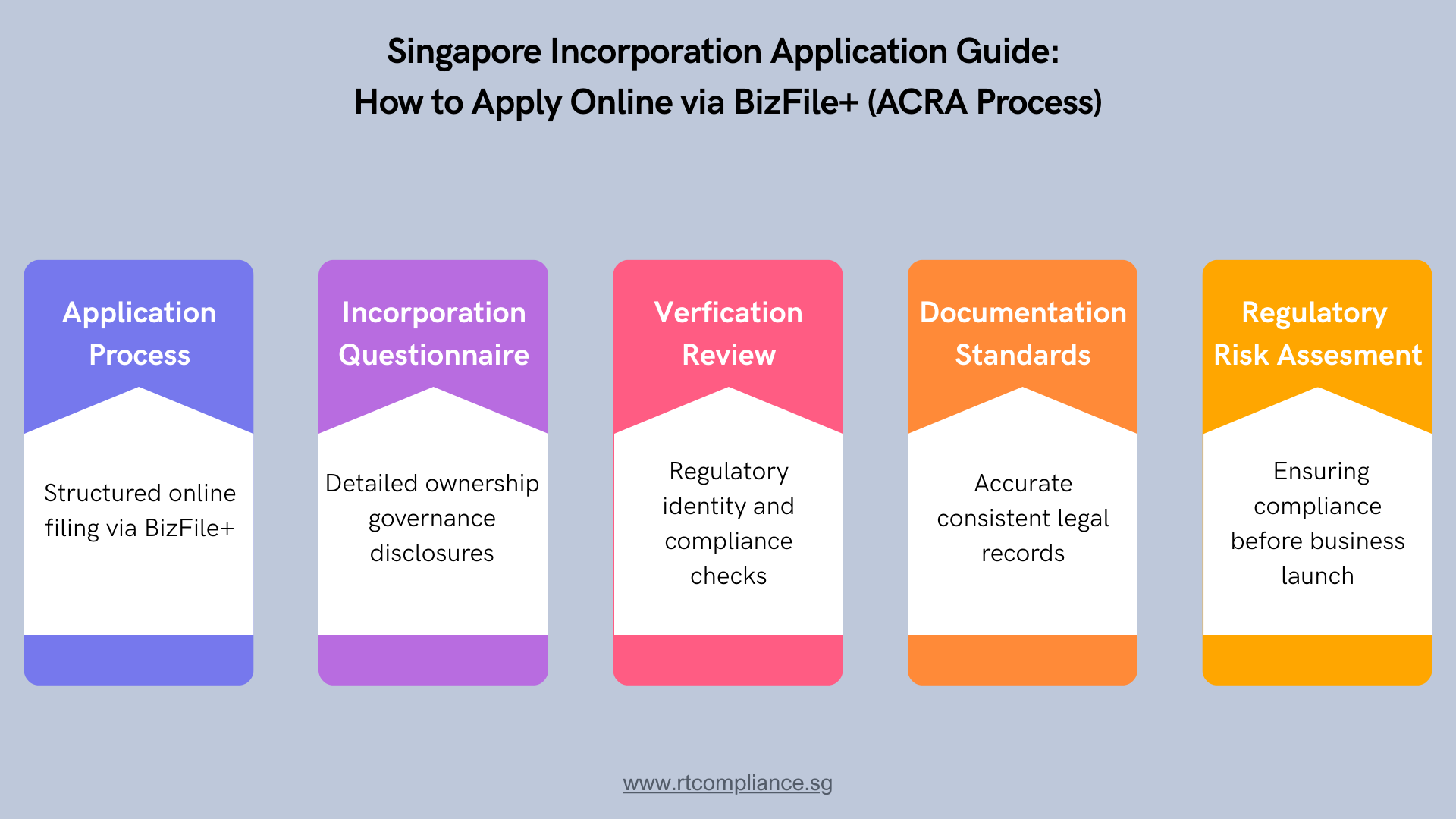
The process of company incorporation application usually involves the following major steps:
- Name of company and business activity.
- Organizing shareholder ownership and share capital.
- Delegation of directors, officers and key representatives.
- Statutory preparations and incorporation preparations.
- Disclosures of company incorporation questionnaire.
- Checking of identity documents and supporting evidences.
- Check of completeness of pre-submission company incorporation.
- Registering with the assistance of the official electronic incorporation system.
- Checking by regulations, permission, and giving of registration confirmation.
Singapore Incorporation Application Guide reiterates that incorporation is not a singular process. The data created at the time of incorporation will be the baseline of corporate compliance in the future. The application stage decisions influence the governance requirements, tax reporting structure, statutory filing requirements and the manner in which the banks and investors analyze the company.
Due to this long-term effect, incorporation should be viewed as the beginning of regulatory responsibility of businesses and not the beginning of business operations.
What is a Company Incorporation application in Singapore?
Company incorporation application is simply a formal application made to the corporate registration agency of Singapore asking to form a company as a legal entity. It is the legal application which converts a business proposal to an officially registered corporate person based on the Singapore law.
After the approval of the application, the company gets to exist independently as a separate legal person, which is independent of the shareholders and directors. This difference is necessary as it provides corporate independence and limited liability. Nonetheless, Singapore only allows this privilege on condition of the meeting of all compliance and disclosure requirements in the application.
Application of company incorporation usually contains systematized corporate information including:
- Suggested name of the company and address of registration office.
- Outline of business operations and areas of business activities.
- Details of shareholding structure and paid-up capital.
- Eligibility and appointment of directors.
- Reporting of owners and controlling interests.
- Affirmation of constitution adoption and system of government.
- Declaration of expiation of the statutory law.
It is not just an assortment of documents. It is a legally enforceable declaration to regulating bodies, and has compliance implication in the event of the information given is incorrect, or deceptive. In case of false statements made, the directors and company officers are liable to be held accountable.
It is because of this that the Singapore Incorporation Application Guide emphasizes that the process of incorporation application must be treated with the seriousness that is associated with tax filing or other legal contracts.
Company Incorporation Questionnaire of Role
Company incorporation questionnaire is one of the most important elements in the incorporation application process. This questionnaire is a structured information collection instrument that is used to make sure that all the facts about the proposed company are documented in a correct and exhaustive manner.
The questionnaire will be tailored to obtain important data concerning the ownership, management, and business operations. This is particularly crucial as it helps in compliance screening and it allows regulators and service providers to evaluate the potential risk exposure prior to filing.
Disclosures made in the company incorporation questionnaire are normally concerned with:
- Identity and percentage ownership of shareholders.
- Name and address of directors and residence status.
- Finally advantageous ownership knowledge.
- Type of business operation and scope of operation.
- Contemplated transaction jurisdiction and foreign exposure.
- Sources of funds and type of business revenues.
- Regulatory requirements and licensing requirements.
- Possible conflict of interest or limited participation in the industry.
The questionnaire has two purposes. First, it makes incorporation authorities get all the information which is coherent with legal filing requirements. Second, it assists in determining potential compliance risks at an early stage, especially risks related to financial crime prevention and governance integrity and regulated business activity.
The Singapore Incorporation Application Guide explains that the questionnaire is not such a mere formal. It is a compliance tool. Wrong answers, omission of disclosures or inconsistencies between the responses on the questionnaires and supporting documents may lead to delays or regulation questions.
In case of a company incorporation questionnaire being filled wrongly, the results could be:
- Request of clarification slows incorporation schedule.
- Greater possibility of further check-ups.
- Greater examination in the process of banking onboarding.
- The chance of getting rejected in case disclosure is viewed as incomplete.
- Compliance issues in the long run because of incorrect registry records.
Well filled questionnaire would mean that integration is not a problem and the company would commence its operations with a reputable compliance profile.
Corporation check of the company: legal and regulatory implications
Company incorporation verification is the formal review of the regulations whereby information has been submitted to the company incorporation is verified to be accurate, legitimate and in relation to the laws of Singapore. The process of verification is one of the most essential protection measures in the incorporation system of Singapore since it makes corporate frameworks not be used to perform illegal operations.
The Singaporean verification is especially rigorous due to the fact that the country upholds high standards of transparency and financial integrity in the corporations. Regulators should be in a position to trace ownership and structures of control so that the corporate cannot misuse their money to launder it, commit fraud and evade tax paying.
The common checks that are done during company incorporation include:
- Directors and shareholders validation of identity.
- Certification of the local directors on the status of residence.
- Checking of addresses (residential and registered office)
- Survey of business activity classification and licensing requirements.
- Cross-checking advantageous ownership reports.
- Assurance that statements are consistent and exhaustive in law.
Verification can also be associated with increased examination of foreign owned companies, companies that are in the regulated industry or companies that have complicated shareholding structures. Where this happens, the regulators can demand more documents or clarifications and only then the incorporation can be approved.
According to the Singapore Incorporation Application Guide, verification does not aim at slowing incorporation. Rather it secures the integrity of the corporate registry. Verified companies have increased credibility and legal assurance and non-verified applications might be held up, disqualified or sent back to compliance inspection.
The positive side of having a robust verification is that it helps legitimate businesses to ensure that Singapore has a good reputation as a place to do business with and therefore this will enhance international acceptance of Singapore-incorporated businesses.
Significance of Company Incorporation Checking Prior to Submission
A company incorporation check is a formal internal audit that is conducted prior to filing incorporation application. It provides completeness, accuracy, and conformity of all the information to those stipulated in the statutes.
This is a step that is usually ignored by the novice applicants, but it is a critical step towards eliminating delays in incorporating. A company incorporation check is similar to an internal audit which would enable the applicants to identify errors and correct them before the submission is included in the formal regulatory documents.
There is an appropriate incorporation check that usually entertains:
- All personal information and names are congruent with supporting materials.
- Percentages of shareholding are rightly computed.
- Residency is satisfied with director appointments.
- The classification of business activity is right and suitable.
- Incorporation forms are consistent with questionnaire responses.
- Discussion documentation is legitimate and up-to-date.
- Documents to support are of the necessary format.
- Reports are signed and are valid in terms of law.
As it is stressed in the Singapore Incorporation Application Guide, incorporation checks are especially critical when a foreign applicant is involved, and the latter might lack a proper understanding of the documentary norms and compliance requirements in Singapore. Applicants are not subjected to a pre-submission check, which means that they can provide incomplete forms or inconsistent disclosures without realizing it, causing delays in the processing of the same.
Company incorporation check is also good as modifications that are made post submission might also be subjected to official amendments which would strain the administration system and also prolong the company set ups.
Requirements and Standards of Documentation and Submission
The incorporation application is to be submitted with certain documents which demonstrate the legal form, identity and main structure of the proposed company. These are documents that are included as a formal company corporate record and which can be examined by regulators, banks, investors and other counterparties in future.
The documentation standards of Singapore are stringent. The documents should be precise, up to date, formatted and conforming to disclosure of questionnaires and incorporation formations. These may be conditional approvals, declines or re-submissions in case of failure to meet these standards.
Typical forms of documentation that are needed are:
- Director and shareholder identification documents.
- Evidence of home address of the parties.
- Corporate shareholder corporate registration documents.
- Board resolutions and consent in case of necessity (Board resolutions).
- Confirmation of the constitution or the government document.
- Address proof and office declaration registered.
- Favourable ownership disclosure benefit documents.
The standards of documentation are aimed at the compliance-based corporate climate in the country of Singapore. Regulators should be in a position to confirm that all participants in the company are eligible legally and identified accordingly.
Singapore Incorporation Application Guide describes that the incorporation documentation is also a long-term factor. Such records will give future compliance requirement like annual filing, tax reporting, corporate reorganization, or audit by regulatory bodies or bodies to refer to.
Thus, incorporation documentation must be made with the view that it would be examined many times over the course of the life of the company.
Review and Approval of regulatory process
Once it is submitted the incorporation application is subjected to a formal review. Regulators evaluate the application in terms of completeness, compliance and risk exposure. Consent may be obtained within a short period of time in most instances in situations where company structure is minimal and documentation is full.
Nevertheless, applications in controlled business operations, foreign ownership, or complicated structures in shareholding can demand more ensures of examination. Regulators can conduct more extensive checks on verification or seek explanation of the scope of business and transparency of ownership.
At the review stage, regulators are concerned with the assurance that:
- All incorporation requirements are satisfied.
- The unapproved licensing of business is not necessary.
- Directors and shareholders pass eligibility requirements.
- The beneficial ownership is duly disclosed.
- Declarations are consistent with supporting documents.
There are no form and questionnaire inconsistencies
In case of inconsistencies, one can request further documents to be provided or clarify the contradictions or update the information given by the applicants. This may slow down incorporation approval, particularly where the applicant does not respond in time.
Upon receiving the approval the company is incorporated. The approval is however not eliminating of any future obligations. It is the start of unending statutory adherence duties.
The Singapore Incorporation Application Guide emphasises that incorporation approval can be considered the initial phase of regulatory responsibility as opposed to compliance being finished.
Responsibilities of Compliance after Incorporation
Following incorporation approval, the company passes into the post incorporation compliance phase. The stage entails governance-related duties, legal reporting, and corporate record keeping. These compliance requirements are directly connected with the accuracy of the first incorporation application.
The companies should ensure that they keep up to date with any information and that any modification in the corporate structure is effectively reported. This involves an amendment of directors, shareholders, registered office address and a change of business activity type.
The general compliance requirements post-incorporation involve:
- Delegation of an individual as a company secretary within the stipulated time.
- Keeping statutory registers, corporate books.
- Lodging annual returns and compliance declarations.
- Filling of financial reporting and tax documentation.
- Making corporate meetings and resolutions where necessary.
- Revision of regulatory records, as change takes place.
In case incorporation information is not correct, there is complication in compliance. As an example, incorrect records on shareholding can make it hard to report taxes, restructure the corporation, or onboard an investor. On the same note, erroneous information on directors will activate regulatory sanctions.
The reason behind this is the incorporation check carried out by the company to be submitted in advance. It also makes sure that the company enters into its lifecycle with proper records minimizing compliance risks in the long run.
Risk Management and Significance of Accuracy in the Applications of Incorporation
One of the risk management tools is an incorporated application properly prepared. Any mistake or statement in the incorporation questionnaire or official forms may subject the firm and its officers to regulatory action.
Singapore corporate laws subject directors and officers to severe responsibilities in the area of honest statements. In the event of some false information being provided with knowledge, it can be punished, investigated, or even criminally liable in extreme cases.
With incorporation accuracy, risks are minimized like:
- Owner-management lawsuits.
- Regulatory enforcement on the basis of misplaced disclosure.
- Rejection by banks as a result of poor compliance profile.
- Problem in attracting investors because of incoherent records.
- Difficulties in the license granting because of misclassification.
The Singapore Incorporation Application Guide underscores that incorporation is not a procedure, but a compliance process. Regulators and financial institutions consider companies that exercise discipline during the time of incorporation to be more credible and less risky.
Not only this, accuracy is also necessary both legally and strategically.
Strategic Values of an Appropriate Incorporation Application
In addition to the legal benefits, a well prepared incorporation application offers some considerable strategic benefits. The first documents that are considered in the due diligence process of banks, investors, and corporate partners are incorporation records.
Good incorporation records are an indication of professionalism and the integrity of governance. They show that the firm was established in a responsible manner and it is most likely to conduct business in an orderly manner.
An incorporated application is that which is well prepared and supports:
- Improved banking onboarding corporate credibility.
- Increased confidence by investors when raising funds.
- Simpler cross-border joint ventures.
- Greater preparedness on mergers and acquisitions.
- Reduced audit and review compliance risk.
The Singapore Incorporation Application Guide places the incorporation accuracy as a platform towards sustainable corporate development. Firms that build high incorporation tracks would be in a position to capitalize on the reputation of Singapore to promote high standards of corporate governance, which would make them more competitive in the global environment.
Incorporation is not a mere requirement of entry, but a business tool that increases business potential in the long-run.
Some Common Mistakes in Incorporation Applications
Although Singapore has an efficient system, incorporation applications may fail or delay because of the common mistakes. Most of these errors occur due to the fact that the applicants do not overestimate the compliance requirements involved or can see incorporation as a mere administrative process.
The most typical errors in incorporation are:
- Irregular shareholder reportings in documents.
- The company incorporation questionnaire (answers) is not filled/incorporated incompletely or incorrectly.
- Coming up with wrong documentation of addresses.
- Wrong classification of the business activity resulting in the licensing problems.
- Lack of helpful ownership revelations.
- Mistakes in eligibility standards of directors appointment.
- Bad documentation format or old records.
Such errors usually result in delays due to the need by the regulators to seek clarification or submissions. In other instances, the incorporation can be turned down altogether when the application is perceived to be unfinished or dubious.
The guide highlights that most incorporation issues can be avoided by a proper planning, preparations of documents and checking of incorporation procedures before a company is incorporated.
Companies that make a serious step towards incorporating have less risk of regulation and less time lag.
Corporate Governance Alignment and Incorporation Application
First governance structure of the company is provided through the incorporation application. The director power, shareholder rights, and decision making are detailed by the information presented during incorporation.
Power is internalized in a company through its shareholding structure and directors. Such structures determine the manner, in which disputes are solved, how decisions are made, and how the company is able to increase future investment.
The incorporation questionnaire is significant in the governance alignment since it demands applicants to reveal:
- Percentages of ownership and control.
- Status and duties of the directors.
- Nominal owning and final controlling interests.
- Expected scope of operation and compliance risk.
Effective disclosure will ensure that the expectations of governance are in line with the regulatory standards. It also assists in the need to make sure that the directors are aware of fiduciary responsibilities and that the shareholders have definite rights before the law.
Well organized incorporation application will thus minimize governance risk, enhance internal stability and increase long term compliance posture by the company.
Conclusion
In the Singapore Incorporation Application Guide, it is shown that incorporation is a legally important procedure which establishes the identity, compliance bases as well as strategic possibilities of a firm in Singapore. Since the first application to incorporation of the company to the continuous verification and compliance period, each step ought to be thoroughly performed with precision, regulatory sensitivity and organized documentation proficiency.
A strong legal foundation can be achieved by firms in Singapore by learning about the significance of the company incorporation questionnaire, proper company incorporation verification and thorough company incorporation checking before submission to ensure the firm has a strong legal foundation. Such measures minimize delays on applications, enhance credibility of compliance, and enhance corporate sustainability in the long term basis.
The application to incorporate should be well prepared because it is not only a mandatory requirement as per the regulation, but also a strategic strength. Accuracy of incorporation is an indication of professionalism, governance integrity and reliability in operations in the highly competitive and compliance oriented business environment in Singapore. Firms that consider incorporation as a serious compliance obligation put themselves in a long term success, better banking facilities, enhanced investor trust, and long term corporate development.