
Singapore Incorporation Verification Process: How to Check if a Company is Legit and Registered
Introduction to Singapore Incorporation Verification Process
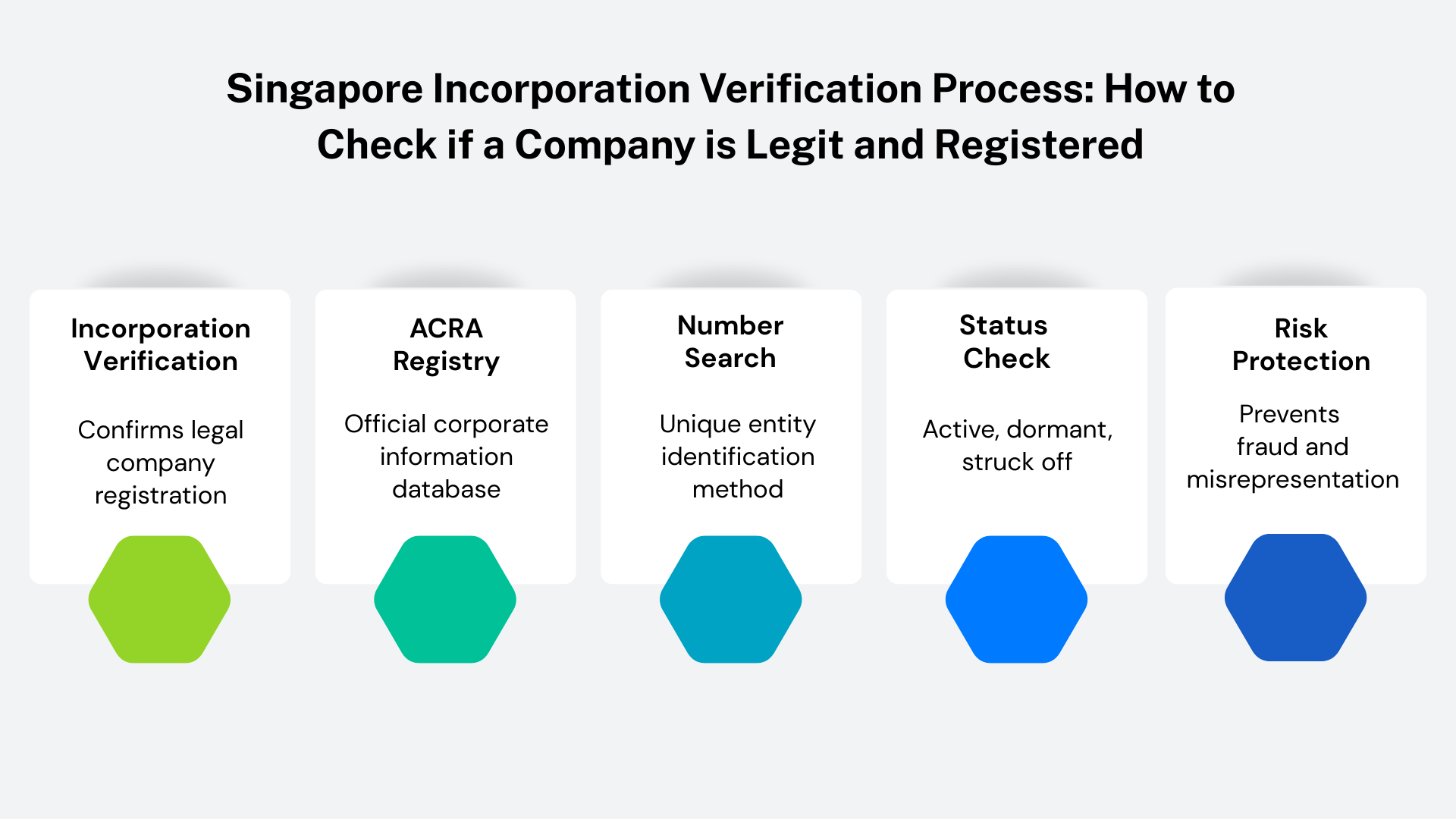
Singapore Incorporation Verification Process is one of the important elements of the corporate regulatory environment in Singapore. It maintains that all entities registered to operate within the jurisdiction are legal and well documented and should be accountable at all times. Since Singapore has been considered to be one of the most reputable and trusted business destinations in the globe, incorporation verification serves as a legal protection factor to shield the business atmosphere against defraud, misrepresentation, and non-compliant business operations.
Incorporation checking is not carried out only once when a company is registered. Verification is also an ongoing need in the life cycle of a company in Singapore. These verification checks by regulators, financial institutions, investors, and business partners are conducted often to ensure that a company is active, compliant and operational as per statutory requirements. This makes the information of corporations accurate, updated and reliable at all time.
Singapore verification system is backed by ACRA (Accounting and Corporate Regulatory Authority) that has an official and centralized corporate registry. Using websites like BizFile+, stakeholders are able to access verifiable corporate information and incorporateation checks are also carried out effectively. Such transparency can increase the level of trust, improve the level of governance and ease of doing business in both the domestic and international markets.
In this article, a detailed description of the Singapore Incorporation Verification Process is presented and the major areas of such process include:
- One of the compliance measures is incorporation check in the company.
- Search identity- corporation number of company incorporation.
- The importance of stakeholders verifying company incorporation on a regular basis.
- The role of verification in enhancing corporate governance and regulatory integrity.
- The effects of unsuccessful verification and obsolete records.
- Best practices of verification management and compliance maintenance
 Singapore Incorporation Verification Process: How to Check if a Company is Legit and Registered
 Singapore Incorporation Verification Process: How to Check if a Company is Legit and Registered
Knowledge on the Purpose of Singapore Incorporation Verification Process
The main aim of Singapore Incorporation Verification Process is to verify whether a company is incorporated and registered in accordance with the Singapore laws. It also makes sure that the firm does not fail to fulfill the statutory requirements required to be operational and legal in the corporate registry.
In a jurisdiction such as Singapore where regulatory integrity has been highly applied, incorporation checks are a critical factor in upholding an open and reputable business environment. Verification helps to eliminate fraudulent organizations that may be running in the background and the stakeholders do not involve themselves in risky business activities.
Major goals of Incorporation Check-up
The Singapore incorporation checking is done with an intention to accomplish some strategic and legal aims, among which are:
- Establishing that a business is a registered one under ACRA.
- Enhancing the company is active and filing is in compliance.
- To enable the validation of corporate identity and structure by the stakeholders.
- Fighting anti-money laundering and counter-terrorism financing measures.
- Energizing openness and confidence in business dealing.
- Limiting risk of fraud in business affiliations and investment transactions.
Why Verification is so Important to Singapore
The corporate governance structure of Singapore is established on the ground of excellent transparency principles. That is why incorporation verification is not considered as optional but rather incorporated in numerous legal, financial as well as commercial procedures.
The check of incorporation helps in enhancing the global image of Singapore by assuring:
- Companies do not find it easy to falsify ownership or corporate identity.
- The regulatory filings are enforceable and traceable.
- Corporate registry is correct and current.
- Banks and investors are able to make sound due diligence.
- The Singapore-based entities can be trusted by the international parties.
Trust Mechanism Incorporation Verification
The Singapore Incorporation Verification Process is a guarantee that:
- A business is actually a legal entity.
- Its registered directors and officers are valid.
- Its corporate information is in line with government information.
- It can be evaluated in terms of its compliance record.
Such a verification mechanism is used to make sure that Singapore is still a low-risk jurisdiction in which corporate operations and global investments can be conducted.
A Core Compliance Tool Incorporation Check on the Company
Company incorporation check is one of the processes of ensuring that a company is registered under the official corporate registry and that it is in line with the requirements of the statutes of Singapore. This verification is commonly done when entering contracts, making payments, financing or forming long-term cooperations.
Checks of company incorporation are necessary since they assist the stakeholders in not conducting business with entities that are:
- Not legally registered
- Removed off the corporate register.
- Dormant or inactive
- Under liquidation
- Violation compliance requirements.
The Usual Confirmations in a Company Incorporation Check
To confirm important corporate information, company incorporation check is normally conducted to verify the following:
- Company name registered officially.
- Registration number / incorporation number of the company.
- Date of incorporation
- Registered office address
- Main business operations.
- Status of the company (active, struck off, etc.)
- Company officers and directors.
- Shareholding structure (based on available information)
The reason why a Company Incorporation Check is important
Incorporation check of a company is not just a formality. It is a risk-governing instrument, which cushions enterprises and institutions against monetary exposure and control issues.
A company incorporation check will assist the stakeholders to ensure:
- The firm is legally authorized to carry out business.
- The business is neither dissolved nor struck off.
- The business possesses a credible name.
- Company data agrees with the official documentation.
- Business operations are legally binding.
Typical Cases of Incorporation Checks
The checks of incorporation of companies are usually conducted in the following:
- Opening corporates banking accounts.
- Approval of suppliers and processes of supplier onboarding.
- Credit risk assessments
- Investment due diligence
- Contract negotiations
- Application of licensing and permit.
- International joint venture deals.
- Government procurement and tender submission.
Incorporation checks are regarded as a good governance and compliance practice in Singapore, particularly in regulated industries.
Search of Company Incorporation Number: A Critical Verification Process
One of the surest methods of verifying the identity of a company in Singapore is by searching the company incorporation number. Every incorporated business is given its own number in the incorporation number, which will be its identifying mark permanently in the corporate Registry.
This is the number that is usually matched with the Unique Entity Number (UEN) system that is, it is shared by various agencies of the government in order to identify the corporations.
What Is Company Incorporation Number Singapore?
Company incorporation number is a reference number that is unique and provided by ACRA when registering the company. It is also retained by the company in its entire life and is incorporated in official documents, regulatory filings and the business transactions.
This incorporation figure is part of:
- The certificate of incorporation is included in the appendix.
- ACRA Business Profile
- BizFile+ listings of companies registeries.
- Bank documentation of corporations.
- Tax filings under IRAS
- Licensing submissions
The importance of Company Incorporation Number Search
A company incorporation number search is relevant in that it gives:
- Very high recognition of the company.
- The reduced irritation of the similarity of company names.
- Better verification reliability of due diligence.
- Increased access to official corporate records.
Incorporation number searches are accurate and are not duplicated as is the case with company name searches that can get several similar results.
Incorporation Number Search is valuable in the following ways
A company incorporation number search enables the following stakeholders:
- Check legal identity within a short time
- Confirm whether corporate books are in accordance with Government registry records.
- Trace the specific company during transactions.
- Status of payments and date of incorporation.
- Minimize frauds and misrepresentation of identity.
Since the incorporation number is not temporal, it still holds even when the name of the company is changed.
The reason why the Stakeholders should verify Company Incorporation status on a regular basis
In a bid to have some levels of legal certainty and minimise risk, stakeholders need to review company incorporation status periodically prior to engaging in business activities. Status of incorporation indicates that a company is a legal entity allowed to conduct its operations under the Singapore law.
Singaporean corporate registry gives companies various statuses according to compliance and operating status.
Types of Common Incorporation status in Singapore
When the stakeholders query the incorporation status of the company, they might be subjected to the following statuses:
- Active
- The company is a registered and compliant company.
- It is legally permitted to operate business.
- Dormant
- The company is in existence but not on a business.
- It might still be liable to compliance.
- Struck Off
- The company has been taken off the register.
- It is no longer legally able to operate.
- Under Liquidation
- It is in the process of formal liquidation and settling of debts.
- Dissolved
The company is no longer legally in existence.
The reason Incorporation Status is a Legal and Financial Indicator
The status of incorporation matters due to the fact that it will influence:
- Enforceability of the contracts.
- Ability to open bank accounts by the company.
- The legality of the company to issue invoices.
- Its eligibility to take licenses.
- Its ability to hire personnel under the MOM rules.
- Its ability to get investment funds.
A negatively incorporated company can be one which is legally prohibited to do business.
On-the-job Reasons to Validate Company Incorporation
The status of company incorporation is usually checked by stakeholders so as to:
- Ensure that the company is not dissolved.
- Make sure that the company is not in liquidation.
- Eliminate the risk of financial losses as the result of counterparty non-operation.
- Guard against fraud and misrepresentation of the corporation.
- Establish the validity of a vendor or a supplier.
- Reduce the compliance risk in regulated transactions.
Verification of incorporation status is being regularly regarded as a mandatory due diligence measure in Singapore.
Regulatory Supervision that aids the Verification Process
Regulatory supervision is an effective contributor to the incorporation verification system of Singapore. Regulators ensure that businesses are in compliance by undertaking systematic monitoring, legal reporting requirements and imposing remedies.
ACRA is the primary body that governs this, being the register of the company and makes sure all the company records are up to date.
The way Singapore ensures a dependable verification system
Singapore ensures its verification reliability by:
- Compulsory yearly filing laws.
- Changes in directors and shareholders updated in statute.
- Online reporting using BizFile+.
- Detection of compliance deadlines.
- Penalties associated with submissions that are late.
- Openness of major corporate documents.
This framework provides the availability of information on the company but at the same time regulated.
Verification Supported by Compliance Reporting and Filing Requirements
The companies have to fulfill the continuous compliance requirements that enhance the reliability of the verification, e.g.:
- Filing annual returns
- Keeping the records of registered addresses up-to-date.
- Reporting directors and secretary appointments.
- Revising shareholding and capital modifications.
- Reporting financial reporting status.
These needs make sure that the incorporation verification is not irrelevant.
Checking Measures that Enhance the Integrity of Verification
Failure by companies to comply may lead to the imposition of the following by the Singapore authorities:
- Late filing penalties
- Enforcement notices
- Court summons
- Director disqualification
- Company strike-off actions
This enforcement increases the credibility of incorporation verification process in Singapore and makes the corporate registry credible.
Verification is important to the Banks and Financial Institutions
Verification of incorporation is a significant contributor in the Singapore financial ecosystem. As a part of their Know Your Customer (KYC) and Anti-Money Laundering (AML) processes, banks and financial institutions are obliged by law to perform incorporation checks.
Financial institutions have to ensure corporate legitimacy before they open accounts, give out loans, or grant credit facilities.
Reason behind Banks Performing Company Incorporation Check
Companies incorporation checks are done by Banks to ensure:
- The company exists legally
- The number of incorporation is valid.
- Directors and officers are properly documented.
- The firm is not wound up or dissolved.
- The company does not have any relationship with fraud.
KYC and AML Compliance: incorporation Verification
Incorporation should be verified by banks since:
- The laws of AML demand identity verification.
- Banking organizations should avoid misuse of corporate accounts.
- Illegal financial flows may be done through shell companies.
- The suspicious dealings have to be tracked to legitimate parties.
The protection of the financial system and the bank itself is ensured with the help of incorporation verification.
The effects of Incorporation Verification on Banking Approvals
Supply outchecks Banks in case of a company failure may:
- Shun opening of corporate accounts.
- Delay onboarding approvals
- Order other supporting documents.
- Flag the company as high risk
- Whistle blow against any suspicious activity to regulators.
This is to show that incorporation verification is directly correlated to financial access and corporate credibility.
Importance of Checking to Investors and Business Partners
Corporation verification is used by investors and corporate partners to ensure the legitimacy and minimize the risk of investment. In Singapore, company records, incorporation records and company profiles are usually sought before an investor commits capital or make an agreement. Checking assists the investors in establishing the structural soundness and legality of the company. Reasons why investors conduct company incorporation number search. Incorporation number searches are done by investors to:
- Having a legal existence and date of registration.
- Establish ownership and form of government.
- Check the past compliance records and business status.
- Make sure that the company has not been dissolved or out of operation.
- Check on whether the company is as good as it purports.
This minimizes the chances of being exposed to the risks of frauds or misrepresented investment opportunities.
Checking as Due Diligence Requirement
Checks in incorporation of companies are required in:
- Financial rounds of venture capital.
- Private equity investments
- Mergers and acquisitions
- Joint venture agreements
- Share purchase agreements
- Corporate structuring transactions.
Integrity of incorporation is thus a basic due diligence instrument.
Status of an Incorporation as a Signal of Investor Confidence
Being an active incorporation is a good sign to investors that:
- Operational legitimacy
- Effective governance discipline.
- Quality regulatory compliance.
- Less risk of disruption by legal actions in the future.
The companies, which have compliance problems, can hardly attract serious investors.
Incorporation Checking in International Business
Checking of incorporation is even more essential at international transactions. Before foreign investors, international regulators and foreign business partners engage in contracts with Singapore based organizations, they normally seek evidence of incorporation.
The high verification system in Singapore contributes to international trust and efficiency in business across the borders.
The reason why foreign parties audit Singapore companies
The incorporation is verified by the foreign stakeholders to ascertain:
- The company is incorporated according to the Singapore law.
- The information in corporations is uniform and traceable.
- Business activities and directors are legal.
- The company is not utilized as a shell entity.
- The contracts of business can be brought to the court all over the world.
Since Singapore is often a jurisdiction of choice when it comes to headquarters, the need to verify is paramount to international credibility.
The use of Incorporation Verification in supporting business confidence in the world
The incorporation verification system of Singapore assists in:
- Security of cross-border investments.
- International banking authorizations.
- Trade finance arrangements
- Global supplier contracts
- Interstate licensing.
This is the reason why Singapore is greatly favourable in multinational business structuring.
Incorporation Check as International Compliance
International companies may need a verification of incorporation to be in conformity with:
- global AML policies
- policies of internal governance risk.
- due diligence frameworks, which are anti-corruption.
- international audit requirements.
The transparency of the registry in Singapore also facilitates the global companies to adhere to these standards.
Penalties of Failed Checking and Erroneous Company Accounts
The inability to pass incorporation verification checks might result in severe legal, financial, and reputational implications. Failure to verify is common in cases where the corporate record is incorrect, obsolete and not in line with registered records.
Business operations can be greatly disrupted, in the tight regulatory environment in Singapore where such failures can be triggered.
Verification Failure of Common Causes
The causes of verification failures can be:
- Inability to make directors or shareholders updated.
- Incorrect old address of registered office.
- Unfiled annual returns
- Submission of late compliance.
- Distinctive wrong classification of business activity.
- Stroke off company because of non-compliance.
- Mismatch of documents and ACRA records.
Legal and Financial Penalties of Verification Failure
Companies are likely to be penalized with:
- Banking rejection of applications.
- Lagging with licensing approvals.
- Cancellation of contracts by partners in business.
- Penalties imposed by ACRA
- Commercial credibility lost.
- Regulatory investigations
- Increased audit exposure
Business interruption can also result due to incorporation verification failure, in particular cases when the company engages with banking facilities or international trade agreements.
Risk of Non-Verifiable Corporate Records: Reputation
Reputation is one of the key resources in the Singaporean business environment. The companies that do not pass verification might be viewed as:
- untrustworthy
- poorly managed
- non-compliant
- high-risk entities
- This image may decrease the business prospects, destroy relationships, and undermine investor trust.
Long-Term Business Impact
In the long run the failure to verify can lead to:
- Failure to increase operations.
- reduced access to financing
- challenge in drawing in investors.
- stricter control over regulations.
- potential corporal discharge of the registry
- by the corporate side
Thus, corporate sustainability depends on readiness to be verified.
Best Practices in Managing Incorporation Verification Requirement
Firms intending to perform business in Singapore have to ensure that they establish effective verification management. This makes sure that at all times the company is verifiable and not derailed due to the compliance.
Best Practices of Verification Readiness
The best practices that companies should embrace include:
- Checking corporate profile information on a regular basis.
- Regular internal company incorporation inspection.
- Placing the update of the ACRA as soon as there are changes in the governance.
- Keeping a structured documentation and records.
- Submission of annual returns in good time.
- Preparation of financial statements in an appropriate manner.
- Maintaining registered office information.
Corporate Governance Strategy- Internal Verification Audits
Checks of internal incorporation facilitate:
- company records are in tandem with ACRA registry.
- the directors and shareholders are rightfully registered.
- meetings of deadlines are not missed.
- incorporation status is in existence.
This minimizes the chances of external verification failure.
Compliance Support Professional Corporate Service Providers
Several organizations recruit the services of corporate secretarial service providers to assist in verification compliance. This is particularly prevalent among foreign owned companies or SMEs that do not have internal compliance departments.
Professional providers are involved in:
- filed reports and annual returns.
- shareholder and director updates.
- management by compliance calendar.
- Checks of consistency of ACRAs records.
- preparation of documentation in banks and investors.
This method enhances the preparedness to ensure verification and minimizes the compliance load.
Advantages of strong Verification management
Organisations which carry out verification in a sound manner enjoy the following:
- quicker bank accounts approvals.
- more convenient licensing requests.
- stronger investor trust
- minimized legal and regulatory risks.
- better corporate image.
- easier processes of cross-border transactions.
Verification management is thus not only a compliance-based one but also a strategically beneficial management.
Conclusion
Singapore Incorporation Verification Process is among the most reliable tools which promote the transparency of the corporate affairs and reputation of the Singaporean business in the international market. It makes sure that organizations are not out of business, that they are well governed and also that they are constantly in check with the Singaporean corporate law system.
The stakeholders can confirm the authenticity of corporate entities through systematic checks of company incorporation processes before they can enter into commercial relationships with the company. Company incorporation number search is a way that improves accuracy in identification as well as the degree of trust of regulatory records. In the meantime, the option of checking the status of incorporation of companies gives the much-needed legal certainty as it ensures that a company is operating, is in compliance, and is authorized to do so.
Incorporation verification is a very important thing to other people as well as regulators, banks, investors, and business partners. It helps to comply with KYC and AML, fortifies due diligence, diminishes the risk of fraud, and makes the financial ecosystem of Singapore more credible in general.
In a jurisdiction where compliance punishment is closely related to corporate reputation and legal validity, verification is not a choice. When companies put their verification preparedness in focus, have proper records and are proactive on their compliance requirements, they will be in a better position to grow sustainably, attract investment, win the the regulatory trust, and be successful in the competitive business world of Singapore.
After all, the Singapore Incorporation Verification Process is not just a regulatory mechanism, but a corporate trust system that safeguard the stakeholders and make Singapore to be one of the most trustworthy business jurisdictions in the globe.