
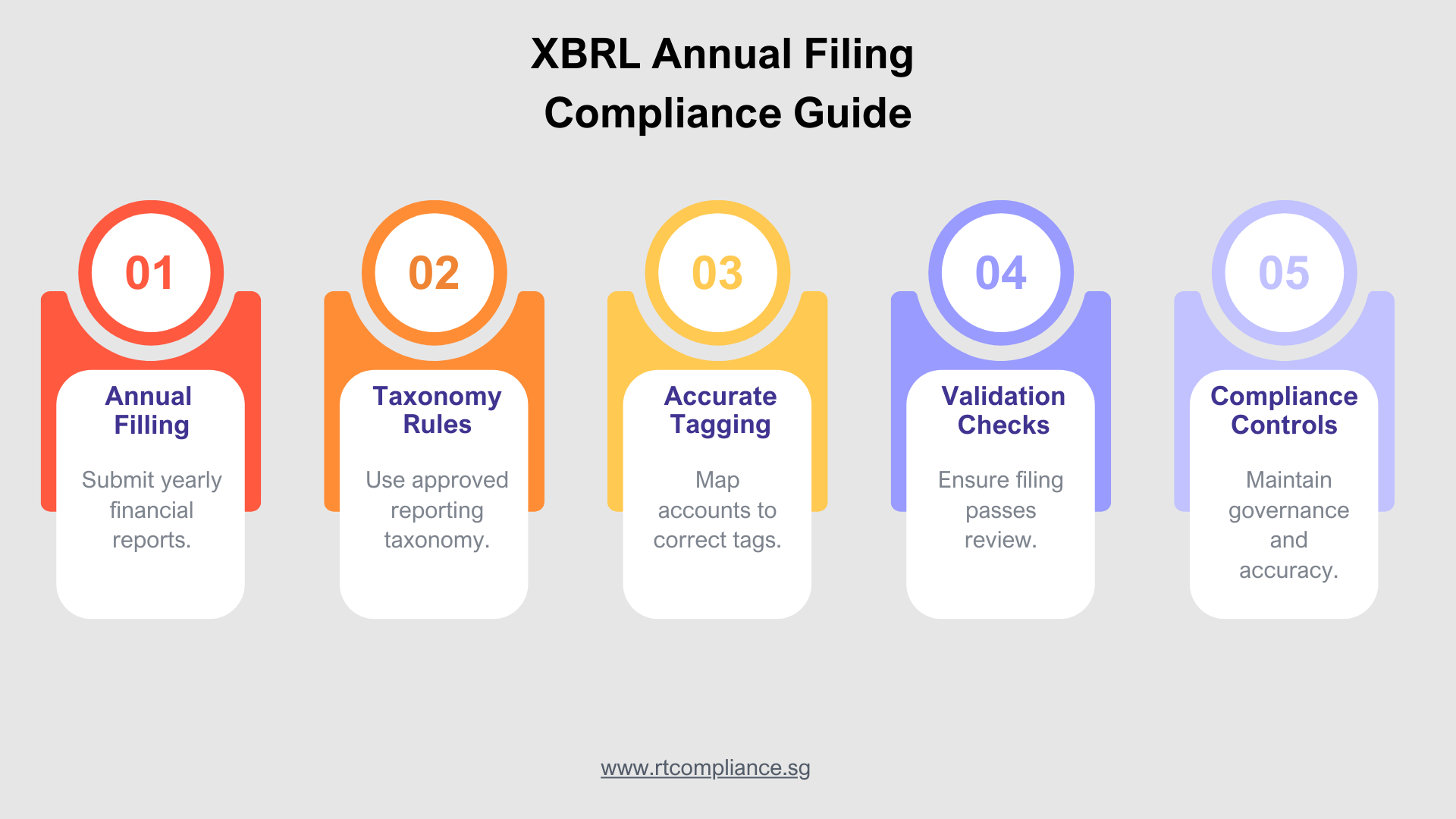
XBRL Annual Filing Compliance Guide
Introduction to XBRL Annual Filing Compliance Guide
The recent years have seen the direction of corporate regulatory reporting being decidedly altered towards digital standardisation and data-driven control. Singapore being a major financial and business center in the region of Asia has been on the front line of this change. Another important part of this regulatory development is the force to use XBRL-based reporting to prepare statutory filings. To companies registered in Singapore, the applicability of xbrl annual reporting, the use of xbrl reporting requirements as obligatory, or otherwise, are not the optional considerations of corporate governance but the mandatory requirements of corporate governance.
XBRL, also known as eXtensible Business Reporting Language, is the format used to provide financial and statutory data in a machine-readable format. This will enable regulators like the Accounting and Corporate Regulatory Authority (ACRA) to work and process corporate information more effectively. With the intensifying regulatory scrutiny and heightening compliance requirements, firms will need to make sure that they report in accordance with the XBRL model of ACRA.
This article is a thorough and authoritative analysis on the compliance of annual filing of XBRL in Singapore. It addresses regulatory goals, the applicability of annual filing in xbrl, the mandatory filing, the links between the XBRL and the acra filing of annual returns, the governance issues, challenges faced in operation and the new trends. The discussion will aim at serving the interests of the directors, the finance professionals, the compliance officers and the advisors who want to have a clear and practical insight into the XBRL reporting regime in Singapore.
Knowledge on XBRL within Singapore Regulatory Framework
XBRL is an international reporting standard that aims at enhancing accuracy, consistency and comparability of business data. XBRL has been formally introduced in Singapore by being part of statutory reporting requirements of at least one reporting platform (BizFile+) provided by ACRA.
XBRL reporting is the introduction that demonstrates the desire of the ACRA to improve the level of transparency and increase the regulatory control. ACRA has the ability to automatize validation by making companies submit structured financial data, which makes it easier to detect inconsistencies. This will decrease the amount of manual inspection as well as data-driven regulation.
In this context, the xbrl annual filing applicability and xbrl filing mandatory ideas are taken as the principle. It is important that companies should identify themselves as belonging to the scope of XBRL requirement before undertaking statutory filing like the acra filing of annual return.
Regulatory Role of ACRA
The main authority in charge of registration of the corporation, financial reporting regulation and enforcement of XBRL requirements in Singapore is the Accounting and Corporate Regulatory Authority (ACRA). ACRA identifies scope, format and technical requirements of XBRL filings.
ACRA uses the acra filing of annual return to gather corporate data and also financial data that would ensure that the companies are not in breach of statutory requirements. This process can be more effectively and consistently analysed (between entities) with the integration of XBRL in this process.
The requirements of ACRA are binding and non-adherence to the stipulated standards can lead to fines, rejection of filing, or regulatory measures.
Applicability of XBRL Annual Filing
The application of xbrl annual filing is one of the important strategies that companies in Singapore must establish. Broadly speaking, the majority of local companies that have been incorporated in the country are obligated to file financial statements using a non-proprietary format namely the XBRL format as part of their annual returns.
Nevertheless, ACRA acknowledges that reporting capacity or complexity is not the same in all entities. In that regard, some exemptions and more simplified filing coverage can be used. As an illustration, other companies might be allowed to submit simplified XBRL template or financial highlights as opposed to complete XBRL financial statements.
In spite of the concessions, xbrl annual filing applicability is extensive. Businesses should also undertake some critical evaluation of their position to identify the level of their commitments. A misinterpretation of the rules of applicability can lead to the situation of non-compliance with acra filing of annual returns requirements.
XBRL Filing Requirement Legal Foundation and Scope
The idea of making xbrl filing mandatory is based on the Companies Act of Singapore and the corresponding regulatory facilities. XBRL submission of financial statements has been formally required by ACRA in order to enhance the quality of reporting and efficiency in regulation.
Within this requirement, the mandate of xbrl filing is mandatory to majority of companies unless they are specifically barred. This is not a procedural duty but has a legal meaning. Statutory records of businesses include financial statements provided in XBRL and are prone to audit.
Knowledge on the time required to make filing of xbrl mandatory is critical to directors and management because lack of this information can expose the company and the officers to fines and a tarnished image.
Association between XBRL Filing and ACRA Filing of Annual Return
The acra filing of annual return is the legal process by which corporations validate their corporate data and provide financial statements to ACRA to do so on an annual basis. XBRL financial statements form a part and parcel of this filing.
Practically, firms would not be able to fill in the acra filing of annual return without being compliant with XBRL requirements where necessary. The XBRL submission should give correct picture of the financial statements approved and be consistent with corporate information as stated in the annual return.
This dependence makes it apparent that the XBRL preparation construction should be an integral part of the yearly filing of the returns. Any delay or mistake in XBRL submission can have a direct effect on the validity and timeliness of the acra filing of annual return.
Compliance and Filing Process Timeline.
XBRL filing normally commences once the financial statements of the company are finalised and approved. After approval, the financial data needs to be mapped to the specification of XBRL taxonomy and validated before submission.
The acra filing of annual return should be filled within the statutory dates after the end of the financial year or annual general meeting depending on the type of company. Late penalties of failure to meet these deadlines might be penalties against late filing.
To ensure that financial close, XBRL preparation, and statutory filing schedules are timely and correct, effective compliance planning involves aligning company schedules to capture all the requirements tied to the effective planning.
Director Responsibilities and Governance.
One of the most important issues that are related to xbrl filing mandatory requirements is corporate governance. Finally, directors have the overall responsibility of accuracy and completeness of financial statements and statutory filings.
It is the duty of the boards to make sure that they have sufficient internal controls, resources and expertise to facilitate XBRL compliance. This can be further covered by oversight mechanisms like audit committees who may ensure that applicability of xbrl annual filing has been rightly evaluated and handled appropriately.
Good governance practices increase confidence on regulation and lessen the chances of non-compliance with acra filing of annual returns obligations.
Popular XBRL Compliance barriers
Even with the explicit guidelines on regulations, firms find it difficult to comply with XBRL requirements. Mistagging and misinterpretation of a taxonomy element together with technical validation error are common ones.
Regarding companies that are not yet conversant with XBRL, it can be quite difficult to establish the applicability of xbrl annual filing and interpret when xbrl filing is mandatory. These challenges can ensure that filing is rejected or the acra filing of annual return may not be completed in time.
These issues should be dealt with by thoroughly planning, training of staff and where necessary, consulting professional advisors.
Application of Technology and Professional Support
Technology is also important in supporting the XBRL compliance. Tagging, validation and submission can be automated using special XBRL preparation tools to eliminate the risk of human error.
Most of the companies are also using professional service providers to help them comply with the mandatory requirements of the xbrl filing. These providers also provide skills in taxonomy interpretation, quality assurance and regulatory updates.
The use of technology and professional support will assist in improving a company capacity to achieve the applicability requirements of xbrl annual filing applicability and to prepare the acra annual return filing of annual return efficiently and in time.
Risks and Consequences of not complying with the regulations
Lack of adherence to the requirements of XBRL has concrete regulatory risks. Delays / inaccurate filings can be subject to fines, enforcement and/or more intense regulation.
Inability to adhere to the requirement of xbrl filing due to the mandatory requirements can also affect the confidence of the stakeholders and the corporate reputation. Unstable or inaccurate information provided as a compartment of the acra filing of annual return can be followed by subsequent inquiries or audits.
These risks are important to understand the role of proactive compliance management.
XBRL Annual Filing Best Practices
In an effort to make compliance effective, companies ought to embrace the best practices that would entail integration of XBRL reporting into the greater system of governance and reporting. Early review of applicability of xbrl annual filing is necessary.
Proper distribution of duties, internal audit, and constant checking of the changes in the regulations are beneficial to adhere to the xbrl filing requirements of mandatory. Constant interaction with ACRA guidance will keep abreast with the latest expectations.
Organisations can enhance compliance risk by integrating XBRL compliance into their routine operations thereby simplifying the acra filing of annual returns process.
XBRL Reporting in Singapore The Future
The XBRL reporting in Singapore will be more advanced as the regulatory technology keeps developing. ACRA can increase the data requirements, adding more rules to its validation, or XBRL data can be integrated with other regulation systems.
More integrations between financial reporting and sustainability disclosures and other non-financial information may also be achieved in the future. In this respect, xbrl annual filing applicability, xbrl filling compulsory requirements can be extended.
Those companies that actively respond to the changes are likely to be more in compliance and be credible to the regulations.
Conclusion
XBRL reporting has been integrated to be a part of corporate compliance in Singapore. Knowledge of xbrl annual filing applicability, awareness of when annual filing requirements of xbrl filing is obligatory and timely and correct annual return submissions through acra filing are critical issues to companies and directors.
To maintain effective compliance, it is necessary to have a mixture of regulatory awareness, governance supervision, technical, and disciplined execution. With the continued development of the digital regulatory regime in Singapore, organisations that consider XBRL compliance to be a strategic concern, rather than a procedural one.