
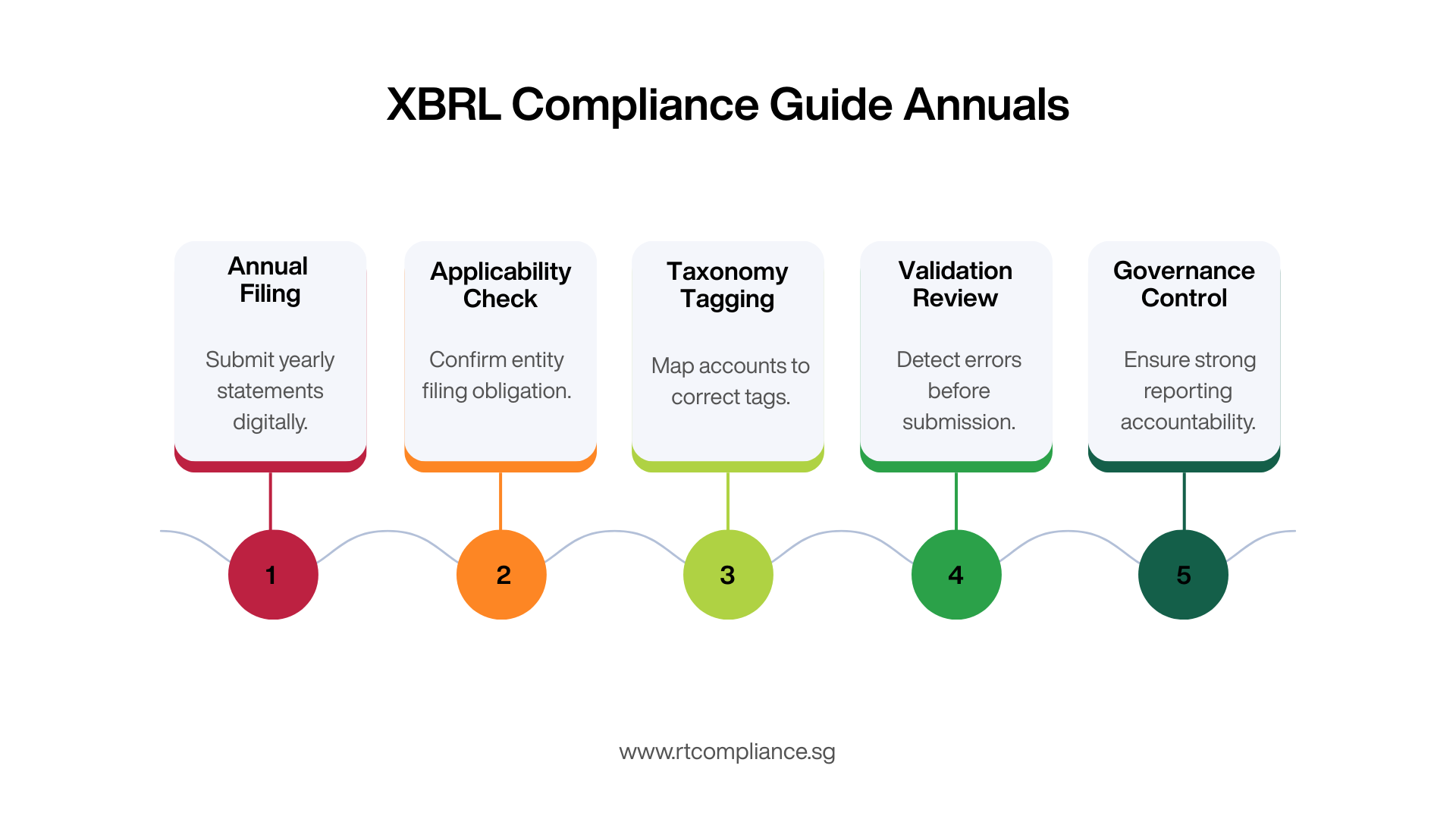
XBRL Compliance Guide Annuals
Introduction to XBRL Compliance Guide Annuals
Regulatory reporting has been transformed by digitalization to alter the way companies present the statutory financial information to the authorities. Annual filing xbrl is one of the biggest regulatory changes of the last years as it means that organizations provide annual financial statements in a structured and machine-readable format. This format is used to improve the level of transparency, data comparability, and enhance oversight by regulators. This has also meant that knowledge of annual filing xbrl is no longer an intellectual fringe benefit but a fundamental compliance requirement.
Coupled with this requirement, other companies also have to test applicability of xbrl annual filing to know whether their entity is under the mandatory filing requirements. The misunderstanding of the applicability set of rules frequently results in a delay or the absence of compliance with the regulations. In addition, fillings xbrl require care and precision in their technical implementation as well as conformance to the recommended taxonomies. Here, the article is a brief and overarching, business-oriented description of what annual XBRL filing is, what it can be applied to, and how it can be used to guarantee compliant and efficient reporting.
Knowledge Annual Filing XBRL in Regulatory Reporting.
Annual filing xbrl is the transmission of annual financial statements in the format of the eXtensible Business Reporting Language as spelled out by the regulators. Contrary to conventional PDF or paper filings, XBRL allows the financial data to be tagged in a standardized manner, so that automated analysis by the regulatory systems is possible. Annual filing xbrl allows the regulators to see the comparative performance of financial performance efficiently among firms and industries.
The aim of annual filing xbrl is not only limited to digitization. It increases the quality of information, prevents ambiguity in financial reporting and increases the efficiency of regulators. The companies are likely to make sure that their balance sheets, income statements, cash flow statements, and notes are properly tagged based on the appropriate taxonomy. Any flaws in tagging may compromise compliance despite the financial figures being accurate.
Corporate governance and financial transparency have now made annual filing xbrl a part and parcel of corporate governance and regulatory expectations as they constantly change.
Applicability of regulatory Framework and Annual Filing of XBRL
The most important compliance measure is to determine the applicability of xbrl annual filing. Applicability is usually determined by regulators in terms of legal structure, size of company, revenue limits or listing status. Additional mandatory annual filing xbrl is usually imposed on public companies and large entities that are privately owned, but usually small entities get exemptions or transitional relief.
The annual filing of xbrl filing needs to be reviewed closely considering the regulations unique to jurisdictions. In other instances applicability is affected by corporate restructuring, mergers, and revenue increase. Those companies which do not review the applicability of xbrl annual filing every year run the risk of missing new requirements.
Proper determination of applicability of xbrl annual filing would help organizations to have the right resources and time of achieving compliance of annual filing xbrl requirements.
Fundamental Elements of Fillings XBRL
The process of preparation of XBRL-formatted financial statements, their validation and submission is referred to as fillings xbrl. This is carried out by starting with mapping of financial statement line items to corresponding taxonomy elements. All tags should capture the right accounting meaning so as not to misrepresent.
Consistency among statements is also a requirement of effective fillings xbrl. Total figures should be matched, relative numbers should be equal, and story revelations should be substantiated with figures. Before submissions, system checks are required to identify inconsistencies identified through regulatory systems using automated validation rules.
Besides the technical accuracy, fillings xbrl include adherence to the rules of procedures, i.e., the name of files, submission portals, and filing deadlines. A combination of these factors defines a successful or a failed annual XBRL filing.
Issues with Annual Filing XBRL Compliance
Although it is widely used, annual filing xbrl has been a problem in most organizations. A lack of internal expertise especially among first-time filers is one of the common challenges. XBRL taxonomies are not simple and improper choice of tags tends to give validation errors.
Yet again another challenge is associated with xbrl annual filing applicability, where any company may err in the decision whether it applies to the company or not. The applicability assessments are also complicated by regulatory changes and changing thresholds. Due to this fact, the organizations could underestimate the scope of annual filing xbrl requirement.
Also, tight reporting schedules are a technical challenge with fillings xbrl. Financial statements that are prepared near filing deadlines have little time to prepare and review XBRL and this poses the risk of making mistakes.
Best Practices of Managing XBRL Annual Filing Applicability
In order to effectively plan xbrl annual filing applicability, the business organization ought to include regulatory evaluation in their annual compliance planning. This involves tracking of the alterations in regulations, amount of revenue required, and the types of reports that could influence applicability.
Another best practice is that of integrating annual filing xbrl in the financial close process. Making early preparations will provide enough time to make corrections, and minimize the need to make changes at the last moment. Organizations which consider XBRL as a normal reporting activity are more likely to achieve a regular compliance.
In the case of fillings xbrl, standardization of templates and internal audit processes would improve accuracy. Most organizations also hire the services of external specialists to take care of complex filings especially in a multi-entity structure setting or first annual filing xbrl reporting.
Implication of Governance and Risk Management
Good governance frameworks identify annual filing xbrl as one of the compliance risk areas that should be controlled. The boards and audit committees are more demanding that the management show effective controls as far as digital reporting processes are concerned.
Proper knowledge of the applicability of xbrl annual filing contributes to the effective risks management in that one must be aware of the existences of obligations at earlier stages. Lack of adherence to annually filed xbrl might lead to fines, loss of reputation or governmental examination.
Correct fillings xbrl is also a factor of efficiency in audit. The use of XBRL compliance becomes a significant part of the general financial governance since auditors use organized information to evaluate the financial stability.
Accurate Filings XBRL: strategic Value
Although fillings xbrl have been considered a regulatory burden, they have strategic benefits. Organized financial information enhances internal analytics, which can better help the management to recognize the trends and performance benchmarks.
Regular annual filing xbrl improves the transparency and establishment of trust with the regulators and stakeholders. Companies that are proving to have a good quality compliance stand less chances of being refused to file or even taken to task.
Scalability is also provided by proper management of xbrl annual filing applicability. With the increase in companies or their move to new jurisdictions, existing XBRL processes allow the process of transitions to further reporting requirements to be smooth.
Blending of Technology and Process
Technology is very important in the effective annual filing xbrl. Tagging of data, validation, and submission is automated by XBRL, which helps to minimize the amount of manual work and decreases the level of errors.
Nevertheless, technology will not ensure compliance. Business organizations should integrate systems to meet regulatory needs and make sure employees have knowledge of xbrl annual filing applicability and reporting requirements. Effective fillings xbrl are achieved by incorporation of technology, experience and governance.
The frequent changes in the system and testing allow organizations to adjust to the taxonomy changes and annual filing xbrl provisions that change.
Timelines and Deadlines of Compliance
One of the key points of annual compliance with xbrl is the adherence to the process of regulations. Authorities usually lead to rigid time limits within which the XBRL-formatted financial statements are to be submitted usually based on the annual report or statutory reporting dates. Inability to comply with these timelines could lead to fines on lateness of filing, submissions rejection, or regulatory sanctions.
The knowledge of deadlines is also closely connected with xbrl annual filing applicability because various types of entities might have other evidence periods. Indicatively, most of the listed entities are usually expected to file xbrl annual returns earlier than non-listed companies. Any change in company status, including listing, restructuring or revenue growth, can also have an impact on the timelines of filing.
Compliance wise it is imperative to plan in advance. Fillerings xbrl timelines should be included in companies calendar on annual reporting so that XBRL preparation can be initiated as soon as the financial statements are prepared. This is done by scheduling at an early stage, which minimizes the need to make last-minute corrections and minimizes the general accuracy of filing.
Conclusion
Annual reporting xbrl has turned into an essential part of the current financial reporting, following the trend of transparency and data consistency prescribed by the regulators. Organizations should be able to know the applicability of xbrl annual filing on a clear understanding to comply with the requirements and inculcate effective processes of compliant filing xbrl.
Through incorporation of XBRL in the financial reporting cycles, investing in expertise, and good governance controls, organizations will be able to satisfy the expectations of the regulators. Finally, efficient annual XBRL reporting both guarantees compliance as well as enhances financial integrity and corporate credibility in the long term.