
XBRL Compliance Requirements
Introduction to XBRL Compliance Requirements
Financial transparency and systematized reporting have become mandatory requirements to companies in an increasingly controlled business world. The introduction of XBRL is one of the greatest regulatory trends in the area of financial reporting that has revolutionized the way financial data is prepared, submitted, and analyzed. The awareness of the xbrl compliance is not an option anymore, as the authorities of different jurisdictions demand companies to adhere to high standards of digital reporting. In order to comply, organizations need to be well aware of the xbrl requirements and ensure that they have good procedures of ensuring that all the filing xbrl requirements are correctly and timely met.
This article is a vivid explanation of the compliance of XBRL based on regulatory expectations, core requirements of XBRL and best practices in promoting error free XBRL filing. It is aimed at finance workers, compliance officers and business executives requiring clear and organized knowledge of XBRL requirements.
Introducing XBRL Compliance in Financial Reporting
Xbrl compliance is compliance to the standards related to regulation that set out that financial statements should be prepared and delivered in the eXtensible Business Reporting Language format. XBRL allows financial data to be standardized and machine-readable and readily compared across companies and industries. XBRL data is used by the regulators to facilitate better oversight, accuracy of data, and transparency in financial reporting.
The compliance of xbrl cannot be achieved through a simple transformation of the financial statements into a computer format. Businesses should make sure that the figures reported are properly mapped to relevant taxonomy, and that they are consistent with the accounting standards and are checked with regulation requirements. Failure to comply can lead to the filing of rejections, penalties or regulatory review and as such, compliance is a vital governance obligation.
Since regulatory frameworks keep on changing, keeping up with xbrl compliance has become a continuous process and not a one time affair.
Mandatory XBRL Requirements That Companies Should Adhere To
Any company that needs to meet regulatory expectations must apply all the relevant xbrl requirements. These are requirements that present the manner in which financial information is to be organized, labelled, and verified before its presentation to regulatory bodies.
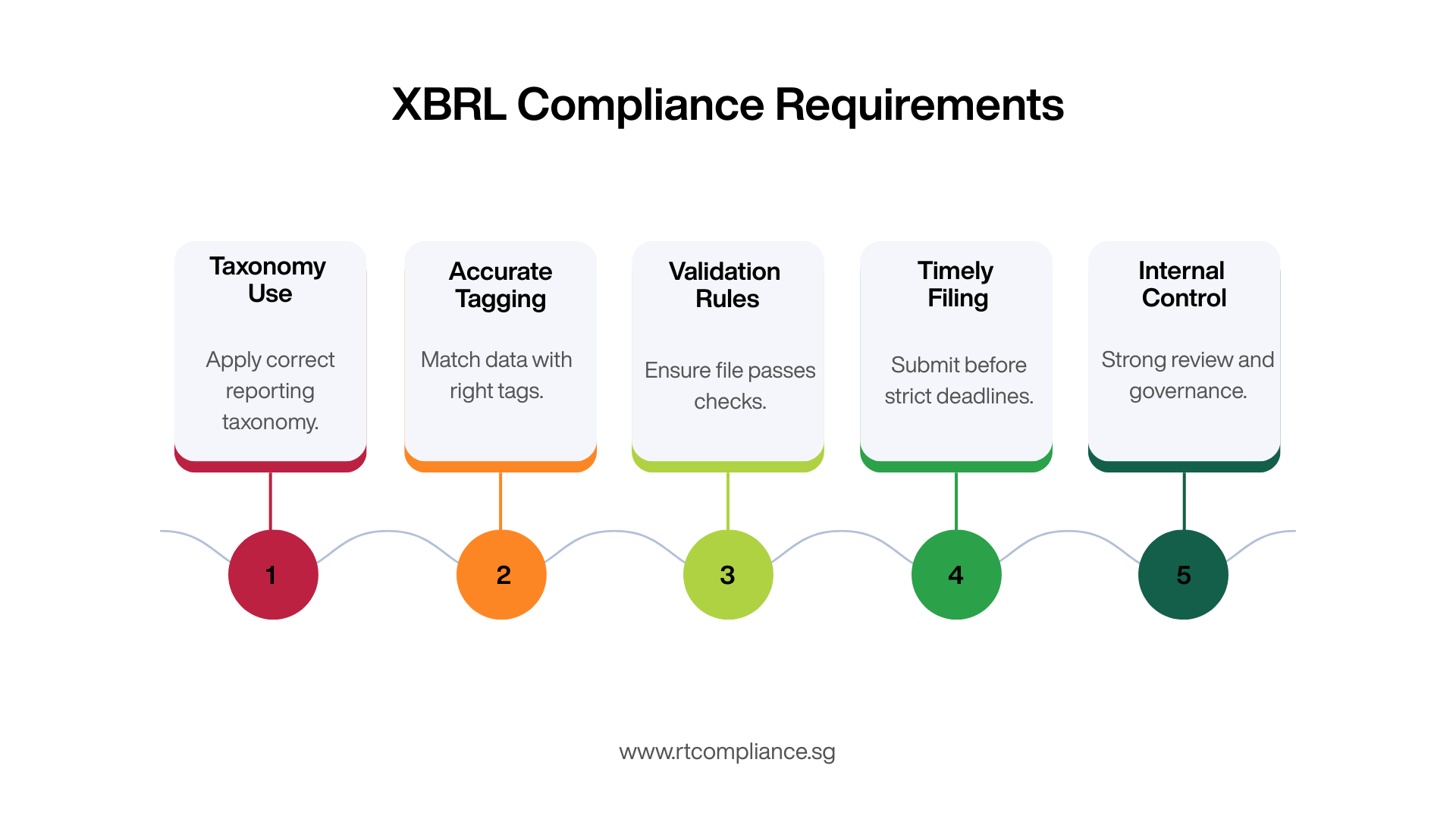
Usually, Xbrl requirements imply the usage of a recognized taxonomy, e.g., regulator-issued or standard-setting ones. The lines of a financial statement need to be appropriately tagged in order to interpret their accounting meaning. The wrong tagging, no disclosures, or inconsistency of the data may lead to the non-compliance in spite of the accuracy of the underlying financial statements.
Data consistency is another important part of xbrl requirements. The financial numbers have to match in the statement and narrative disclosure has to correspond to money numbers. Regulators also use validation rules to guarantee logical accuracy and thus companies should carry out proper checks prior to submission.
Being knowledgeable about these xbrl requirements will enable organizations to reduce errors and will also help them to meet the expectations of regulators in their financial reporting.
Use of XBRL Taxonomies in Providing Accurate Compliance
XBRL taxonomies are the basis of digital financial reporting that is accurate and compliant with the requirements of regulators. A taxonomy delineates standardised financial terms their accounting meaning and the relationship between data items with respect to relevant accounting frameworks like IFRS or local GAAP. An appropriate application of taxonomy will promote the fact that financial information will be read equally by regulators and any other stakeholders, irrespective of the reporting entity.
To reach the XBRL compliance, the choice and usage of the proper taxonomy are of paramount importance. All the lines and disclosures in the financial statements should be mapped to a more relevant element of the taxonomy to mirror the real accounting meaning. Reported information may be misrepresented by incorrect tagging or inappropriate use of taxonomy extensions, thereby causing comparability to decrease and leading to the validation error or repudiation of the filing by regulatory bodies.
The regulatory authorities periodically refresh taxonomies to indicate shifts in the accounting standards and disclosure requirements. Businesses should thus keep tracking the changes in taxonomy and reflecting taxonomy changes in their reporting systems promptly. Active tax management is expected to assist companies in sustaining long-term XBRL compliance and reduce the potential chance of non-compliance by old reporting structures.
Making XBRL Requirements and Regulatory Expectations
Filing xbrl-meeting entails both technical and procedural requirements which are required by the regulators. These requirements indicate timing, format and manner of XBRL filing.
Submission of xbrl requirements requirements is normally relegated to the submission of XBRL financial statements alongside annual returns or periodic reports. Companies have to meet stringent deadlines and failure or submission of time-bound deadlines or failure may attract penalty or enforcement measures. The regulators also insist that the XBRL files should pass through automated validations before they are accepted.
Moreover, the filing xbrl requirement is usually different based on the type of company, size of company and listing. In the case of public companies e.g. they normally have more disclosure requirements as compared to private entities. Appreciating the extent of these duties is also a requisite of proper compliance planning.
By harmonizing the internal reporting procedures with the filing xbrl requirements, companies will be able to minimize the risk of compliance and mitigate the last-minute filing problems.
XBRL Reporting Internal Controls and Governance
Good governance structures and internal controls are necessary in order to provide credible XBRL reporting. The compliance of XBRL is interdisciplinary and is done by finance, compliance, information technology and audit functions. In the absence of a proper governance and coordination, organizations are prone to more risks of tagging errors, inconsistencies in data, and non-compliance with regulations.
An effective governance structure must have well defined roles and duties all through the XBRL reporting cycle. The accuracy of financial data is the role of the finance teams, regulatory requirements compliance is the role of regulatory compliance teams, and the preparation and validation of XBRL files is the role of the technical specialists. Putting in place organised workflows and approval procedures makes them more accountable and general quality of XBRL filings is also improved.
Proper validation checks, reconciliation and documented reviews should be made under the internal control procedures before submissions. These controls guarantee consistency of XBRL filings with audited financial statements, as well as, mitigating validation rules imposed by the regulators. Incorporation of XBRL controls within the financial reporting system increases corporate governance and boosts the trust in the digital disclosures.
Typical barriers on the way to XBRL Compliance
Although regulations are evident, xbrl compliance is a challenge in most organizations because of the technicalities and lack of knowledge. The wrong choice of the taxonomy is one of the most frequent problems, and it may result in the distortion of the financial information.
The second problem is also the misinterpretation of xbrl requirements especially in disclosures and validation rules. Businesses can create true financial reports and yet they do not pass compliance tests because of errors in tagging or discrepancies.
It can also be difficult to meet the filing xbrl requirements when there is a tight timeline. The lateness in the finalization of the audited financial statements usually affects the XBRL preparation and has the probability of hasty or ineffective filing.
The identification of these obstacles at the initial stage helps organizations take correctionary actions and enhance their compliance system.
Best Practices in XBRL Requirement Meeting
Companies aim to have the same compliance of xbrl standards; this will require them to incorporate the XBRL preparation into their routine financial reporting. The early planning will minimize the pressure at the time of filing deadlines and will be ample time to validate and review.
There should be a good grasp of relevant xbrl requirements. The finance departments ought to keep abreast of regulatory changes and taxonomy changes that could impact the reporting requirements. Internal competency is maintained by frequent training and documentation.
Co-ordination among finance, audit, and compliance functions is also needed in order to address the xbrl requirements in filing. Having timelines and roles inside the company enhance efficiency and precision.
A lot of organizations prefer to use professional XBRL specialists to assist in the compliance, especially in case of complex financial setups or when filing first time.
Strategic Value of Good XBRL Compliance
Xbrl compliance can be considered as a strategic advantage though it is usually perceived as a burden to the regulation. When the financial data is organized, it deepens the internal analysis, increases the comparability, and contributes to the improvement of decision-making.
Proper adoption of xbrl requirements enhances the corporate governance and shows transparency to regulators and other stakeholders. Companies that are always able to comply with xbrl requirements develop trust and limit the risk of regulation.
With time, efficient XBRL reporting will enhance operational efficiency through minimizing errors, re-work, and compliance costs. With digital reporting as the new global standard, robust XBRL compliance puts the companies in a good stand for the forthcoming regulatory advancement.
Trends and Digital in XBRL Compliance Future
XBRL compliance has an evolution that is strongly tied to the overall digitalization of the financial reporting. The structured data are becoming increasingly important to regulatory authorities to improve the regulation of the market, identification of risks, and analytical results. Because of this, XBRL is no longer considered merely a compliance requirement, but as a strategic data infrastructure to regulatory reporting.
The changes in the XBRL preparation are being transformed by the advances in automation and reporting technology. Companies are embracing automated tagging systems, sophisticated validation systems and built-in reporting frameworks to enhance efficiency and minimize human. All these technological advances contribute to the increased data quality and allow submitting regulatory reports faster and more accurately.
In the future, organizations that have mature XBRL compliance systems will be in a better situation to conform to changing regulatory demands. Superior quality of XBRL data improves transparency, data-driven decision-making and instills stakeholder confidence. In this regard, a good XBRL compliance does not only imply regulatory compliance but also an investment into the future of digital financial reporting.
Conclusion
Nowadays, xbrl compliance is critical to proper and transparent financial reporting as the compliance and its implementation are understood and implemented. To avoid the penalty and regulation scrutiny, companies should strictly adhere to all xbrl requirements and make sure that filing xbrl requirements are fully satisfied.
Through a systematic method, internal knowledge investment and regulation of reporting procedures, the organizations can attain viable XBRL conformity. After all, good compliance not only meets the requirements of the statute, but also helps to improve the quality, credibility, and strategic importance of corporate financial reporting.