
XBRL Filing in Singapore Compliance Guide
Introduction to XBRL Filing in Singapore Compliance Guide
The regulatory reporting requirements in Singapore have been modified considerably due to the demands of transparency and accuracy as well as digital standardisation throughout the world. A serious step in the same direction is the enactment of XBRL-based reporting of statutory financial reports (compulsory). To firms that do business in Singapore, knowledge of xbrl filing in singapore is no longer a choice but a mandatory course of compliance which is imposed by the Accounting and Corporate Regulatory Authority (ACRA).
XBRL, or eXtensible Business Reporting Language, makes financial data submittal in a machine-readable format possible. This enables the regulators to examine corporate financial information effectively and uniformly. Under this framework, businesses are expected to follow well outlined xbrl filing requisite acra and strictly follow the stipulated xbrl filing deadline singapore to prevent imposition of fines or sanctions.
This paper gives an in depth and authoritative discussion of xbrl filing in singapore, its regulatory purposes, filing, deadlines, applicability, governance, operational issues, and best practices. The work is aimed at corporate directors, finance professionals, compliance officers, and advisors that would like to obtain a clear and practical insight into the XBRL compliance environment in Singapore.
XBRL Filing in Singapore Overview
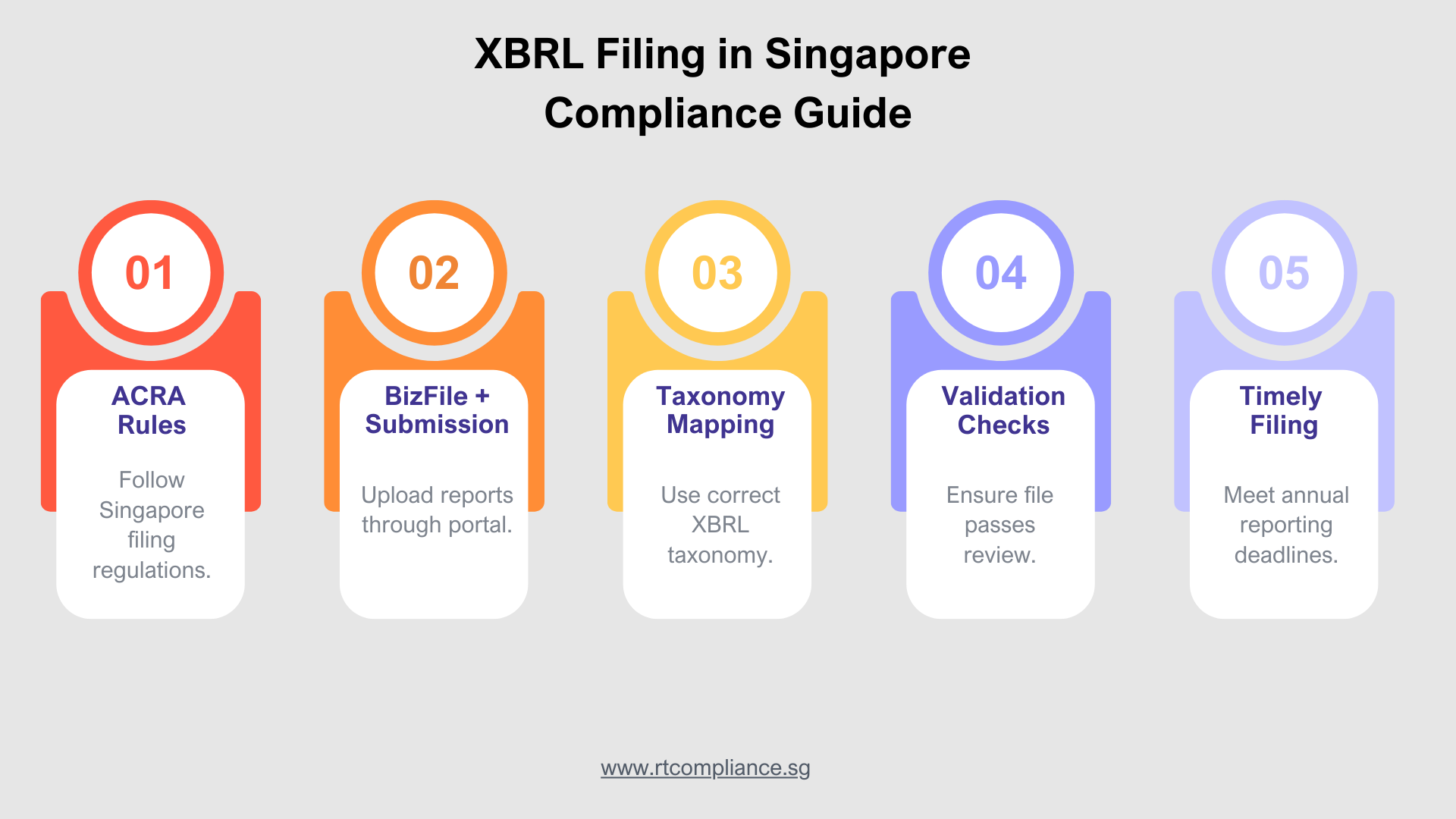
Xbrl filing in singapore is known as a statutory filing of financial statements to ACRA with use of XBRL format via BizFile + system. The need was made to ensure the quality of data, regulatory oversight, and to make Singapore compliant with international best practices regarding digital financial reporting.
In this structure, financial reports and statements are no longer completed and submitted in a traditional format of PDF documents. Rather, the most essential financial information should be marked with an identified XBRL taxonomy released by ACRA. It is a structured format that can be validated and analyzed automatically without involving human review and enhances the effectiveness of regulation.
Introduction of xbrl filing in singapore signifies the wider digital transformation plan by ACRA, which is to reinforce corporate governance and enhance transparency of the business ecosystem.
ACRA and its role in Regulatory Authority
The main regulator of the enforcement of xbrl filing requirement acra is the Accounting and Corporate Regulatory Authority (ACRA). The reporting standards, applicable taxonomies, and compliance by ACRA are determined by way of its electronic filing platform.
The aim of the xbrl filing that is being required by ACRA in singapore is to provide consistency, comparability and reliability of financial information that companies provide. The standardisation of financial disclosures will help ACRA to identify compliance risks better, detect anomalies and aid data-driven supervision.
The penalty imposed on failure to comply with xbrl filing requirement acra could lead to filing rejection, regulatory notice, or penalty, which is why it is important to know and comply with the guidelines of ACRA.
Knowledge XBRL Filing Requirement ACRA
Xbrl filing requirement acra is applicable on most companies incorporated in Singapore under certain exemptions. Unless the companies are eligible to and decide to utilize simplified filing, which has been allowed by ACRA, companies are expected to file their financial statements in XBRL format.
ACRA sets out particular XBRL taxonomies which dictate the way financial data should be tagged. These taxonomies are revised periodically to accommodate the developments in accounting standards and regulations. One of the major constituents of xbrl filing requirement acra is compliance with the appropriate version of taxonomy.
It is also important that the XBRL data should be a true reflection of their accepted financial statements by the companies. The discrepancy between XBRL submissions and financial records can be the source of validation errors or regulatory inquiries.
XBRL Filing Applicability in Singapore
Not every entity is liable to the same xbrl filing in singapore. As a rule, Singapore-incorporated companies are required to submit XBRL financial statements, in particular, foreign companies or those with permission to submit financial highlights instead of financial statements.
The small and inactive companies can be provided with a lessened filing requirement, yet they are required to adhere to the xbrl filing requirement acra that is applicable in case full financial statements are presented. The applicability is important in order to understand the scope and complexity of XBRL preparation.
The uncertain companies must determine their position early to prevent non-compliance with xbrl filing deadline singapore.
XBRL Filing Deadline Singapore
One of the most important issues of statutory reporting is compliance with the xbrl filing deadline singapore. The XBRL financial statements should be submitted along with the annual return during the stipulated period of time.
Most of the time, the companies are counted to present their annual return alongside XBRL financial statements within a given number of months after the financial year end or the annual general meeting, which is subject to the company type. Failure to meet xbrl filing deadline singapore can attract late filing fines and regulatory measures.
Prudent governance is evident in timely compliance, and an augmented level of scrutiny by ACRA is diminished.
Correlation of Annual Return and XBRL Filing
The filing of Xbrl in singapore is highly associated with the filing of annual return. Statutory annual return package is part of financial statements submitted in XBRL format to ACRA.
The acra of the xbrl filing requirement is used to guarantee that the information presented using XBRL reports is consistent with corporate information reported in the annual return. The discrepancies in these filings can cause an error of system validation or compliance audit.
The companies should organize the financial reporting and statutory filing procedures so that they can easily meet the xbrl filing deadline singapore.
Responsibilities and Governance on Directors
Compliance with xbrl filing in singapore is the eventual responsibility of the directors of the company. According to xbrl filing requirement acra, directors are supposed to make sure that financial statements are prepared and presented in the correct form and manner.
Sound governance, such as audit committee controls and internal controls, is very important in the proper XBRL reporting. The directors must also be keen on ensuring the management teams are properly trained and assisted to comply with the xbrl filing deadline singapore requirements.
Lack of exercising adequate oversight can subject directors to regulatory risk and reputational harm.
Typical Triumphs in XBRL Filing Conformity
Most businesses also face difficulties in the introduction of xbrl filing in singapore especially at the initial stage. Some of the challenges that are encountered are wrong tagging, missing data mapping, and misconception of the taxonomy requirements.
Another common problem is technical validation errors. Such errors can occur when XBRL files fail to meet requirement acra of xbrl filing which causes rejected submissions leading to loss of time which would compromise the achievement of the xbrl filing deadline singapore.
The solution to these challenges would involve proper planning, technical skill, and scrutiny.
Technology and XBRL Preparation Tool Usage
Technology is at the core of promoting the xbrl filing in singapore. Companies can either do it with specialised XBRL preparation software or hire professional service providers to help with tagging and validation.
Automated tools serve to support the xbrl filing requirement acra by minimizing the number of mistakes in the manual process and simplifying the preparation. They facilitate on time submission before the xbrl filing deadline singapore as well.
To achieve effective and effective XBRL compliance, the right tools and resources should be selected.
Penalties and Risk of Regulation
Failure to file in xbrl in singapore has a real regulation risk. Failure to submit the xbrl filing deadline singapore before the stipulated deadline may result in financial fines, and an enforcement action may reward failure to comply regularly.
Regulatory confidence and subsequent scrutiny may also be compromised by filings that are not right and do not meet xbrl filing requirement acra. The effect of bad compliance records in the long run is a reputation and a lack of trust among stakeholders of a company.
These risks can be understood to boost the essence of disciplined and active compliance management.
Best Practices of XBRL Filing in Singapore
Best practices that incorporate XBRL preparation in the overall financial reporting environment would enable companies to make successful xbrl filing in singapore. It is important to plan early, allocate roles well and do internal reviews.
Frequent revising of modifications to xbrl reporting requirement acra and active tracking of the xbrl reporting deadline singapore is used to eliminate compliance risk. The compliance capability is also enhanced by continuous training and interaction with professional advisors.
XBRL Reporting in Singapore Future Developments
The singaporean regulatory framework on xbrl filing is likely to keep changing with the enhancement of digital reporting features by ACRA. Further evolution might feature the increased data demands, the improved validation procedures, and the more effective consolidation with the other regulatory systems.
With the augmented regulatory requirements, the adherence to xbrl filing requirement acra will entail more sophistication and governance control. The early investments made by companies in the strong reporting framework will enable them to be more adaptive to the changes in future and satisfy the needs of the xbrl filing deadline singapore on a regular basis.
Conclusion
Xbrl filing in singapore is one of the pillars of the contemporary business compliance that facilitate transparency, accountability, and regulatory effectiveness. Companies that comply with xbrl filing requirement acra and meet the stipulated xbrl filing deadline singapore, have high levels of governance and regulatory discipline.
A mix between proper financial reporting, technical skills, governance control, and timely implementation is the key element of effective XBRL compliance. Organisations that make xbrl filing in singapore a strategic compliance concern will enjoy a long-term benefit of regulatory reputation and operational strength as Singapore continues to develop its digital regulatory standards.