
Case Study: Major Payment Institution License Advisory Supporting Scalable Payment Services in Singapore
Background on Case Study Major Payment Institution License
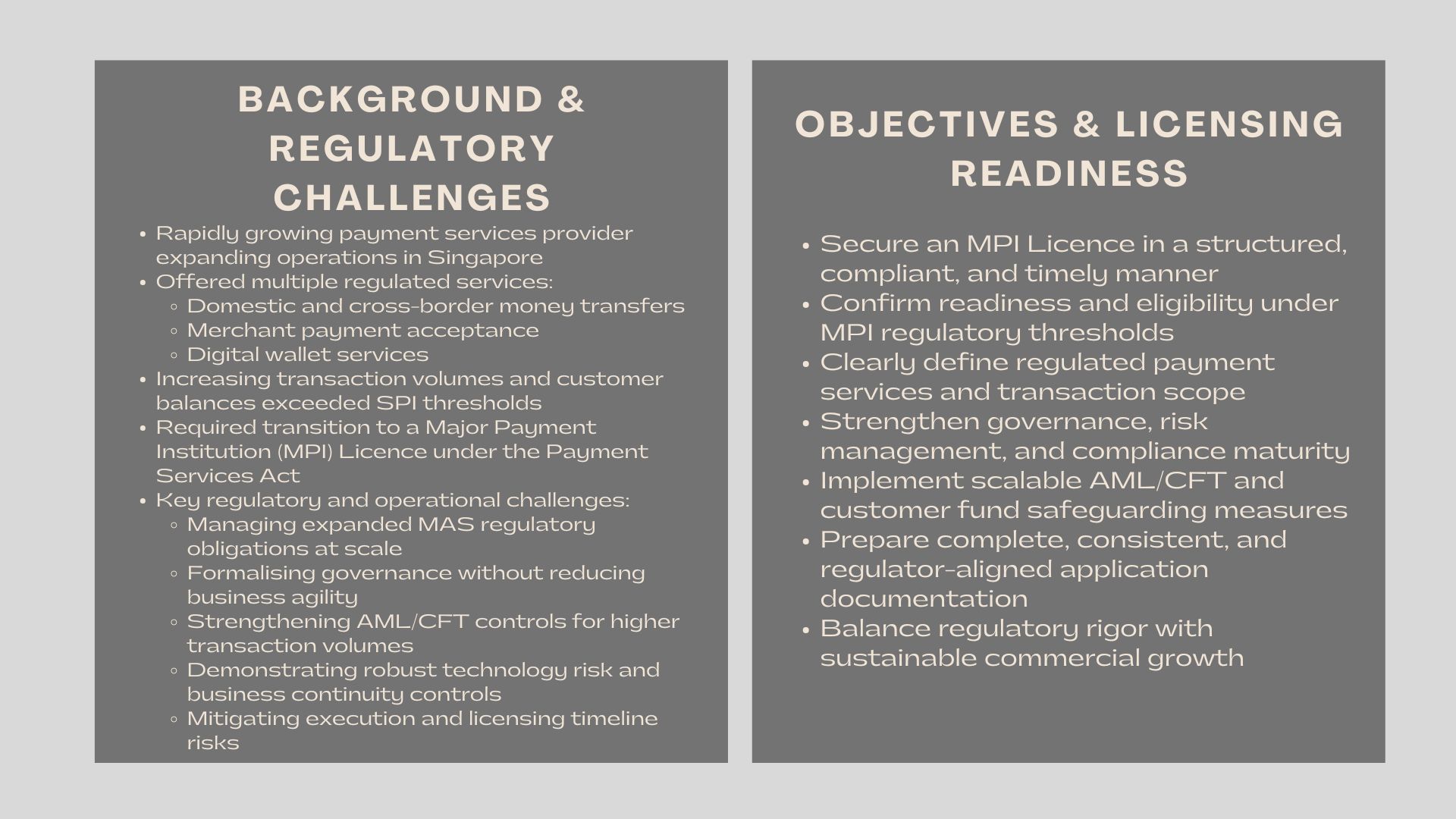
A fast-growing payment service company is expanding its business in Singapore, and it provides a variety of regulated services, such as domestic and international money transfers, accepting payments as a merchant, and providing digital wallets. Since the volume of transactions and the customer balances were increasing, the firm expected to surpass the regulatory requirements that a Standard Payment Institution was supposed to have.
In order to foster its further development and guarantee adherence to the necessary regulations, the company realized the necessity to receive a Major Payment Institution (MPI) License by the Payment Services Act that would be supervised by the Monetary Authority of Singapore (MAS). The management appreciated that the MPI license has an increased regulatory burden in the form of increased safeguarding, governance and learn risk management requirements.
The company has used our Major Payment Institution License Advisory Services to provide advice on the process of licensing and assist in the shift between a growth-oriented fintech business and a full-scale, large-scale payment institution that is licensed.
Issues and Challenges
The process of licensing MPI presented the more complicated regulatory environment than that of the previous stages of licensing.
One of the difficulties was to find its way through the newly enlarged scope of regulations. The company had to learn to apply the Payment Services Act on a large scale, especially regarding the volume of transactions, the security of the funds belonging to the customer and the stability of the operations.
The other difficulty was governance and organisation preparedness. MAS intends MPI applicants to have good board oversight, accountability, and mature compliance and risk management practices. The company had to formalise the governance framework without interfering with the operational agility.
Another source of complexity was AML/CFT compliance. As transaction volumes and international activity increase, MAS imposes additional demands on customer due diligence, transaction monitoring, the screening of sanctions and suspicious transaction reporting. The company needed assistance in streamlining its systems to best regulatory practice.
There were technological risks management and business continuity also. The firm as a more systemically-important payment provider had to prove effective controls in respect of cybersecurity, availability of the system, data protection and how it responds to cybersecurity incidents.
Lastly, there was execution and timing risk to the firm. Any delays or lack of MPI license application might affect growth plans of business, commercial relationships, and client confidence.
Objectives
The main aim of the engagement was to assist the firm to secure a Major Payment Institution License in Singapore in an organised, adherent and effective fashion.
In particular, the company aimed at:
- Verify that one meets the minimum qualifications and is prepared to be licensed as MPI.
- Well defined regulated payment service.
- Enhance governance, risk and compliance systems.
- Defend strong resiliency and protective mechanisms.
- Make complete and regulator-compliant documentation of license application.
The interaction was meant to mix regulatory rigour with commercial viability, which would allow sustainable growth in the Singapore regulatory framework.
How We Helped
The advisory approach that we implemented was structured and aligned with the regulators in response to the increased demands of the MPI licensing regime.
We have started with the extensive MPI preparation test. To determine regulatory weaknesses and areas of priority, we analysed payment flows, transaction volumes, customer fund arrangements, organisational structure and the current compliance frameworks of the firm.
On the basis of this evaluation, we came up with an elaborate MPI licensing roadmap. The roadmap identified regulatory requirements, documentation deliverables, system improvements, and governance milestones that would give the management a clear direction towards submitting a license.
We assisted the company in enhancing systems of governance and oversight. This involved counsel on board composition, management roles, compliance and risk reporting line and internal control processes in line with MAS requirements of major payment institutions.
A considerable part of the interaction was devoted to the AML/CFT and control over financial crime. We helped in the improvement of customer onboarding procedures, transaction monitoring systems, bad-check handling procedures and record procedures to ensure scalability and regulatory compliance.
We as well recommended on customer monies safeguarding such as trust accounts arrangements, connection of reconciliations and the control of fund segregations. All these were well documented to show the adherence to the statutory requirement of safeguarding.
The risk management of technology and operational resilience was also handled by the creation and improvement of policies on cybersecurity, system access control, data protection, business continuity planning, and incident response procedures.
Lastly, we facilitated the preparation of the MPI license application and other materials. Consistency, clarity and completeness were stressed to minimize regulatory friction and assist in a streamlined process of reviewing the MAS.
During the engagement, we collaborated with the management to convert regulatory expectations into viable operating practices to enhance internal understanding and ownership of compliance.
Value Delivered
As illustrated in this case study, professional Major Payment Institution License Advisory Services can be used to assist payment service providers as they grow and become a part of the regulated financial environment in Singapore.
The engagement, using a building and balanced advisory approach, assisted the firm in increasing the level of governance maturity, reinforcing compliance frameworks, and creating operational resilience in line with MAS expectations. Licensing preparation process also aided in the easy transition phase of early stage growth to regulated scale.
This engagement also gave the MPI advisory structure a robust basis of sustainable growth, regulatory trustworthiness and prolonged involvement in the payments industry of Singapore.