
Singapore Certificate of Incorporation: How to Get It, Download It, and Use It for Banking
Introduction to opening company in Singapore
Most consideration is usually focused on the process of incorporation when the entrepreneurs are making their decision to set up a business in Singapore. The founders are usually interested in such practical questions as the period of company registration, the possibility of incorporating a business by foreigners, the minimum paid-up capital, and the necessity of appointing a Singapore resident director. These operational details are selected, but they tend to mislead the business owners of one serious consequence of the incorporation process itself: the possibility to have formal evidence of corporate existence.
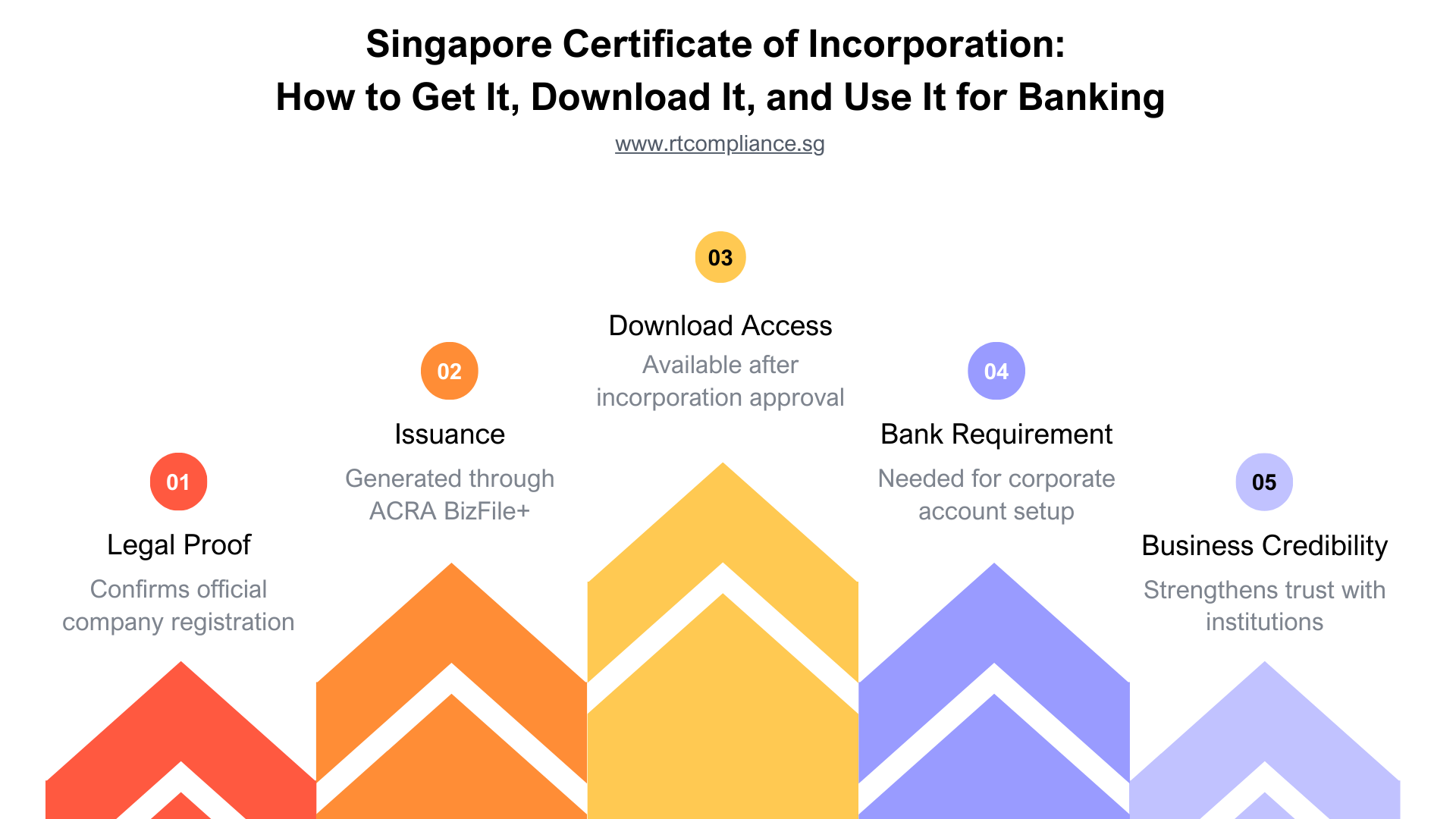
The best official evidence in Singapore that a business has been legally formed is the Singapore Certificate of incorporation. This is not just a mere formality. It is the legal assurance of a company being registered as per the Companies Act and being identified by the Accounting and Corporate Regulatory Authority (ACRA). Upon its issuance, it gives the business entity legal standing upon the fact that it is now a legal corporate body and is free to operate on its own within the framework of the Singapore law.
The Singapore Certificate of incorporation. comes into focus more particularly as the business companies start transacting with banks, investors, regulators as well as commercial partners. To give an example, it has been seen that many businesses that have been incorporated recently find it impossible to open a corporate bank account without producing this certificate. In the same fashion, government licensing bodies and the payment service provider often insist on the certificate as a way of verifying the company. This document can also be required by even an overseas counterpart before the sign of a contract, granting of supplier accounts or even cross-border transactions are undertaken.
In reality, the certificate is a bedrock document that is re-used many times during the life cycle of the business. It is commonly needed when the business is facing some critical milestone like fundraising, bank onboarding, venturing into regulated business and trade partnerships across borders.
In this article, a detailed description of the Singapore Certificate of Incorporation has been given, which includes:
- The nature of the Singapore Certificate of incorporation and what it means in legal terms.
- The issuance of the certificate by ACRA on the post-registration of companies.
- How to download and get the certificate of BizFile+.
- The reason why banks need it when opening corporate accounts.
- The use in bank and financial compliance processes.
- Other practical applications, such as licensing, contracts and investment transactions.
- Issues that are common to companies and how to avoid them.
- Corporate document management after incorporation best practices.
At the conclusion of this paper, entrepreneurs and foreign investors will discover the reason why the Singapore Certificate of Incorporation is not a mere administrative product. It is among the most prerequisite documents of corporate credibility, legal identity, as well as operational readiness in the highly regulated business world of Singapore.
What Is the Singapore ACRA Certificate of Incorporation?
Singapore Certificate of Incorporation is a government issued document that proves the successful incorporation and registration of a company in Singapore. It is given out by ACRA when an application of incorporation of a company is approved on BizFile+.
This is a certificate which, legally, goes to show that the company is a corporate entity under the law of Singapore. The process of incorporation makes the business a person who is independent of its shareholders and directors. It is this principle of distinct legal personality which contributes to the basic principles of corporate law because it guarantees that the company is able to act on its own and accept legal responsibility in its own name.
To the point, the certificate affirms that:
- The company is incorporated by the Companies Act.
- The company is registered legally with ACRA.
- The company has become a legal corporation under the Singapore government.
The company is legally able to operate, trade, enter into a contract and own assets
This is usually the first document that is produced by many business owners as evidence that legally their business is in place. The need of both local and foreign operations becomes inevitable since it is generally accepted as a genuine corporate record.
Even though the incorporation certificates of Singapore are usually given in electronic format, the document is legal and legally accepted by banks, investors, licensing authorities, and business partners around the globe.
Who is the Issuer of Singapore Certificate of Incorporation?
Accounting and Corporate Regulatory Authority (ACRA) issues Singapore Certificate of Incorporation and is the official regulatory body that is mandated to:
Incorporation and registration of business in the company.
- Corporate monitoring on compliance.
- Reporting and registering of company data.
- Recording of the companies in public.
- The implementation of the Companies Act and the regulations.
ACRA operates under its online platform called BizFile+ that is the official electronic filing system of the company registration and statutory compliance related issues in Singapore.
Upon BizFile+ successfully receiving and approving a company incorporation application, ACRA automatically gives rise to and issues the Certificate of Incorporation. It is to guarantee that the document is official and verifiable and registered in the national corporate registry.
The documents given by ACRA have a great legal force due to the fact that it is a government authority. That is why the Certificate of Incorporation is considered to be one of the central corporate identification documents in the banking and compliance.
What Is Contained in the Certificate of Incorporation?
The Singapore Certificate of Incorporation has key information that verifies the identity and the status of registration of the company. These are the essential details as they are used by banks and regulators to check corporate legitimacy.
How to choose Company Name
The certificate contains the complete legal name of the company as registered. This is accompanied by the legal suffix, bearing which is: Pte. Ltd. which signifies a limited company that is privately owned.
The company name is usually demanded to be identical in all documents supporting by banks and counterparties. Any minor inconsistencies will result in delays in approvals in the banking.
What is Unique Entity Number (UEN)?
Individual business identification number in Singapore is called Unique Entity Number (UEN). All registered entities are given a UEN which becomes the permanent identifier of the company in official transactions.
The UEN is used for:
- Corporate banking
- Tax filings with IRAS
- CPF employer registration
- Application of business licenses.
- Submission of grants by the government.
- Regulatory reporting
The UEN is a significant corporate identifier in Singapore since it is unique.
Date of Incorporation
The certificate has the official date of incorporation. This is an important date in that it decides:
- The legal beginning of the company.
- Company adherence schedules.
- Deadlines of filing annual returns.
- Financial obligations at the end of financial year.
- The benefit of some government incentives.
Incorporation dates are also checked by many banks to determine whether the company is new or has a long history of operations.
Company Type
The certificate generally indicates the structure of the company, like:
- Pte. Ltd. is a Limited Liability Company, which is privately owned.
- Public Company
- Limited by Guarantee Company.
The classification has an impact on the regulatory reporting requirements as well as compliance obligations of the company.
Official Authentication
The certificate also possesses official authentication functionality that is provided by ACRA. This is commonly reflected in electronic certificates in digital form of verification, as opposed to physical stamps.
Singapore is one country whose electronic corporate documents are accepted and recognized in the international arena and so most banks do not need a hardcopy of the same; they can accept a digital copy.
The Singapore Certificate of Incorporation and the significance of the same to banking
Corporate banking is one of the most useful and significant applications of Singapore Certificate of Incorporation.
In the event that a firm wants to open a corporate bank account in Singapore, banks expect one to provide official documents to ensure that the firm is established and has the right to do business. This belongs to the tight system on anti-money laundering (AML) in Singapore, and international compliance requirements including Know-Your-Customer (KYC).
Banks must ensure that the firm:
- Is officially incorporated
- Has a legitimate corporate identity.
- Registered in Singapore law.
- Is not a fake or nonexistent party.
- Has a registered registration in ACRA
This is the proof that is given by the Certificate of Incorporation. It is among the initial documents that banks require when opening corporate accounts since it establishes legal existence in a non ambiguous and standardized manner.
In the absence of the certificate, a bank will not be able to move on to onboarding since it does not have any proof that the company has a legitimate legal basis.
Business Profile vs Certificate of Incorporation: Banks Preferred Documents
Most entrepreneurs believe that corporate banking only requires the Singapore Certificate of Incorporation. The fact is that, additional ACRA documents, most famously the Business Profile (also called the BizFile extract) are frequently needed by banks.
Certificate of Incorporation
The certificate proves:
- Legal incorporation
- Registration confirmation
- Incorporation date
- UEN
- Company name
ACRA Business Profile
The Business Profile includes information that is detailed as:
- Registered office address
- Code of business activity (SSIC code)
- Paid-up capital
- Shareholding details
- Director details
- Company secretary details
- Status of the company (active, dormant, struck off).
The two are necessary in banks since they do not just need evidence of existence but also of ownership and management.
- The Certificate of Incorporation is evidence that the company is a reality.
- The Business Profile is an evidence of the owners of the company.
Application of Singapore Certificate of Incorporation
Singapore certificate of incorporation is automatically acquired after the incorporation process has been approved by ACRA. This implies that the owners of a business would not have to make another application in order to obtain the certificate as long as the incorporation application has been done successfully.
The certificate however can only be granted when the company is incorporated.
The process of obtaining the certificate is as follows.
Step 1: Book and Instal the Name of the company
The name of the company should be registered by ACRA before incorporation.
ACRA checks the name proposed to them to make sure:
- It does not correspond to an existing thing.
- It does not violate trademarks or limited terms.
- It lacks any banned or indecent language.
- It does not imply that the government should be affiliated without permission.
Certain business names might need to be referred to other agencies, particularly where those are in the regulated spheres like finance, education, law or healthcare.
After the name gets approved, it is held in an interim fashion and the company is then allowed to be formally incorporated.
Step 2: Get ready Incorporation Details and Statutory Requirements
Incorporating a company in Singapore normally needs the following information:
Shareholders
A Singapore company shall have minimum of one shareholder. Shareholders can be:
- Individuals
- Corporate entities
The foreign shareholders are permitted and one hundred percent foreign ownership is permitted.
Directors
One of the directors should be a Singaporean resident. This director can be:
- A Singapore Citizen
- Singapore Permanent Resident.
- A local address Employment Pass holder.
- A reliant pass holder (in others).
It is also possible to employ foreign directors, although at least one resident director has to be in place, too.
Company Secretary
Singapore law states that companies have to have a qualified company secretary within six months of incorporation.
The company secretary has a significant role that is playing by ensuring that the company is compliant, meets the filing deadlines and keeping of corporate records.
Registered Office Address
A local Singapore address should be registered in the company. This speech is also official correspondence and should be available within the working hours.
Paid-Up Capital
Singapore permits incorporation of a minimum capital of S$1 paid-up. Nevertheless, companies have options of setting up larger capital bases to enhance the demand of banking, investor confidence and Tender qualification.
Company Constitution
A constitution is required. It stipulates regulations of governance, rights of the shareholders, powers of directors and procedures in the corporation.
Step 3: Applicant: File the Application by BizFile+
After preparing all the incorporation information, they make the company registration application with the help of ACRA BizFile+.
The application includes:
- Approval of name reservation of the company.
- Shareholders and directors information.
- Registered office address
- Constitution confirmation of the company.
- Business activity details
- Information on capital structure.
The application is then scrutinized by ACRA. Approval can be given fast, in case there are no regulatory problems.
Step 4: Issue of the Certificate of Incorporation
Once it is approved, ACRA provides the Singapore Certificate of Incorporation electronically.
It normally generates the certificate on the spot and it can be downloaded through BizFile+.
At this stage the firm is already legally established and is registered under the Singapore law.
The Singapore Certificate of Incorporation can be downloaded in the following way
After incorporating a company, the certificate will be available to download using the portal of ACRA: BizFile+.
The certificate is usually given in electronic PDF
An authorized individual has to download it by using BizFile+ with SingPass or CorpPass credentials. This is often done by:
- Company directors
- Providers of corporate secretarial service.
- Registered filing agents
The certificate can be downloaded and stored after access, and used as internal corporate records
The certificate is often used by many companies in storing in several secure locations due to the fact that they are often needed to:
- Bank onboarding
- Licensing submissions
- Registration of business accounts.
- Multinational corporate documentation.
Is It possible to re-download the certificate when you lose it?
Yes. The certificate may often be re-retrieved on BizFile+.
The system of Singapore has been structured in such a way that incorporation records exist in ACRA and, therefore, companies can be able to get official copies even several years after incorporation.
The reason behind this is that the certificate can be requested by banks or regulators many years after the establishment of the company.
Is the Digital Certificate of incorporation legally valid?
Yes. The Certificate of Incorporation of Singapore can be legally considered valid even when it is in its electronic form.
Singapore has a contemporary electronic system of corporate governance, and the documents that are issued by ACRA under the BizFile+ are legally binding.
Electronic versions are generally accepted by banks, other investors, and even the regulators in Singapore without physical stamping.
Nevertheless, a few foreign counterparties might also demand certified copies or notarized ones based on the jurisdiction.
Is it possible to order a hard copy of a certificate of incorporation?
The default format used in Singapore is electronic although companies can also demand certified extract or printed copies in case they need them internationally.
The PDF certificate suffices in most instances in:
- Singapore banks
- Domestic compliance regulations.
- Licensing and submission of regulations.
In international business dealings, organizations may decide to certify or notarise documents in order to comply with the foreign law. The use of the Certificate by the banks when opening accounts of companies.
The Singapore Certificate of Incorporation is one of the main verifications used by banks
When opening a corporate account, banks will have to ascertain:
- The company is a registered one.
- The name of the company is correct and so is the UEN.
- The date of incorporation is legitimate.
- The organisation is not disbanded or cancelled.
The certificate facilitates these checks and enables banks to carry on with ownership checks, risk assessment and compliance reviews.
Standard Banking Requirement with the Certificate
Banks normally demand in addition to the Singapore Certificate of Incorporation:
- ACRA Business Profile
- Constitution of the company
- Account opening board resolution.
- Directors and shareholders identification documents.
- Documentation of address of residence.
- Evidence of business operations (contracts and invoices, web site, business plan)
Banks can also demand favourable ownership reports particularly that of foreign owned entities.
The Reasons why Banks Need these Documents
Singapore is an international financial centre. This is the reason why the financial institutions have to be under stringent regulations to avoid:
- Money laundering
- Terrorist financing
Shell company activity Fraud Shell companies Shell companies commonly act as fronts for fraudulent financing through shadow bank networks.<|human|>Shell company operations Fraud Shell companies Shell companies Shell companies are often used as fronts in fraudulent funding via shadow bank networks.
Illegal fund flow and tax evasion
The first item in proving that the business is legitimate and is recognized by the law is the Certificate of Incorporation.
Additional applications of the Singapore Certificate of Incorporation
In other areas of operations other than banking, there are numerous operational and legal applications of the certificate.
Business Licensing
There are some business activities which are subject to license such as:
- Food and beverage business.
- Financial services
- Employment agencies
- Education providers
- Travel agencies
The certificate is frequently demanded by the licensing authorities as evidence of legal registration.
Investor and Funding Requirement
During due diligence, investors usually insist on incorporation documents. The certificate will be necessary in most cases when:
- Raising venture capital
- Grant applications to the government.
- Issuing shares to investors
- Conclusion of shareholder agreements.
Contractual Agreements
Before entering into contracts, the commercial partners might insist on the certificate. This is especially common in:
- International trade
- Supplier onboarding
- Government tenders
- Company purchasing systems.
Immigration and Work Pass Applications
The certificate can be needed to demonstrate the existence of a company and ability to sponsor employment in case of Employment Pass (EP) or other work visa applications.
Corporate Service Accounts
Before authorizing business accounts, service providers like payment gateways, logistics providers, cloud providers and merchant processors might need incorporation documents.
Checking a Singapore Certificate of Incorporation
Acra records can be searched to determine the existence of a company by third parties.
Separate checks by banks and investors are often done to ensure that:
- The company is active
- The UEN is equivalent to official registry records.
- The business has never been liquidated.
- The information provided by the company is consistent with what is being submitted.
- Such verification is significant as it minimizes fraud and builds the confidence of the corporate environment in Singapore.
Best Practices of the Certificate Management after incorporation
The Certificate of Incorporation should be regarded as a fundamental corporate record of companies.
Best practices include:
- Keeping the certificate in digitized safes.
- Keeping multiple backups
- Getting certified copies to be printed in case overseas transactions are to be made.
- Making the certificate available to the banking and licensing requirements.
- Keeping current Business Profiles and certificate.
Effective document management minimizes time wastage in the bank onboarding, audits and due diligence processes.
The reason why Foreign Entrepreneurs need to take an additional step
Singaporean banks tend to be more strict in checking the business owners who are foreigners. This is not a discriminatory act but rather risk assessment of compliance.
Banks may request:
- Business plans
- Source of funds evidence
- Evidence of foreign ownership of business.
- Real operations shown in contracts.
- Advisory on beneficial ownership.
In this situation, the Singapore Certificate of Incorporation will be the major starting document, and further documentation is usually required.
Foreign founders ought to be ready early enough to prevent setbacks.
Schedule: Time necessary to issue the certificate?
Immediately incorporation approval is made, the certificate is issued.
In most standard cases:
- Approval of names can take minutes to 1 day.
- The process of incorporation can be completed in a few hours.
- Upon approval, the issuance of certificates is instant.
Nevertheless, when an application is forwarded to other authority, it may take days or even more.
After the approval, the certificate is normally created immediately via BizFile+.
Expenses of Acquiring the Certificate
The process of incorporation itself entails the certificate. Costs typically include:
- Name reservation fee
- Incorporation filing fee
- Certified extracts or supplementary ACRA reports costs which are optional.
- Fees of a professional service provider in case of a corporate service provider.
Majority of the entrepreneurs receive the certificate free of additional charges other than incorporation, unless they demand certified physical copies or extra business extract.
Conclusion
One of the most important documents, which are issued upon successful registration of a company, is the Singapore Certificate of Incorporation. It is official evidence that the company is legally incorporated according to the Companies Act and the ACRA regards it as a legal corporate entity.
This certificate is particularly significant to business owners as they are needed to open bank accounts of corporations, and to license, sign commercial contracts, onboard payment systems, and investor due diligence. It is a fundamental corporate document which makes credibility, regulatory legitimacy and operational preparedness in Singapore.
The knowledge of obtaining the certificate, downloading it in BizFile+, and getting it to work efficiently in banking would make the business start-up process easier and minimize the time loss in the compliance checks.
Finally, Singapore Certificate of Incorporation is not merely a legal document. It is an important working document that allows an organization to operate in the global respected business environment of Singapore.