
Singapore Company Incorporation Requirements: Complete ACRA Registration Guide for New Businesses
Introduction to Singapore Company Incorporation Requirement
The first step in setting up a legal corporate presence in Singapore which involves understanding the requirements in singapore incorporation is one of the most important steps that entrepreneurs, investors and foreign business owners ought to make before establishing a legal corporate entity in Singapore. Although Singapore is known to have a good business climate and quick incorporation process in the world, incorporation is not an administrative filing. It is an official process of the law that is controlled by rigid rules and legal requirements.
Most founders believe that all they do during the registration of a company is to fill a form on the internet and be given a number of registration. Incorporating in Singapore is however controlled by the Companies Act and as administered by the Accounting and Corporate Control Authority (ACRA). This is because of the fact that business entities have to meet certain structural requirements, disclosure requirements and in addition, they have to make formal legal documentation before they can become recognised into existence as a separate corporate entity.
Non-compliance with these singapore incorporation requirements may result in rejection on the spot, failure to get approval on time or long-term compliance implications which could impact on licensing, banking, taxation and corporate governance. That is why copying the registration is crucial not only to succeed in registration but also be a credible company within the strictly regulated Singaporean corporate environment.
The following has been extensively broken down in this article:
- singapore incorporation requirements and legal basis.
- company incorporation needed documents and their legal operation.
- company incorporation forms needed to be filed under ACRA.
- the objective of the singapore company incorporation documents to the long-term compliance and governance.
At the end of this guide, the reader will know not only what it takes to incorporate in Singapore, but why it takes those requirements and how they impact corporate accountability and business sustainability.
Singapore Company Incorporation Requirements Overview
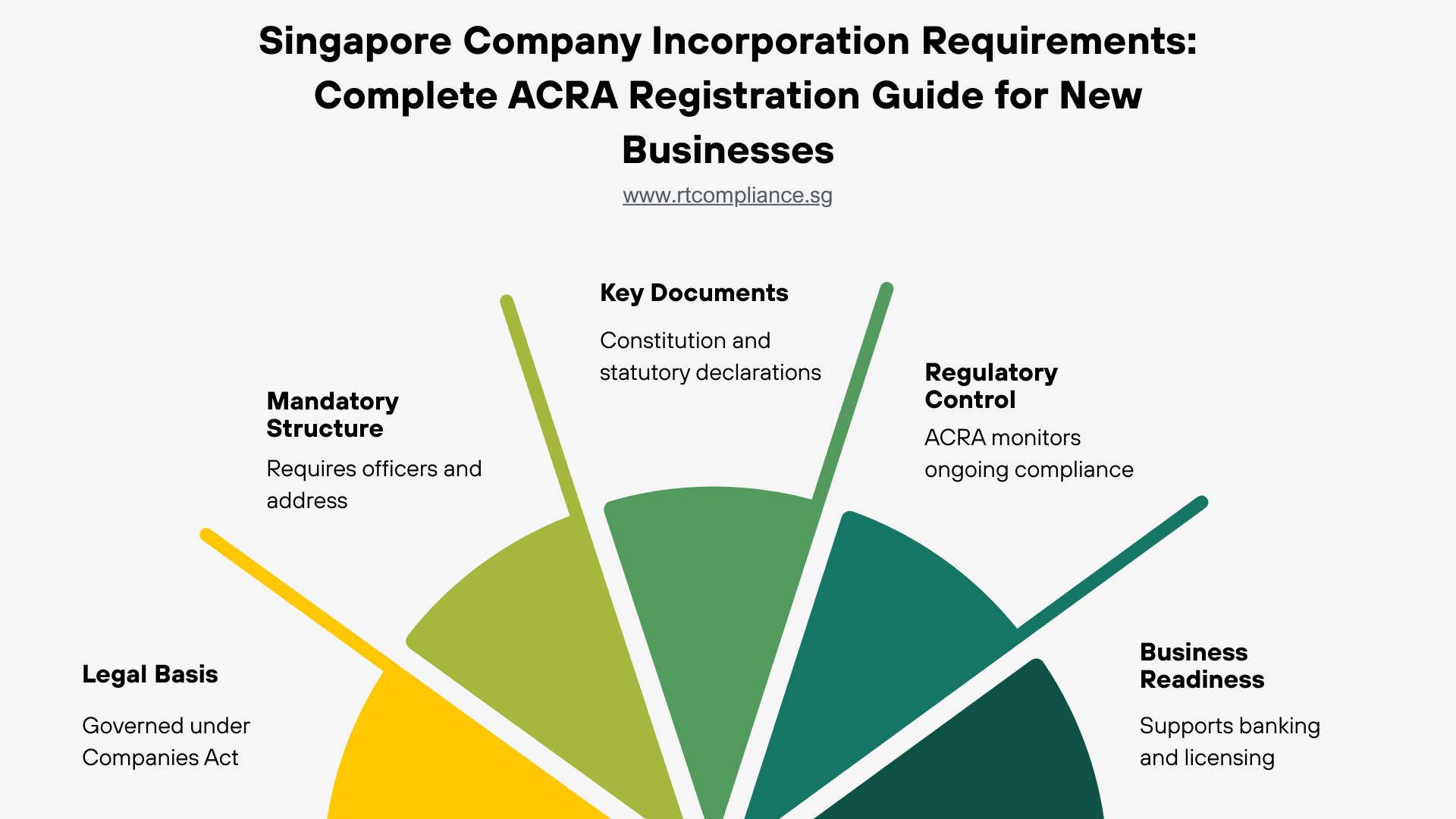
The basis of the requirement of incorporation of singapore is developed under the Companies Act and the ACRA. The requirements are aimed at making sure that all the incorporated companies are transparent, traceable and ruled by legally enforceable structures.
Singapore has a corporate system which is highly concerned with accountability. The incorporation structure is such that each company is owned by identifiable owners, has appropriately appointed officers and has a structured governance documentation that can be looked at by the regulators and stakeholders.
A firm that intends to incorporate in Singapore is required to meet structural and documentary requirements. These are the needs of both the local entrepreneurs and non-nationals. Its most important goal is to make sure that after incorporation, the company is a legal corporate entity with rights and responsibilities according to the Singaporean law.
The requirements related to the incorporation of singapore are usually:
- at least one shareholder
- one director ordinarily resident in Singapore.
- a Singaporean registered office address.
- selection of a competent company secretary.
- implementation of a constitution (previously referred to as Memorandum and Articles of Association)
- adherence to legal statements and registration requirements.
These are the minimum conditions that define whether the company can exist as a separate legal personality under the Singaporean law.
What are Singapore Incorporation Requirements?
A singapore incorporation requirements is the legal requirement that must be met before one can incorporate a company and be recognised by ACRA. Such requirements are applicable at registration point and are used in the course of the lifecycle of the company.
Singapore incorporation is not merely a registering affair. The legal process is that which turns a business idea into an autonomous business entity. Being incorporated, the company becomes independent, possesses property and liable under the law.
This legal change provides a distinct difference between:
- the incorporated company as an independent legal entity.
- the stockholders and the directors of the firm.
After completion of these requirements of incorporating a company in Singapore, the entity is recognised as a corporation. This means:
- the company is able to get into contract on its own name.
- the company is able to possess property and assets.
- the company will be able to open corporate bank accounts.
- the firm is capable of suing and being sued.
- the company is made liable to its own debts and liabilities.
This is the reason why requirements to incorporate are considered as primary legal norms and not alternative procedures.
Simple Incorporation Structural Requirements in Singapore
The significance of the singapore incorporation requirements is high because they introduce the compulsory structural provisions to all companies. These necessities are good governance, representation by law and accountability at the outset.
- Shareholders
There should be at least one shareholder, either a natural or a corporate person. The company is legally owned by the shareholders who own the company shares. - Directors
The directors should include at least one who is ordinarily resident in Singapore in order to have local accountability. Nominee directors can be used by foreign founders, however, the matter should be handled with care. - Company Secretary
The company is required to appoint a company secretary within six months after its incorporation so as to handle statutory compliance and filing. Failure to appoint one could attract penalties. - Registered Office Address
Each firm shall possess a registered office address in Singapore where it can be contacted. The speech should be a physical address and should not be a P.O. Box. - Company Constitution
The internal governance regulations like the shareholder rights and directors powers are stipulated in the constitution. Upon the adoption, it becomes legally binding to the company.
Documents to be incorporated in the company explained
The process of incorporation is very paper-intensive. Documents used in the incorporation of the company are the legal basis of the corporate and are a formal evidence that the company has been founded through legal means.
Identification and disclosure materials are the most common documents that are required in the incorporation of a company. These reports give ACRA a precise information regarding owners, officers, and internal governance organization of the company.
In reality, incorporation papers are not paperwork. They are some statements that are legal in nature and accountable. False statements can result in legal fines, denial of incorporation, or permanent business wrangles.
A well organized company incorporation file normally contains:
- director and shareholders identification documents.
- approach papers assuring of acceptance of roles.
- company constitution
- registered address details
- statement of share capital structure.
- appointment of officers and corporate specifics.
- All these documents are used to prove that incorporation process is legal.
Incorporation Documents of the Company as per the Singapore Law
Incorporation papers that are necessary in Singapore are not optional. The Companies Act requires them to be prepared and correctly in order to be incorporated.
The company constitution is one of the most significant legal papers. The constitution is basically the government contract which stipulates how the company will be governed internally. It stipulates the rights and duties of shareholders and directors, and decisional authority is developed.
After the adoption, the constitution is binding between:
- the company and the shareholders.
- the stockholders on their part.
This, renders the constitution as one of the most important documents to the incorporation of a company needed, as it has to influence the long term governance of the company, shareholder conflicts, and reorganization of the company.
The other major group of company incorporation documentation that is required is a set of statutory declaration and consent forms. The following documents affirm that:
- directors fulfill the eligibility criteria.
- ownership is agreed upon by shareholders.
- officers accept their roles
- Introduction of incorporation conditions has been fulfilled.
Such statements are legal commitments to the regulators. The provision of false information can result in the criminal liability or disqualification of directors.
Documents and Regulatory Oversight of Singapore Company Incorporation Documents
All incorporation of the company documents in Singapore are electronically registered using BizFile+ portal of ACRA. The company is registered in the official Singaporean public corporate registry once the incorporation has been approved.
This publicly available register ensures transparency and third parties like banks, investors, and business associates are empowered to confirm the existence and ownership of the company. This is one of the reasons why Singapore is trusted as an international corporate jurisdiction.
But when the company is incorporated, regulatory control is not terminated. The documents of singapore company incorporation are not expired during the lifecycle of the business. These reports can be discussed in:
- compliance audits
- licensing applications
- tax investigations
- shareholder disputes
- regulatory enforcement activities.
Due to this, incorporation documents are to be adequately stored, revised, and kept. Any company that does not keep proper corporate records can be fined, taken to task, or its image tarnished.
Relationship between incorporation requirements and Legal Identity
The main aim of singapore incorporation requirements is to incorporate the legal identity of corporate. Upon registration, the company is now a separate legal person. This implies that the company is no longer a company that is identical to its shareholders. Rather it is a separate legal person capable of rights and liabilities.
This brings about an absolute legal differentiation between:
- assets and liabilities of the company.
- the individual shareholder and director liabilities and assets.
This is one of the reasons why a bank, a regulator, and investors demand company incorporation required documents. These are documents that serve as evidence that the company is a legal entity that is legally permitted to transact.
Compliance with incorporation requirements enhances the legal base of companies, lowers the risk of operations, and increases their stability in the long-term.
Corporate Governance and Incorporation Requirements
Incorporation is not different to corporate governance. Rather, the management is initiated at incorporation. Most of the requirements in singapore incorporation are specifically tailored so that the structure of governance is in place at all times.
As an illustration, presence of a resident director would mean that there is local legal responsibility by an individual to oversee the activity of the company. In a similar manner, the statutory requirement of having a company secretary ensures that the company filings, statutory registers and other compliance requirements are handled professionally.
Corporate governance is also formalised in the incorporation documents. The constitution establishes voting rights, power of directors and modalities of making key decisions like issuance of shares or paying of dividends.
Companies that do not meet the incorporation governance requirements are likely to increase risks of:
- shareholder disputes
- exposure to director liability.
- regulatory penalties
- poor financial management
Incorporation therefore is not simply about the creation of a company- it is about the creation of an organisation in a legal form.
Use of Incorporation Requirement as a means of enforcement regulation
The other significant role of singapore incorporation requirements is that they are a form of regulation supervision.
Mandatory disclosure of ownership, directors and governance structures of companies at onset, will give the regulators an idea of who owns corporate entities. This is necessary in making sure that there is not misuse of corporate structures to make illegal use like to commit fraud, money laundering or nominee abuse.
The company incorporation forms compulsory establish an inflexible document that regulators may follow to establish responsibility. Directors, shareholders, and officers involved can be identified by the enforcement agencies in a very short time in the case of non-compliance.
This brings legal certainty and it is certain that the corporate accountability is enforceable under Singapore law.
Incorporation Documentation and Foreign Business Operations
The singapore company incorporation documents are also very important to foreign entrepreneurs since they are needed in international transactions and cross-border compliance of regulations.
Before issuing a company permission to:
- open overseas corporate bank accounts.
- sign cross border agreements.
- establish subsidiaries
- register trademarks abroad.
- seek business licenses in foreign countries.
Moreover, multinational corporations adopt incorporation documents to organize corporate groups effectively. Singapore is commonly held as a jurisdiction holding company and good records ensure that corporate forms can resist the international due diligence criteria.
The ability to meet the requirements of the incorporation of the foreign company in Singapore properly will boost confidence, minimize regulatory suspicion, and boost and expand the international market creditworthiness.
Strategic Importance of appropriate Planning in Incorporation
Even though incorporation is a legal necessity, there are also business strategic implications to it. The future growth potential of the company is determined by many of the decisions that it makes during incorporation.
To illustrate, decisions pertaining to shareholding structure include:
- brotherhood potential future fundraising.
- investor control rights
- appraisal and diluting the share holdings.
- dividend disbursement systems.
Likewise, the constitution may contain some clauses that secure founders, deal with the shareholders conflict, or even stipulate the exit strategies.
The companies that consider incorporation to be an exercise and not a formality are normally well prepared to:
- venture capital investment
- mergers and acquisitions
- corporate restructuring
- international expansion
Due diligence also includes investors and acquirers looking at incorporation records. A firm whose incorporation records are well held and up to date is usually perceived to be less risky and more investible.
Importance of Compliance of Incorporation Documentation
Company incorporation is serious business that needs documents which are not limited to company incorporation approval. These records are added to the legal record of the firm forever.
They facilitate continued compliance requirements like:
- annual return filings
- tax submissions to IRAS
- registration of statutory registers.
- shareholder and director reporting conditions.
The missing or errors in incorporation documents may lead to long-term complications. Indicatively, wrongful shareholding statements could cause legal wrangles during investment rounds. On the same note, a lack of provisions in the constitution can create confusion of leadership over decision making.
Correct incorporation documentation thus saves operation and legal expenses in the long run.
Possibility of Singapore Incorporation Requirements Non-Compliance
Non-observance of requirements of incorporating singapore might be subjected to severe legal ramifications.
The incomplete filings during inc incorporation may result in:
- denial of the application.
- prolonged processes of approval.
- further regulatory audit.
Inaccurate or misleading incorporation documents after incorporation may lead to:
- fines imposed by regulators
- director disqualification
- such legal actions as false declarations.
- dismissal or suspension of incorporation of a company
Besides legal punishment, non-compliance has a negative impact on corporate reputation. The banks, investors, and counterparties might not be willing to conduct business with companies that are poorly incorporated.
This has led to incorporation documents being professionally prepared which is sometimes regarded as a critical risk management practice.
Professional Corporate Service Providers and the role that they play in ensuring that the requirements of incorporation are met
Practically, a significant number of foreign entrepreneurs and first-time founders have difficulties in meeting the requirements of singapore incorporation, as the procedure is associated with the legal statements, legal frameworks, and high regulatory standards. Even though ACRA gives an efficient online filing system, incorporation still needs accuracy in documentation application, the appointment of officers, and organization of governance records to be done properly. This is the reason why corporate service providers of the respective profession have a great role to play to make sure that all the documents needed to incorporate the company are well prepared, verified and presented without any mistake.
The incorporation services are particularly sought after by the foreign business proprietors requiring nominee director services, registered office services, or constitutional drafting. In cases where such aspects are not managed properly then this may pose a long-term compliance risk particularly in cases where the business may request the facilities of a bank, a license or an investment financing. Through professional services, businesses may have confidence that the papers of incorporation of singapore companies are legally consistent, duly registered, and in line with the companies act requirements.
Besides this, corporate service providers assist companies to uphold their compliance after incorporation (annual returns, statutory registers, director resolutions, and secretary appointments). This generates a governance benefit in the long run since the legal base of the company is not shaky and can be audited. Thus, the cost of seeking professional advice is not considered often, as it is taken as a step to safeguard the legal identity of the company and the unproblematic regulatory position in Singapore.
Future Obligations of Compliance Board in Singapore
The requirements to meet the incorporation requirements in singapore do not cease when ACRA provides the company registration confirmation. The incorporation is the start of a corporate compliance lifecycle which will continue to exist as long as the company is there. When incorporated, the business is bound to statutory requirements like the annual returns, maintenance of current registers, preparation of financial statements and corporate changes are to be duly reported to ACRA. These are continuous duties and are closely connected with the company incorporation forms and documents required during registration like the company incorporation needed.
The precision of the documents of corporate incorporation of the singapore company is paramount in the future operations of the corporation like transfers of shares, appointment of directors, issue of new shares, or restructuring. When incorporation records are not complete or not consistent, this may lead to severe problems with banks, investors, auditors or regulators. To illustrate, an organisation whose shareholder documentation is not clear can be delayed when opening corporate accounts or raising capital. In a similar manner, the provisions of weak governance in the constitution may bring about legal uncertainty in the event of a dispute or in decision making at a board level.
The regulatory environment in Singapore is very transparent and enforcement based, that is, compliance requirement is high even to small private limited companies. Companies that consider incorporation a mere administrative task at the start-up level are usually punished in retrospect because of ineffective record keeping or submission of the statutory returns at the late stages. That is why, founders need to understand that the incorporation requirements in Singapore are directly associated with the long term corporate credibility. Effectual incorporation not only produces legal consent, but also an environmentally viable compliance framework, which has facilitated the growth of business, licensing preparedness, and investor confidence.
Conclusion
All the companies registered in Singapore have a legal basis that starts with adherence to the incorporation laws in singapore. These mandates are meant to provide transparency, accountability and corporate integrity in a very trusted corporate environment in Singapore.
The company incorporation preparation documentation, the company incorporation documents completion documentation as well as the maintenance of singapore company incorporation documents are not only administrative requirements. They are legal documents that are used to define corporate identity, corporate governance and corporate responsibility.
When these requirements are met, businesses would have a better chance of being approved, enhance the compliance preparedness, and establish a well-grounded system of long-term operational stability. The incorporation in the globally acclaimed business climate of Singapore is not a simple formality but the beginning of the corporate prosperity.