
Singapore Company Legal Identity: What It Means and Why It Matters for Business Registration
Introduction to Singapore Company Legal Identity
The incorporation business is two things about corporate establishment that are related to one another. To begin with, it is the lawful process of incorporating a business on a recognized system of regulations. Second, it is known as the professional services industry which helps the business owners to get the incorporation process done correctly, effectively and in a compliant manner. When the jurisdiction is like Singapore, where the corporate regulation is organized, very transparent, and its international legitimacy is highly respected, the procedure of incorporating a business is not only the administrative necessity, but also the critical event of the legal establishment which defines the way the business is going to be run, develop, and safeguard its stakeholders.
Singapore is commonly known to be one of the most business friendly environments in the world. This image is backed by the stable political system, effective corporate laws, well-developed financial system, and trusted legal system throughout the world. The ease of doing business in Singapore, however, does not imply that incorporation is a one-dimensional and smooth process. Although the registration of the company and the incorporation process may be carried out very fast, the process of incorporation is a grave legal procedure that determines the right and the liability of the corporation, rules of internal governance and credibility of the company in business.
Singapore has several professional service providers to assist in incorporation ecosystem who have specific roles to play in ensuring that incorporation process is legally valid and is optimized in terms of strategy. These include:
- Secretarial Firms of Corporations.
- Corporate secretarial firms refer to firms that provide corporate secretarial services and are categorized under business law.
- Corporate Secretarial Firms Corporate secretarial firms are firms that offer corporate secretarial services and fall under business law
Corporate secretarial firms happen to be some of the most critical participants of the incorporation ecosystem in Singapore. They should mainly help companies to comply with requirements of statutory requirements in the Companies Act. Incorporation services are also available in many corporate secretarial firms including preparing incorporation documents, filing them with ACRA and making sure that post incorporation services are met.
In addition to registration, the corporate secretarial firms offer constant services that include maintenance of statutory registers, preparation of annual returns, updating of corporate information, and ensuring that directors and shareholders adhere to legal security. The company secretary is a compliance-critical one that supports the governance and corporate accountability in Singapore and not a symbolic position.
Law Firms
Incorporation is the support of law firms mostly on legal risk and documentation grounds. Whereas, procedural filing and statutory compliance are performed by corporate secretarial firms, legal structuring services are frequently demanded by law firms during more complex incorporations such as:
- preparation of shareholder agreements.
- anticipating investment deals.
- organization of corporate groups and subsidiaries.
- legal advice on regulations.
- management of intellectual property ownership and transfer.
- making the contractual structures enforceable.
Incorporation planning is the key to conducting business activities in areas where a company requires venture capital investment, or cross-border growth, and the use of the legal advice.
Tax and Accounting Consultancy Companies
The accounting and tax advisory firms help to incorporate business by making sure that the business structure is tax effective and financially viable. Although incorporation is a legal entity establishment, tax advisors make sure that the financial form and structure of the company is in accordance with the corporate tax laws, accounting standards, as well as compliance requirements in Singapore.
Tax and accounting companies can recommend:
- paid-up capital strategy
- profit allocation planning.
- Prerequisites of GST registration.
- corporate tax incentive qualification.
- selection at the financial year-end.
- bookkeeping and audit requirements.
The tax incentives and business grants provided in Singapore usually have certain terms, and this aspect makes early tax planning a necessary element of incorporation.
Nominee Directors Service Providers
The nominee director services are especially useful to foreign entrepreneurs. According to the Singapore law, at least one director of any company ought to be ordinarily resident in Singapore. This is necessary to provide the company with a locally responsible person to take care of statutory compliance and regulation communication.
Foreign entrepreneurs without a Singapore resident director can use the services of the nominee director service providers who are mostly corporate service firms providing resident director services. Such nominee directors are selected to comply with the law, despite the fact that the business owners must know that directors are granted legal responsibilities and liabilities as under the Companies Act.
The services of nominee directors are usually combined with compliance monitoring mechanisms so that the company does not subject the director to any unwarranted legal risk. The nominee director providers therefore usually demand that the owners of the business must have clear records, sound accounting records and discipline in adherence.
The reason why Incorporation is more than just a mere filing
This is a common misconception among first time entrepreneurs that incorporation is simply a matter of filling forms with ACRA and getting a Unique Entity Number (UEN). Although the technical part is filing, incorporation entails far more than administrative registration. The establishment of a legal person with rights and liabilities is what will play a role in the future of the business.
A company is not just a name registered. It is an organized business vehicle that is lawfully run. Strategic decisions are necessary in incorporation in various aspects, such as the type of ownership, the governance, the rights of the shareholders, and the future investment planning.
Shareholding Structure
The allocation of shares is one of the initial choices in incorporation. The shareholding structure influences the ownership, voting rights, distribution of profits, and influence on the decision making of the corporation. Founders need to determine if the shares are to be allocated on an equal basis, on the basis of capital contribution or on the basis of strategic positions.
Moreover, shareholding structure also plays a decisive role in case the company is planning to raise capital. The investors will usually require transparency in the distribution of shares, rights of shareholders and documentation of ownership. Weakly formulated shareholding arrangements tend to cause disputes or barriers to investments in the future.
Rights Attached to Shares
The shares are not equally the same. Singapore permits firms to issue various shares of different classes and rights. These may include:
- voting rights
- dividend rights
- liquidation preferences
- conversion rights
- redemption rights
To businesses who have plans to bring in investors, issuing the various class of shares is a usual strategy in balancing the interests of the founder with those of the investors.
Appointment of Directors
The company is under the legal management of directors. Their responsibilities are to make sure that compliance is checked, good faith and serving the company interests. The appointment of directors is not only symbolic, the directors have serious legal obligations, and liability in the event of misconduct, non compliance or violation of fiduciary duties.
It is because of this reason that incorporation should be planned carefully in terms of:
- who will serve as directors
- the number of directors required.
- the need to have independent directors.
- what will be the governance policies to be used?
Corporate Governance Structure
Corporate governance is the rules, systems, and structure of managing and controlling a company. To a small privately-owned company, governance is significant as it instills accountability, lessens risk and allows business continuation.
The powerful governmental system can comprise:
- definitive separation between the role of directors and the role of shareholders.
- specified decision making processes.
- adequate record keeping and fulfilment in documentation.
- monitoring processes: compliance.
- internal financial controls.
Lack of discipline in governance has the tendency of creating inefficiencies in the running of the business, lawsuits or fines in compliance.
Imminent Capital Creation Plans
Incorporation has been taken as the initial step in the long term business development. Most of the companies integrate not just to be able to operate but also to be prepared to raise funds or collaborate or even be eventually acquired.
In case a business decides to issue capital in the future, the incorporation decisions would have to be in line with the investor expectations. For example:
- founder vesting restrictions might be necessary to investors.
- Issuance procedures of shares should be legally valid.
- equity distribution should be recorded in an open manner.
- early payment of shareholder agreements may be necessary.
Initial decisions to incorporate or not will either facilitate or limit the possibility to raise capital in the future.
The significance of incorporation among the foreign entrepreneurs
The incorporation business is particularly important to foreign entrepreneurs as Singapore has certain statutory requirements that would make the local accountable and introduce regulatory transparency. Despite 100 percent foreign ownership in Singapore, foreign founders are obliged to meet specifications, which could be easily met by the local entrepreneurs.
The need of at least one locally resident director is the most valuable regulation requirement. This is necessary to enable the company to have a person based in Singapore who is bound by law on the responsibility under the Companies Act. This resident director needs to be:
- a Singapore Citizen
- a Singapore permanent resident.
- a holder of Employment Pass and a local address of residence
Nominee director services are usually used by foreign entrepreneurs who are unable to meet this obligation. But nominee directors are not merely those that appear on the paperwork: they are individuals who have a legal duty and who can face the wrath of the regulatory laws in the event of failure by the company to abide by the laws.
That is why professional firms are very important in foreign incorporation ecosystem. The corporate service providers make sure that the compliance requirements are not accidentally breached by foreign entrepreneurs in a particular domain, particularly tax filing, annual returns, and statutory recordkeeping.
Businesses that are non-incorporated vs those that are incorporated
To fully enjoy the Singapore incorporated company meaning, there is need to carry out a structural comparison between incorporated and non incorporated forms of business. Most entrepreneurs believe that registering a business offers protection automatically as it is not necessarily the case. In Singapore, the law safeguards the business based on the business structure chosen.
The major distinction is whether or not the business is considered as a separate legal entity.
Sole Proprietorship
One of the business types is a sole proprietorship. It is individually owned and operated. It is not very complex to form and has less compliance, but does not offer legal separation of the business and the owner.
Key Characteristics
A sole proprietorship has:
- no separate legal identity
- full personal responsibility of business debts.
- poor capital raising capability.
- limited scalability
- reduced regulatory compliance requirements.
Incorporation of a Business: Legal Formation and the Professional Ecosystem
The incorporation business is a two-fold intertwined concept of the corporate formation. First, it is a legal process of establishing a firm according to an established regulatory system. Second, it means the professional services sector which facilitates the business owners in ensuring that the incorporation process is apt, effective and compliant. In a country like Singapore, where the corporate regulation is not only highly transparent and structured but also internationally acknowledged, the incorporation process is not only a technical administrative requirement but also a significant legal step, which defines the manner, in which the business will run and develop and how it will safeguard its stakeholders.
Singapore is prominently known as one of the business environments in the world that are friendly to business. A constant political system, well-developed corporate legislation, developed financial market, and a legal system that is trusted worldwide favor this image. But the fact that incorporation is a very easy and procedural process does not imply that incorporating in Singapore is a hassle-free process. Although the registration of the company can be rather fast, incorporation is a grave legal procedure according to which the rights, liabilities, internal control regulations, and business reputation of the company are determined.
The incorporation ecosystem of Singapore is underpinned with several service providers in the field of professional services, and they perform a specialized role in making sure that it is a legally valid process that is optimally tailored to the strategy. These include:
Corporate Secretarial Firms
One of the most necessary actors of the Singaporean incorporation ecosystem is corporate secretarial firms. They mainly help companies to comply with requirements in statutes as stipulated under the Companies Act. Corporation services are also offered by many corporate secretarial services including preparing incorporation documents, filing with ACRA and making sure the post-incorporation obligations are met.
In addition to registration, corporate secretarial companies offer continuing services including maintenance of statutory registers, annual return filing, corporate information maintenance and adherence to the law by directors and shareholders. The company secretary in Singapore is not another name, rather it is a compliance heavy, post that helps in the governance and corporate accountability.
Law Firms
Legal risk and documentation point of view is the main reason why law firms support incorporation. Whereas procedural filing and statutory compliance are done by corporate secretarial firms, legal structuring services are offered by law firms which may be necessary in more intricate incorporations, including:
- preparation of shareholder agreements.
- preparation of investment agreements.
- organizing corporate groups and subsidiaries.
- consulting about legal compliance.
- managing a property of intellectual property and transfer.
- making contractual structures binding.
Legal advice is an important part of incorporation planning to businesses wanting venture capital funds, or to invest in a privately owned business, or to expand internationally.
Tax Advisory Firms and Accounting
The accounting and tax advisory firm can help in incorporation by making sure that the type of business structure adopted is tax-effective and viable. Although incorporation is the process which makes the legal entity, tax advisors are also sure that the financial structure of the company has been adjusted to the rules of the corporative taxation of Singapore, accounting standards, and the requirements of legislation.
Tax and accounting firms can recommend on:
- paid-up capital strategy
- distribution planning of profits.
- Registration requirements-GST.
- eligibility to corporate tax incentive.
- selection at the end of financial year.
- audit and bookkeeping requirements.
The tax incentives and business grants offered by Singapore usually have conditions that must be fulfilled by companies and this makes early tax planning a fundamental part of incorporation.
Nominee Director Service Providers
Especially to foreign entrepreneurs, nominee director services are a very significant factor. According to the Singapore law, any company should have at least one director who should be ordinarily resident in Singapore. This is necessary to make the company have a locally responsible person to take the charge of statutory compliance and regulatory communication.
Foreign investors lacking a resident director in Singapore can use nominee director service firms, usually corporate service firms offering the services of resident directors. The nominee directors are introduced to meet the legal requirements but the business owners should realize that directors have legal responsibilities and liabilities as stated in the Companies Act.
The compliance monitoring systems are usually combined with nominee director services as this ensures that the company does not subject the director to unnecessary legal risks. Nominee director providers are therefore known to insist on business owners keeping transparent records, having good accounting records and discipline in keeping records.
The reasons why Incorporation is more than just a Form
The majority of first-time entrepreneurs believe that incorporation is the process of merely filing the documents at ACRA and being issued with a Unique Entity Number (UEN). Although filing is the technical part, incorporation is way beyond administrative registration. It is the birth of a law-making entity that has its rights and responsibilities and will affect the business throughout its existence.
A company is not a name that is registered. It is an organized corporate vehicle that is lawfully run. The incorporation involves strategic choices in various aspects, such as structure of ownership, governance structure, rights of shareholders, and future investment planning.
Shareholding Structure
A decision on the share distribution is one of the initial incorporation choices made. The shareholding structure influences the ownership, the voting rights, distribution of profits, and the ability to control corporate decisions. The founders have to choose whether to allocate shares equally, according to the shares of capital contribution, or according to the strategic position.
Moreover, shareholding structure is also very essential in cases where the company is planning to raise capital. The shareholders usually expect transparency in the distribution of shares, rights of the shareholders as well as documentary of ownership. Improperly designed shareholding schemes can result in the conflict in future or barriers to investment.
Rights Attached to Shares
Stocks are not necessarily the same. Singapore gives companies the option of issuing various classes of shares with different rights. These may include:
- voting rights
- dividend rights
- liquidation preferences
- conversion rights
- redemption rights
To businesses intending to get investors, the issuing different classes of shares becomes a typical resource to control the founders without compromising the security of the investors.
Appointment of Directors
Managers have a legal responsibility of running the company. Their responsibilities are to guarantee compliance, exercise good faith and safeguard the interest of the company. Director nomination is not something meaningless; directors really have a major legal liability and may be subjected to fines in case of misconduct, non-compliance or violation of their fiduciary obligations.
Due to this reason, incorporation takes planning seriously in terms of:
- who will serve as directors
- how many directors shall there be?
- need of independent directors or not.
- what policies of governance will be used?
Corporate Governance Structure
Corporate governance can be said to be the guidelines, mechanisms, and frameworks that determine how a business is run and governed. Governance is also significant even to small privately owned enterprises as it helps in promoting accountability, less risky and continuity of the business.
Good governance structure can contain:
- definite separation of roles between shareholders and directors.
- stipulated decision-making processes.
- appropriate documentation and record keeping.
- monitoring of compliance processes.
- internal controlling of finances.
In the absence of discipline in the governance, businesses usually experience inefficiencies in their operations, law suits, or punishment.
Future Capital Raising Plans
The first step in the long term business development is often incorporated. Most of the companies merge not only to conduct business within the law but to prepare to raise funds, alliances or to be acquired some day.
When a business decides to raise capital in future, the decision on incorporation should be in the line with the expectations of an investor. For example:
- founder vesting structures might be necessary to investors.
- procedures of issuing shares should be legal.
- shares should be recorded in an open manner.
- early shareholder agreements can be obliged.
The decisions made during incorporation, including incorporating or not incorporating future capital raising opportunities, slow down or facilitate future capital raising opportunities.
The Significance of Incorporation to the Foreign Entrepreneurs
The process of incorporation is of great importance in the case of foreign entrepreneurs since Singapore has certain statutory requirements aimed at making the local accountable and the regulations transparent. Though Singapore does not restrict foreign ownership, in case of foreign founders, Singapore has a number of requirements that must be met, which might prove difficult by foreign founders.
The need to have at least one locally resident director is the most crucial regulatory factor. This is necessitated by the fact that the company needs a person based in Singapore who has a legal responsibility to the company as stipulated in the Companies Act. This resident director shall be:
- a Singapore Citizen
- a Singaporean Permanent Resident
- a local residential address and Employment Pass holder
Foreign investors with the inability to meet this provision tend to use nominee director services. Nominee directors, however, are not mere names on papers, they are persons with the statutory liability of being subjected to regulatory actions in case the company does not observe statutory provisions.
That is why professional firms are an important component of the foreign incorporation ecosystem. Corporate service providers will ascertain that the foreign entrepreneurs are not unintentional in breaking compliance requirements, particularly in matters of tax declaration, yearly returns, and statutory records keeping.
Incorporated and Non-Incorporated Businesses
In order to have a complete understanding of the Singapore incorporated company meaning, some structural comparison of the incorporated business and non-incorporated business forms is required. Most entrepreneurs think that once they have registered their business it has become lawful and that is not always the case. The protection of the law in Singapore is determined by the type of business structure adopted.
The only difference is whether the business has been established as a separate legal entity or not.
Sole Proprietorship
One of the easiest types of business is a sole proprietorship. It is operated and owned by one person. Although it is simple to form and has less compliance obligations, it does not offer legal separation between the owner and the business.
Key Characteristics
A sole proprietorship has:
- no separate legal identity
- complete personal liability on business liabilities.
- inadequate capacity to attract funds.
- limited scalability
- reduced regulatory compliance standards.
Company Inc Meaning vs Singapore Pte Ltd
Most entrepreneurs are faced with international corporate terms like Inc. and they assume that it is an entirely different structure compared to that of Singapore (Pte. Ltd.). Indeed, these terms are based on various jurisdictions but they signify similar legal concepts.
Meaning of Inc
Incorporated has an abbreviation of Inc. It is more commonly used in the United States and other jurisdictions which follow the American systems of corporate naming. It means that the business is registered under the corporate law and can be considered a separate legal entity of its owners.
Meaning of Pte. Ltd
Pte. Ltd. is an abbreviation of Private Limited. In Singapore, the term implies that the firm is privately owned, a company incorporated in the Companies Act and limited by share.
Common Characteristics
Both the Inc. and the Pte. Ltd. usually denote:
- separate legal identity
- protection of limited liability.
- governance obligations
- share-based structure of ownership.
- continuity of the law outside the engagement of founders
Why This Matters
It is worth realizing that in cross-border contracts Inc. and Pte. Ltd. are equivalent. Under international agreements, corporate references are usually embedded like:
- incorporated in the laws of
- limited liability company
- corporate entity status
- registered corporation
A founder who misinterprets these terms can get the wrong contractual requirements and corporate powers or requirements.
Conformity and Post-Incorporation Governance
Although incorporation is associated with significant advantages, it also gives rise to continual statutory liabilities. Due to the perception held by many entrepreneurs, incorporation is a singular process. As a matter of fact, incorporation is where continuous compliance responsibilities commence.
Singapore is a country that is revered in the world due to its high corporate governance standards. The incorporated companies are required to keep accurate records and file on a regular basis.
This is the maintenance of Statutory Registers
The companies should keep statutory registers including:
- register of members (shareholders)
- register of directors
- register of secretaries
- register of charges (i.e. where applicable)
- beneficial ownership register (register of controllers).
Such registers may be changed in case of some changes, and they should be provided to the regulation.
Maintaining Reasonable Accounting Records
Business firms should keep proper records of accounting that portray financial transactions. To keep a proper record keeping is necessary in:
- corporate tax filing
- financial reporting
- audits (if applicable)
- investor due diligence
- bank compliance checks
The inability to keep adequate accounting records may result in fines and also affect the financial capability of the firm to raise funds.
Annual Returns with ACRA
All incorporated companies are supposed to submit annual returns. This is among the significant compliance requirements in Singapore. The filing of yearly returns indicates that the company is still operating and within the legal boundaries.
Failure to file in time may lead to penalty and even enforcement measures.
Turning in Corporate Income Tax Returns to IRAS
Businesses are required to file corporate taxes with Inland Revenue Authority of Singapore (IRAS). This includes:
- Submission of Estimated Chargeable Income (ECI).
- Form C or Form C-S Corporate income tax filing.
- subsidiary financial statements.
Tax compliance is vital as failure to comply may lead to fines, enforcement, and the negative publicity.
Hiring a Qualified Company secretary
The Singapore law obliges appointing a company secretary within six months of incorporation. The secretary makes sure that compliance is met and that corporate governance processes are supported.
The secretary will be in charge of:
- organizing board meetings
- keeping company documentation.
- filing statutory updates
providing advice to directors on compliance issues.
Non-Compliance Consequences
Non-compliance can result in:
- monetary penalties
- legal prosecution
- director disqualification
- strike-off of the company
- unpossibility of renewing licenses or banking relations.
Thus, incorporation encompasses the legal rights and the regulatory liability. Without complying with the corporate legal identity, a company cannot have the advantages of corporate legal identity.
Strategic Significance of Incorporation as a Growth and Investment
Incorporation is not the process solely based on the legal procedure, it is the base of the development. Singapore has a lot of business opportunities that entail the incorporation structure.
Raising Venture Capital
The venture capital investors normally insist on incorporation of the company as they invest by way of equity holdings. Sole proprietorship does not have shares, and therefore it is not suitable when it comes to equity investment.
A company that is incorporated is able to issue shares, establish classes of shares, as well as establish rights of investors as a result of a shareholder agreement.
Private Equity Investment Attraction
Corporate transparency, governance and legally binding structures of ownership are necessary in the private equity firms. Incorporated companies are more convenient to assess, reorganize, and purchase.
Investment in private equity may invariably entail:
- board representation
- shareholder rights
- dividend policies
- exit strategies
These aspects can only be exhibited in an incorporated structure.
Issuance of Different Share Classes
There are various types of shares that Singapore companies can issue e.g. ordinary shares, preference shares, etc. This enables founders to have control and also provides investors the financial safeguard.
The strategic benefit of incorporation is share class flexibility
Expanding Internationally
International expansion is facilitated by incorporation which offers a legal user-recognized entity to:
- signing foreign contracts
- establishing international bank accounts.
- establishing subsidiaries
- being a part of the international trade networks.
- Incorporated businesses are even more credible because of the reputation of Singapore.
Subcontracting Government Tenders
Most government tender and corporate acquisition systems involve the inclusion of bidders as incorporated companies. The reason is that incorporated entities present transparency and accountability.
Tapping into Tax Reliefs and Government Resourcing
Singapore offers tax incentives and business support programs, with most of them being offered to incorporated companies. This renders the process of incorporating, a gateway to government-sponsored growth aids.
Acquisition and valuation advantages
Valuation wise the incorporated companies are easier to evaluate since:
- ownership is well acknowledged.
- financial records are organised.
- the governance of corporations is traceable.
- liabilities are subtracted off the assets.
This renders incorporated companies more desirable acquisition targets. Incorporated entities are favored by buyers since they are able to obtain shares as opposed to assets that are purchased alone.
Conclusion
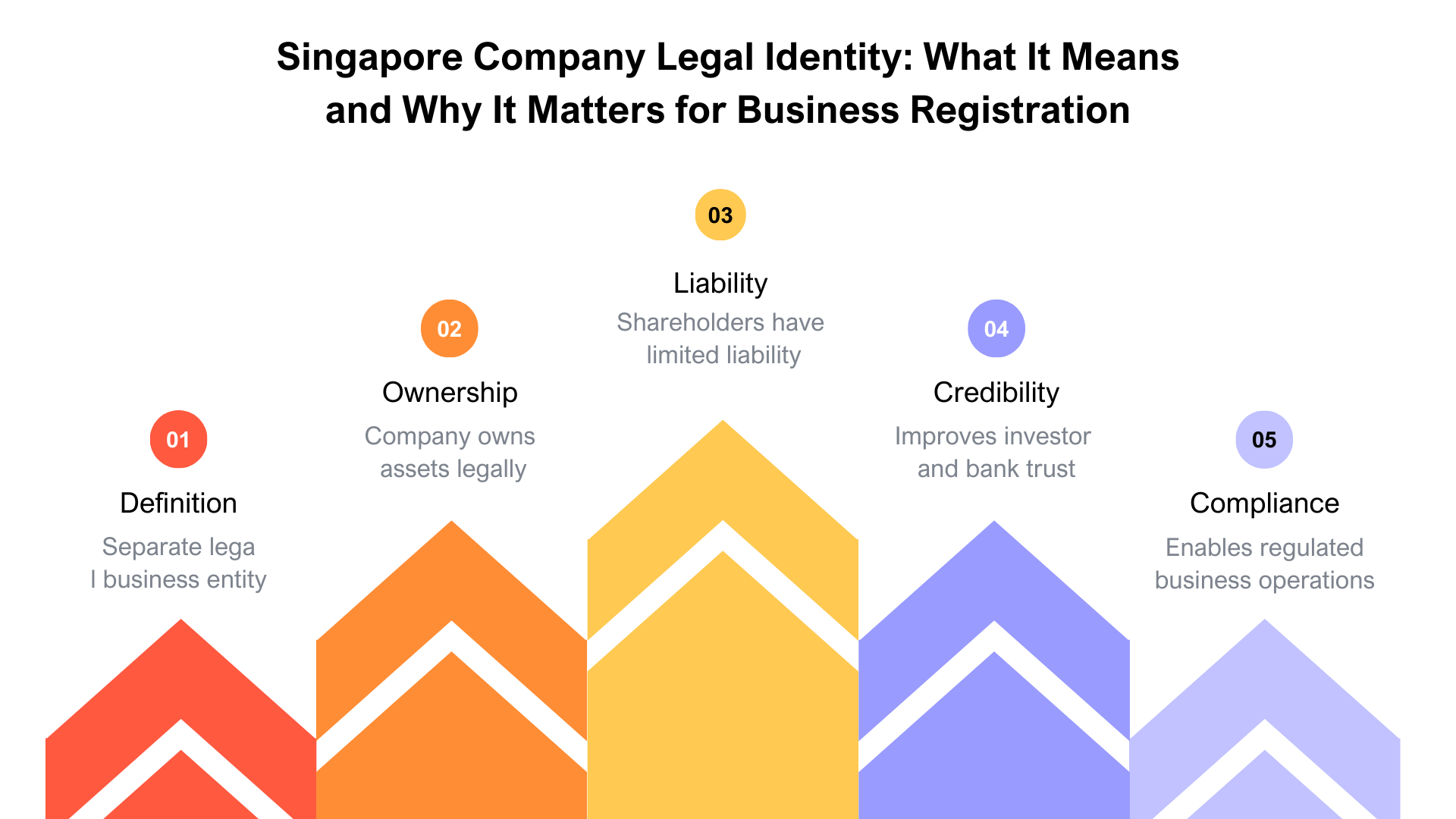
Singapore incorporated company meaning This is a legal meaning of incorporating a company that is a legally recognized corporate entity and has a separate legal personality and limited liability, and exists as a legal entity in perpetuity in the Companies Act.
Incorporation provides a business that is not dependent on its owners. It offers the benefits of legal protection, business credibility and continuity. The meaning of company inc and full form of company inc will explain the ways the incorporation works at Singapore and the international company frameworks.
Incorporation is not an administrative thing only. It creates the legal framework which ensures protection of owners, investment facilitation, increased credibility, and facilitates long term expansion. It also brings on board governance obligations, compliance requirements, and statutory reporting red tape which have to be met in order to retain the legitimacy of corporations.
Incorporation is not just a process that an entrepreneur, investor or a foreign founder follows to begin their entrepreneurial venture but rather the legal basis of creating a sustainable, scalable and compliant corporate presence in Singapore.