
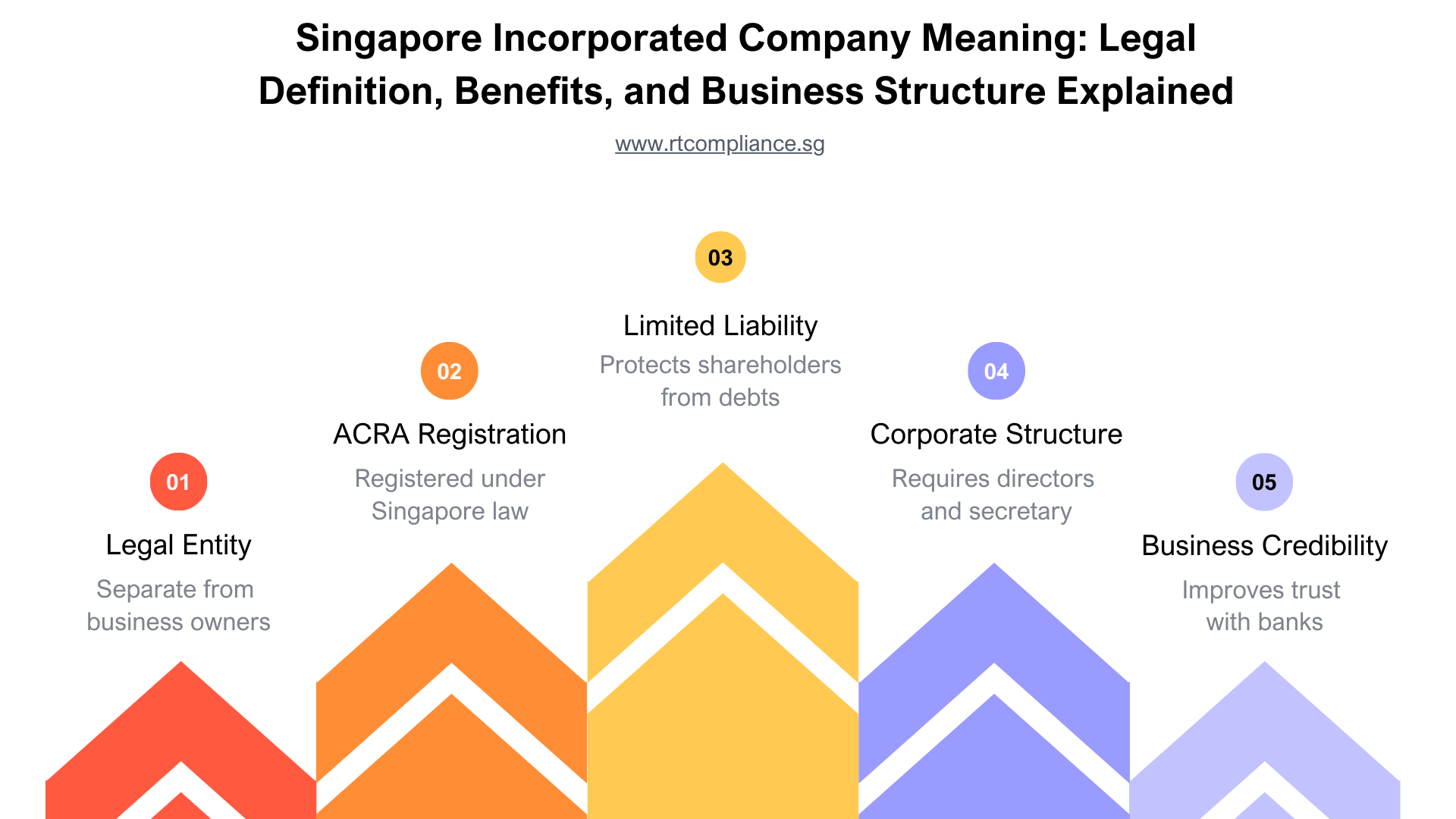
Singapore Incorporated Company Meaning: Legal Definition, Benefits, and Business Structure Explained
Introduction to Singapore Incorporated Company
The meaning of an Singapore incorporated company is crucial to the business owners, investors, and entrepreneurs since incorporation in Singapore is not just an administrative procedure of registration, but a legal change that establishes a new corporate body under the Companies Act and governed by the ACRA. Although most founders are concerned with such procedural things as incorporation dates, UEN, and nomination of a resident director, the actual importance is that incorporation gives the company its own legal personality separate of its shareholders and directors.
The legal status enables the company to possess property, be involved in binding agreements, open corporate bank accounts, employ workers, be licensed, conduct fundraising activities, and be involved in legal proceedings in its own name. Consequently, the meaning of incorporation has significant implications on the protection of liability, statutory compliance, taxation obligations, scalability and long-term business continuity and its lack of understanding by founders can lead to poor regulation compliance or led to a failure to abide by the Singapore corporate law.
Moreover, uncovering the corporate terms like company inc meaning, company inc definition and company incorporation date meaning is often faced by many businessmen when transacting business with foreign partners, international corporate documents, investment related transactions or a legal agreement involving multinational companies. These words do not merely represent technical jargon. They are fundamental legal terms that affect the ways businesses are run, the manner in which ownership is organized and the distribution of corporate liabilities.
This paper explains in detail the definition of an incorporated company in Singapore, the process of incorporation in corporate law, and has provided an insight into the applicability of the terms Inc. and incorporation date. It also writes about the legal, governance and business strategic value of incorporation. At the end, readers will have the answer as to why incorporation is not just a formality but a basis of establishing a credible and scalable business in Singapore.
Definition of Singapore Incorporated Company Meaning
Singapore incorporated company is a term used to describe a company that has been registered by the Singapore Companies Act and is registered by a body the Accounting and Corporate Regulatory Authority (ACRA). Upon incorporation, the company will have a separate legal personality, and that is, it will exist as an independent entity, notwithstanding its shareholders and directors. This individual legal entity is among the main principles of the corporate law in Singapore and the core of corporate rights and duties.
Practically, this legal status will enable the company to possess property, conduct corporate business, sign business contracts, employ, open corporate bank accounts, and pursue legal proceedings under its name. The ownership and management changes do not void the legal rights and obligations of the company. This distance between the company and its owners is very very useful to long term business structuring, risk management, and corporate governance particularly in Singapore where compliance and transparency are highly stood.
Statutory requirements of incorporation also include acceptable record-keeping, annual reporting, the appointment of directors and a company secretary, as well as the requirement to observe governance rules. Thus, not only a Singapore incorporated entity is registered, but it is legally formed as a legitimate and responsible corporate entity according to the Singapore law.
Company Incorporation into Law
The legal establishment of a business as a formally recognized corporate entity under the company law of a jurisdiction is what is referred to as company incorporation. In Singapore, the incorporation is regulated by the Companies Act and is managed by ACRA as the primary regulatory institution. This is a legal structure through which companies are established, regulated and how they have to adhere to corporate rules.
In Singapore, the incorporation process follows BizFile+ system of ACRA in which founders enter the company information including business name, directors, shareholders and constitution. Upon approval, ACRA gives a formal confirmation of incorporation and a Unique Entity Number (UEN), which will be the legal name of the company in all government transactions, taxation and corporate transactions.
Once incorporated, the firm is a distinct legal entity with the ability to be the owner of property, sign contracts, establish corporate bank accounts, and act as an independent entity apart from its shareholders. Incorporation also offers limited liability, such that generally the shareholders are not liable to the company debts outside their share capital. Corporate credibility and increase in trust with the investors, banks, and business partners are also higher in Singapore because of the strict standards of governance and compliance.
The company Inc Definitions and Its Application
The definition of company inc is normally linked with the symbol Inc. that means Incorporated. The term is quite common in such jurisdictions as the United States and Canada. It usually comes after the name of a company and it means that the company is a legitimate business and has been incorporated legally in that jurisdiction as a corporation under their corporate statutes.
Company inc meaning simply means a company, which has a formal incorporation and is legally established as a separate legal person that is not owned by individuals forming its part. A business included in the name with the suffix Inc. is an indicator that the company is registered as a corporate entity with protection of limited liability, legal separation, and governance. It is not mere branding that there is Inc. It is a legal position that has certain corporate consequences.
Limited liability is one of the greatest implications of the company inc meaning. Incorporating a company generally insulates the shareholders against being held personally liable by respect of corporate debts. Their risk is financial to the extent to which they contributed to the firm by way of capital (share capital). This principle promotes entrepreneurship since the business person will have less financial risk. It also promotes investment since the investors are made to become owners without any personal liability to the corporate.
The company inc meaning is very important to international business owners, as they allow to understand corporate documents, investment agreements, and contracts that contain corporate terminology in a foreign language. It makes it clear that incorporation results in a separate legal entity, whether the name of the company is terminated by Inc., Ltd., Pte. Ltd., or any other designation of a company defined by the jurisdiction.
Legal Implication of Incorporation in Singapore
Incorporation has direct legal implications which determine the manner in which a company is to run, the manner in which it is treated by the law as well as the manner in which the stakeholders relate with the company. These implications make up key component in the definition of Singapore incorporated company and it is the reason why incorporation is generally regarded as a necessity among businesses that want to be stabilized, credit worthy and secure in their risks.
The company is considered to be a legal person with its rights and liabilities that are independent of the owners. Certain repercussions of this legal status are liability exposure, contractual enforceability, ownership structure, and continuity of the business. It also defines the manner in which conflicts are solved, ownership of assets, as well as financial liabilities.
The major legal implications of incorporation are:
- Separate Legal Personality
- Limited Liability Protection.
- Perpetual Succession
Increased Capital Raising Ability
The company will be able to issue shares, reorganize the ownership, to attract investors and formalize shareholder agreements.
It is these legal implications which respond to why the meaning of Singapore incorporated company goes way beyond business registration. Incorporation creates a legal safeguard that separates individual risk and corporate risk. It also offers continuity on a long term basis, such that even when founders leave, there is a change of ownership or management, the business will still be running.
Nevertheless, these legal benefits have compliance requirements. A Singapore incorporated company is required to file annual returns, have statutory registers, prepare financial statements and adhere to the governance requirements. Any non-compliance may lead to fines, disqualification of the directors, and tarnished reputation or company may be struck off. Thus, incorporation is to be seen as one of the legal privileges, as well as a legal obligation.
Incorporation Date of Companies: Meaning and Legal Impact
The official legal date on which a business is registered and accepted by ACRA and mentioned in the incorporation confirmation of the company is the company incorporation date. This is significant as it is on this date that the company acquires a legal personality that is, the company can own property, enter into contracts and be liable by law. It is also an important base of compliance since a large number of statutory filing dates and reporting requirements in Singapore are determined by the date of incorporation.
The date of adoption has a number of legal and operational implications:
- Start of Legal Capacity
- Contractual Recognition Point.
- Deadline Reference of Compliance.
- Commercial Credibility Indicator.
Strategically, the company incorporation date meaning is also applicable since most grants in business, tax incentive schemes and government schemes of assistance demand minimum operational history. The official date in which incorporation has been done becomes the measuring rod of eligibility. Thus, incorporation date does not merely become a legal milestone but also a business resource that can play a crucial role in financing and formation of partnership.
Credibility in Terms of Incorporation of Business
- Director and Legal Appointment.
- Position of Company Secretary Requirement.
- Statutory Registers: Maintenance.
Financial Statements and Accounting Records
Accounting records should also be well in place and financial statements should be made to facilitate transparency and compliance.
These governance requirements are enforceable in the law. Lapse can result in fines, disqualification of directors or reputational harm. This shows that the disciplined corporate governance must always go hand in hand with the meaning of Singapore incorporated company. Incorporation is not a mere legal form but also an accountability-based structure of operation which is compliance-based.
Sustainability is also enhanced by corporate governance. Governance practices are one of the practices that investors and lenders consider prior to funding. A firm with proper governance is perceived to be less risky, more transparent, and well administered. Thus, the corporate governance requirements are perceived as the burden at times, but in fact, they are one of the key drivers of corporate growth and investment preparedness.
Incorporation and Long Term Business Strategy
Strategically, incorporation offers a base of expansion, growth and sustainability. The meaning of company inc and company incorporation meaning are not just the legal status, but the corporate structure that is needed to be scaled and ready to invest.
Incorporation promotes business strategy since it enables businesses to raise funds, reorganize ownership, indulge in mergers and develop continuity in the long-term. The Singapore incorporated company can have an upper hand in expansion than informal business structures mainly because it is in a position to operate under a system that is recognised by investors and banks.
Incorporation helps in enhancing long term business strategy through facilitating:
- Capital Raising based on Equity.
- Mergers and Acquisitions Prep Readiness
- Succession Planning and Continuity
- International Expansion Ability
The date of incorporation of the company is a very strategic date since it has been established that older companies are considered to be more stable and credible by investors and this minimizes risk. It may also have an influence on qualification of some grants and tax incentives in which there is a minimum age of the company.
Moreover, the Singapore corporate system is also geared towards global business which provides an access to a robust financial system, international tax treaty networks and a reputable legal system. This renders Singapore incorporation an ideal system to startups as well as multinational corporations venturing into Asia.
Further Discussion: Why Singapore Incorporation is an International Respected Organisation
A Singapore incorporated company has its fair share of significance in the international world of business. Singapore has a reputation of high enforcement of its regulatory frameworks, consistency of legal frameworks and business friendly policies making it to be a favourite jurisdiction of foreign entrepreneurs and multinational firms.
Transparency is one of the main strengths since ACRA has corporate records that enable investors, banks, and partners to ascertain the validity of the company within a short period. Singapore also has good legal enforceability as it has a well-organised judicial system which enables a contract to be enforceable and conflicts between parties to be settled through a fair court system. Moreover, the compliance standards are strict, which increases the credibility since the companies have to observe the governance, reporting, and filing requirements.
The incorporation in Singapore also enhances ease of international banking in that the financial institutions have great trust in Singapore entities. In general, it is not only a legal position but also an international reputation of reliability, transparency, and good governance.
The Meaning of the Role of ACRA in Singapore Incorporated Company
ACRA is instrumental in the definition of the meaning of a Singaporean incorporated company as it controls the incorporation, registration of corporate, and continued compliance. Under BizFile+, the ACRA approves incorporation applications and issues the UEN of the company, and such is the official identity of this company in business, government transactions, and legal dealings.
ACRA also keeps the corporate records like the directors, shareholders, address of the company, and the history of the filing which provide the credibility and transparency. Moreover, ACRA also places compliance obligations such as annual returns and statutory reporting and has power to impose penalties on or strike off non-compliant companies. This demonstrates that incorporation in Singapore cannot be a one-time process and it is a continuous legal status which is implemented through governance and compliance.
Popular Confusion Incorporation vs Business Registration
One of the widely spread myths is that incorporation is merely equal to business registration. Most entrepreneurs presume that by registering a name of a business, they have incorporated the business. This is not correct. Registration of business can be made on partnerships or on sole proprietorships that do not form a distinct legal entity. In such structures, the owner is the business and vice versa.
Incorporation, on the contrary, forms a distinct legal entity. This is the greatest difference in company incorporation meaning. Upon incorporation, a company has legal independence. It is able to hold property, have debts and to enter into contracts on its own name. The owners do not necessarily bear liabilities. This does not exist in non-incorporated structures as this legal separation does.
This is the reason why incorporation is popular in many professional businesses. It offers stability, protection of risks and credibility at long term. Sole proprietorships might be easier, however, they subject the proprietor to unlimited liability and do not offer the same benefits as the corporate structure.
Conclusion
The incorporation of company meaning of Singapore is much more than formal registration. The incorporation forms a distinct corporate body that has legal rights, responsibilities and protections under the Singapore Companies Act. It establishes a separate legal personality that is independent of shareholders and directors allowing the company to hold assets, form a contract, and transact, and incur its own debts and obligations.
Intimately connected ideas like meaning of company incorporation, definition of company incorporation, and meaning of company incorporation date, shed more light on the impact of incorporation on corporate personality, limited liability, compliance requirements, corporate governance issues, and the continuity of business at long-term. The three principles of the limited liability, perpetual succession, structured governance and regulatory accountability are based on incorporation.
The interpretation of Singapore incorporated company enables entrepreneurs, investors and business stakeholders to make sound decisions regarding the structuring of a business, compliance management and strategic growth planning. The legal and strategic basis of credibility, scalability, investment readiness and sustainable corporate achievement, incorporation in the globally admired Singapore corporate environment is not just a procedural outcome but a fundamental legal and strategic platform to build on.