
XBRL Filing Guide Annuals Report
Introduction to XBRL Filing Guide Annuals Report
Increased need of transparency, accuracy, and standardisation in corporate reporting have made regulators in most countries of the world enforce digital financial reporting systems. Annual report xbrl filing is one of the greatest advancements in this field as every company is now required to file their annual financial reports in a structured machine-readable format. This will help regulators and other interested parties to more effectively analyse financial data and also enhance comparability between entities and industries.
Annual report xbrl filing is not just a mere technical undertaking. It is one of the regulatory requirements that have a direct impact on corporate governance, management of compliance and the quality of financial reporting. Firms which are not able to comply with the XBRL filing criteria may receive submissions disallowance, fines or greater regulation. Therefore, familiarity with the regulatory intent, filing scope and implementation of annual XBRL reporting is vital to the finance professionals and decision makers.
This guide will fully explain the XBRL annual report filing which includes the regulatory intent, filing processes, challenges, governance factors, and long-term strategic value.
Knowledge Annual Report XBRL Filing
Annual report xbrl filing is a filing of the annual financial statements with eXtensible Business Reporting Language which is a globally recognised digital reporting standard. XBRL enables the tagging of financial data to standardised identifiers that identify the meaning of each item disclosed in accounting.
Compared to the archaic systems like PDF or paper reports, XBRL allows the financial data to be automatically processed by regulation systems. The data is made searchable, comparable and reusable through the annual report xbrl filing which enables regulators to perform automated checks and reviews of the data.
In the case of companies, annual XBRL reporting entails using financial statements that are in tandem with predetermined taxonomies provided by the regulators. All the elements of financial report such as primary statements and related disclosures should be correctly tagged to guarantee compliance.
The XBRL Reporting regulatory objectives
The major regulatory goal of the annual report xbrl filing is to enhance transparency and quality of data in financial reporting. Organized data enables regulators to identify discrepancies, risks in the financial sector, and adherence in a more efficient way.
The authorities can minimize the use of manual interpretations of financial statements by requiring XBRL reporting. This enhances efficiency in regulation and reinforces regulation in the markets. Comparability also increases as the same annual report xbrl filing is standardised making the companies operating in the same sectors comparable.
Moreover, electronic reporting promotes the wider regulatory programs, such as data-based supervision and information exchange across borders. These are the goals that render XBRL a pillar of the contemporary financial regulation.
Applicability and Scope Annual Report XBRL Filing
Applicability of annual report xbrl filing is based on jurisdiction-related regulations, size of the company and classification of regulations. XBRL-formatted annual reports are virtually mandatory to publicly listed companies. Mandatory XBRL reporting is also a requirement in large private companies in most jurisdictions.
It is imperative to know what is applicable as companies can be pulled into having to file annual reports xbrl because of change in the revenue thresholds, the health of the corporate restructuring, or the listing status. The inability to identify new requirements can cause them to be late or non-complaint.
Detailed guidance regarding the applicability of XBRL is usually released by regulators and thus it is necessary to keep the finance and compliance teams informed and review their obligations annually.
The Major Elements of XBRL Filing Process
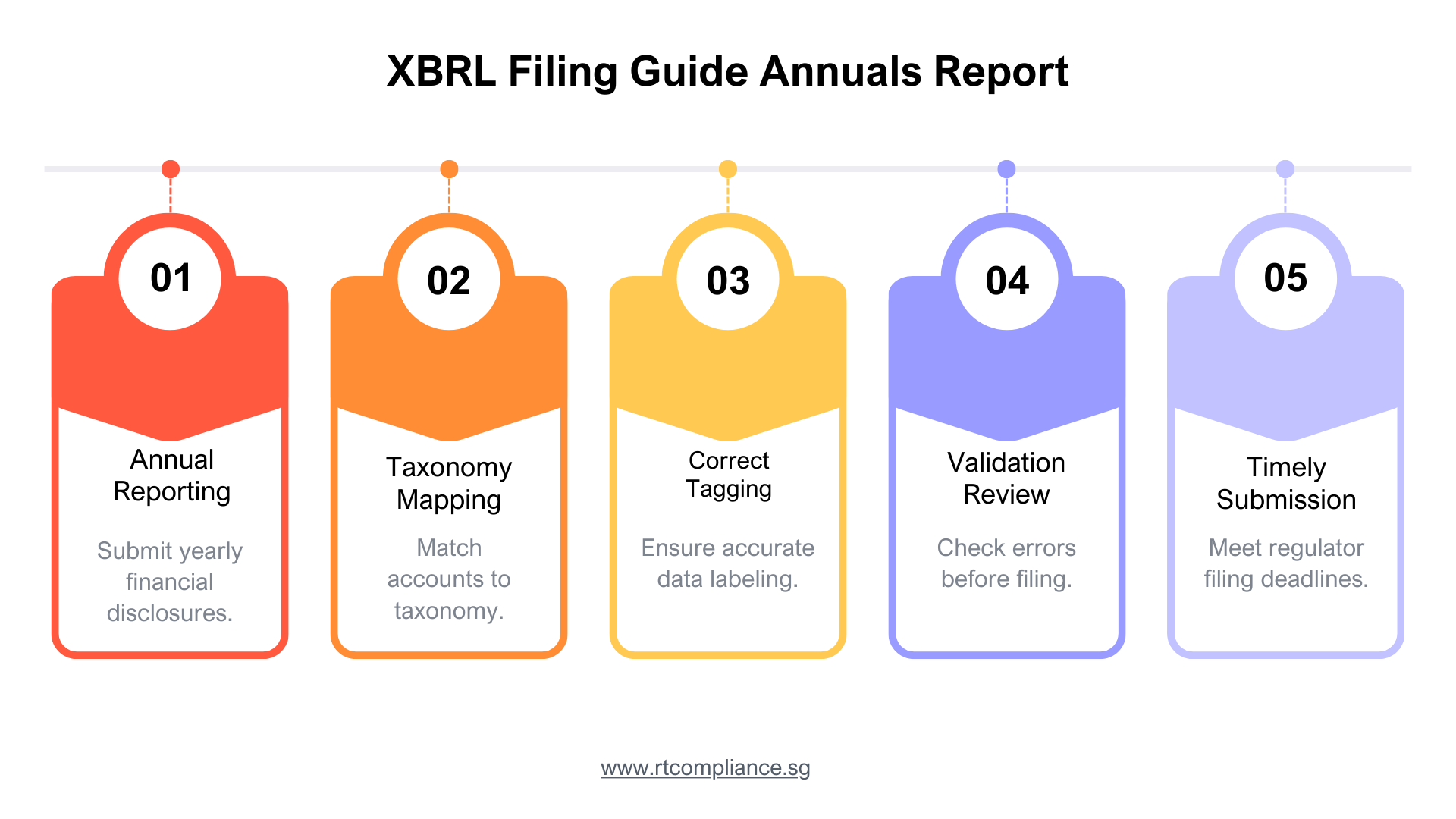
The xbrl filing process of the annual report is composed of a number of processes that are interdependent and demand accuracy and regulatory consciousness. This is commenced by selecting taxonomy to define the way in which financial data will be organized and interpreted.
After choosing the right taxonomy the financial statement items are mapped to the taxonomy elements. The tagging should be done correctly because the wrong mapping of the data is able to reflect the financial information even the underlying data is correct.
Annual report xbrl filing includes validation as one of its key elements. Regulatory systems provide automated control to check the data consistency, mathematical accuracy and correspondence to the reporting provisions. Regulators accept only the validated filings.
The last part is the submission via the official regulatory portal within a stipulated deadline. On time filing is equal to technical accuracy in obtaining compliance.
Ordinary Problems when filling Annual Report XBRL
Annual report xbrl filing has proven to be a challenge to most organisations despite its benefits in terms of regulation. Among the most frequent ones is the lack of internal expertise, especially when first-time filers that are not well-versed in the structures of taxonomies and rules of validation are involved.
The filing is also difficult due to complex corporate structures. The companies that have more than one subsidiary, reporting segments or international operation might have difficulty in maintaining the consistency in the data XBRL-tagged.
Another constraint is time. The XBRL preparation process can be hurried, or it is more likely to contain errors, when audited financial statements are prepared near to filing deadlines, thus, there are higher chances of the submissions being rejected.
Internal Controls and Governance
Good governance will facilitate good annual report xbrl filing. Digital reporting is a compliance risk area that boards and audit committees are increasingly aware of and that needs to be oversight.
The internal controls must be to assure the correctness, completeness and uniformity of the XBRL-tagged data. One of the critical control activities in the XBRL output is the reconciliation of the audited financial statements.
Effective governance and assistance of audit and regulatory reviews are achieved by clear documentation of the procedures of filing, the decision to tag and validation of the results. Effective governance structures minimize the compliance risk and increase the credibility of reports.
Integration and Audit and Financial Review Processes
The annual report xbrl filing is supposed to be closely related to the audit and financial review procedures of a company. To be reliable and acceptable by the regulators, XBRL-tagged financial information should be completely consistent with the audited financial statements. Any difference between XBRL disclosures and audited figures could cause validation error and cause concern during regulatory reviews.
Auditors are getting more and more dependent on structured information produced by annual report xbrl filing to determine financial regularity and completeness of disclosure. Consequently, coordination must be made early between finance departments, auditors, and compliance departments. By including XBRL preparation in the audit schedule, the chances of making changes at the last moment are minimal, and the quality of the filing would not be impaired.
Governance wise, xbrl filing annual reports in accordance with the audit mechanisms augment the internal control and the credibility of the reports. When XBRL compliance is incorporated into the audit procedures of companies, they are in a position to guarantee higher levels of financial integrity as well as to comply with the expectations of the regulators.
Technology use in XBRL Filing
Technology is a major element in efficient annual report xbrl filing. XBRL-based software will be used to automate the tagging, validation, and submission process, resulting in fewer people involved and less error.
Technology, however, does not ensure compliance. There should be proper configurations of the systems, and the user should know the regulatory requirements and the logic of taxonomy. Annual report xbrl filing can only be successful when there is coordination of technology, expertise and governance.
The system should also be updated regularly to suit the change in taxonomy and emerging regulatory policies.
Considerations of first time filing
The preparation that is usually necessary is first-time annual report xbrl filing. New organisations using XBRL reporting can fail to make the proper estimates of time and resources required to do proper tagging and validation.
A pre-filing gap analysis can be used to reveal disclosures that are not present as well as areas of compliance concern. Early interaction with experienced professionals can help a great deal in minimizing first year filing risks.
The creation of solid procedures in the first filing cycle brings a strong background to the latter reporting periods and enhances the efficiency of compliance in the long term.
Strategic non-Compliance Benefits
Annual report xbrl filing has strategic advantages though this is mainly a regulatory one. Formatted financial information enhances internal analytics, and the management is able to evaluate the trends of performance and compare the outcomes better.
Regular and proper reports increase the transparency of the corporation and create trust among regulators and stakeholders. Firms that have good XBRL adherence records also have reduced regulatory interventions.
With time effectiveness, the XBRL processes will lower compliance costs, as they will reduce the amount of rework, errors in filing, and regulatory correspondence.
XBRL Reporting Continuous Improvement
Adherence to annual report xbrl filings should be considered as a long term process and not a duty. Each filing cycle presents an idea of how the accuracy of tagging, efficiency of the process and control over governance can be improved.
The post-filing reviews enable organisations to know the recurring issues and improve internal guidelines. Ongoing observation of regulatory changes is done to make sure reporting does not become stagnant compared to the existing requirements.
Continuous improvement culture enhances compliance resilience and equips organisations in terms of regulatory developments in the future.
Risks and Regulatory Implication of the Law
Non-observance of the annual report xbrl filing requirements may subject companies to huge regulatory risks. Regulatory agencies normally have stringent rules of validation and submission, and submissions which do not pass automated checks can be simply rejected. Filings which are rejected may need to be resubmitted within a short period, which puts strain on operations and compliance costs.
In more severe instances, failure to comply with annual report xbrl filing requirements could lead to administrative fines, publicity or regulatory examination in future reporting cycles. Constant mistakes or procrastinations may be an indication of poor internal controls, which may impact the regulatory position and reputation of a company. In the case of listed entities, investors and other players in the market may also be concerned about non-compliant XBRL filings.
The awareness of the risks supports the need to have well-developed preparation, validation, and governance frameworks. Firms which consider xbrl annual report filing as strategic compliance are in a better position to escape regulatory implications and keep reporting credibility.
Prospects of Annual Report XBRL Filing
Regulatory environment of annual report xbrl filing is still developing as the authorities are inclined to use data-driven supervision models. The trends that are likely to be pursued in the future are more advanced analytics of data, enlarged reporting standards and interoperability of regulatory systems.
The further development of technology will also automatize the annual report xbrl filing process, which will minimize manual interference and maximize the complexity of validation checks. Both regulators can implement more granular tagging conditions especially on sustainability reporting, risk disclosures and non-financial data.
Companies have to be flexible as these trends develop. Constant tracking of regulatory changes and taxonomy updates and reporting standards will be needed to maintain compliance. The faster and more progressive organisations that invest in scalable and expertise will be in a better position to respond to the future annual report xbrl filing requirements and regulatory expectations.
Conclusion
The requirement to provide transparency, standardisation and data quality has led to the adoption of annual report xbrl filing as one of the key components of contemporary corporate reporting. Companies should also be aware of their filing requirements, proper tagging procedures and have high governance controls to guarantee compliance.
Through the incorporation of XBRL reporting into the financial close processes, use of the relevant technology and creation of regulatory awareness, organisations will be in a position to comply with the statutory requirements whilst also achieving the long term strategic value. With the growing amount of data in the regulatory landscape, a successful annual report XBRL filing not only becomes a compliance requirement, but also a sign of good corporate governance and financial stability.