
XBRL Reporting Guide Stock Exchange
Introduction to XBRL Reporting Guide Stock Exchange
The increasing sophistication of capital markets has pushed regulators and stock exchange to embrace well-organized digital reporting systems to enhance transparency, regularity and efficiency in regulation. The establishment of XBRL-based reporting, which enables a submission of financial and company information in standard machine-readable format, is one of the most notable approaches to this challenge. In the case of listed companies, XBRL reporting has become a technical necessity, and a part of regulatory compliance.
In India, listed companies must adhere to stock exchange requirements by submitting annual report xbrl bse and annual report xbrl nse; such that audited financial reports are presented in a standardized digital format. Meanwhile, the power to submit xbrl annual return allows the exchanges to retrieve structured corporate and governance data. The definition of these requirements is of paramount importance to the companies that want to obtain the regulatory credibility, reduce compliance risks, and increase investor confidence.
This paper has briefly discussed the stock exchange XBRL reporting in its entirety, objectives of regulation, filing requirements, the implications on governance, operation challenges, and the developments in the future.
XBRL Reporting overview of Stock Exchange
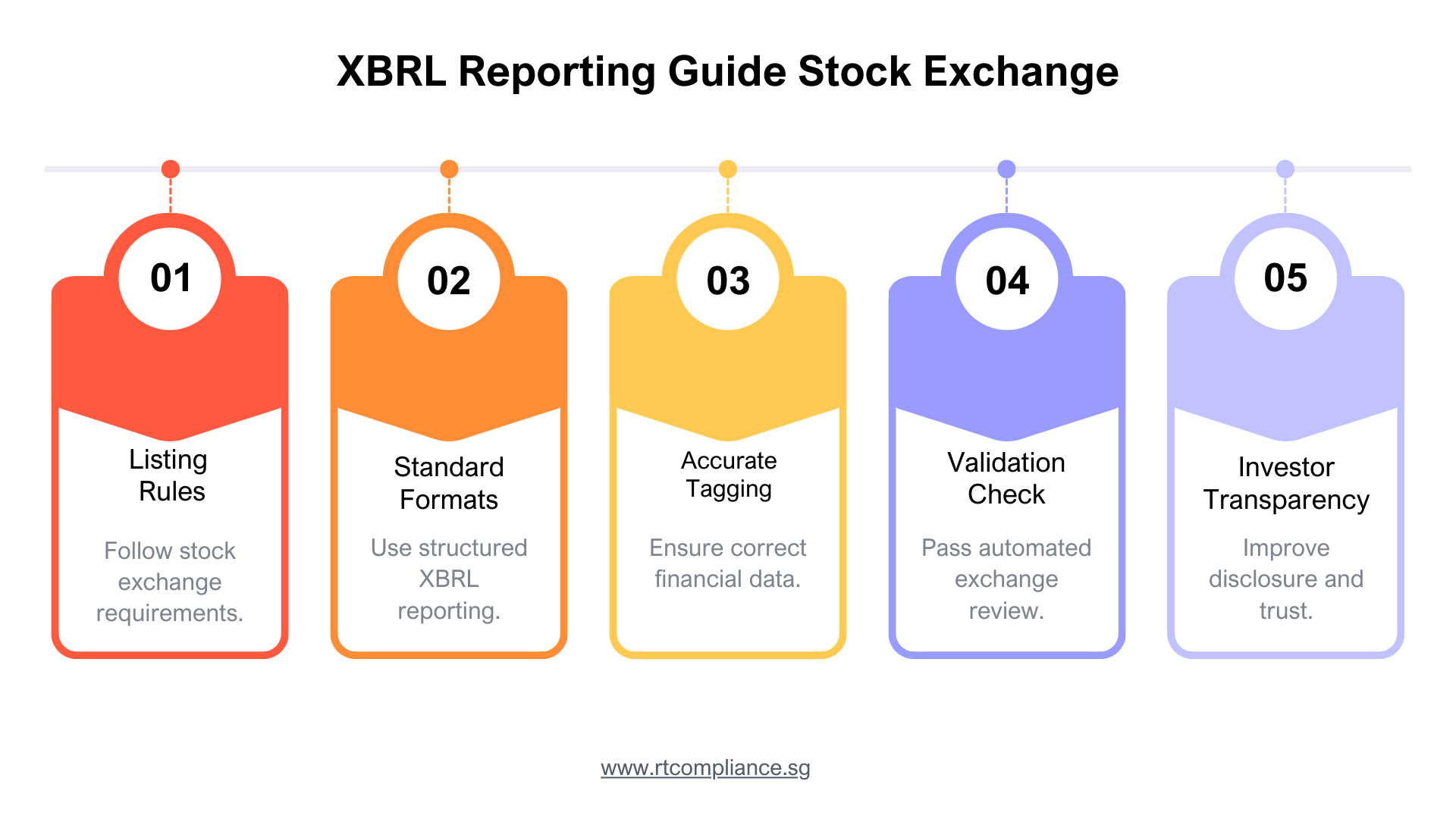
XBRL reporting Stock exchange Stock exchange Stock exchange XBRL reporting is the compulsory filing of financial reports and associated corporate disclosures in XBRL format to the recognised stock exchanges. Contrary to the old-fashioned report that uses narrative form, XBRL enables regulators and other market participants to validate, compare and analyse data automatically.
Stock exchanges regulate the presentation of financial information in a similar and uniform way in which listed companies publish data through annual report xbrl bse and annual report xbrl nse. This will minimize the grey areas in terms of interpretation and increase the dependability of public disclosure. This is enhanced by the presence of xbrl annual return, which has been a regulatory control measure because it gives organization information on the governance, ownership, and compliance of statutes.
XBRL BSE Filing Requirements: Annual Report
This xbrl bse requirement on annual report applies to all the Bombay Stock Exchange listed companies that are required to present audited annual financial statement. These filings are to be prepared in the taxonomy that is required by the regulator and presented within a given set of time.
The main aim of annual report xbrl bse is to facilitate automatic regulatory examination at the cost of increasing comparability of data among listed companies. The companies should make sure that the entire primary financial statements and other disclosures are properly tagged and reconciled with audited figures.
Annual report xbrl bse failure to comply with disclosure requirements could attract rejection of filing, penalties or increased regulatory oversight and thus precision and prompt filing are very important aspects of compliance management.
United States of America Annual Report XBRL NSE Reporting Obligations
The same is required by the National Stock Exchange via annual report xbrl nse filings. NSE can have exchange-specific validation rules and submission procedures though it is broadly applied to comply with BSE standards.
The listed companies, under annual report xbrl nse are required to make sure that there are full disclosure of XBRL-tagged data in the audited financial statements. Any discrepancy can lead to the error of validation or regulatory questions. To eliminate differences between annual report xbrl bse and annual report xbrl nse filings, companies traded on both exchanges have to make co-ordinations in the submissions.
XBRL Annual Report and Corporate Reporting
The xbrl annual returns are a very important element of stock exchange reporting as they help in capturing the structured information beyond financial performance. The information that is usually provided as part of this filing is information on shareholding pattern, directors and key management staff, and status regarding statutory compliance.
Comprising of the requirement of xbrl annual return, stock exchanges can now obtain the capability to oversee governance practices and proprietorship frameworks effectively. Timely submission of xbrl annual return is accurate and shows regulating discipline and adds more transparency to investors and stakeholders.
Brief Components of Stock Exchange XBRL Filings
XBRL filings at stock exchange are composed of elements, which are connected, such as audited financial statements, comparative figures, and explanatory disclosures. In the case of annual report xbrl bse and annual report xbrl nse, the companies should ensure that all obligatory components are duly tagged with the required taxonomy.
The filing process revolves around validation. Before the exchange accepts annual return and financial reports, automated systems are used to assess the completeness, logical consistency and mathematical accuracy of xbrl.
XBRL Error Resolution & XBRL Validation
The stage of validation plays a very crucial role in making sure that the XBRL filings submitted to the stock exchange like BSE and NSE are not rejected. The automated checking process is known as validation in which the XBRL file is checked against established regulatory rules, mathematical consistency, taxonomy structures, and required disclosures. Validation systems are used by the stock exchanges to see that the financial statements are complete, they are logically correct and in line with audited financial statements.
The most widespread problem of validation is the wrong tagging where companies place a financial item in the wrong taxonomy element. This can cause misstatement of the accounting meaning although the financial figures could be accurate. The other common mistake is that of calculation inconsistency as in totals not equal to their break values or incorrect representation of negative values. These validation errors tend to cause automatic rejection and will have to be removed right away before resubmission.
In order to control the process of eliminating errors, organizations need to provide internal pre-validation of files loaded into the exchange portal with the help of XBRL software tools. The completeness, proper tag mapping, correct units and proper reporting periods should be checked by using a structured review checklist. The common mistakes and their solutions ought to be documented within the organization as well in order to enhance efficiency during subsequent reporting periods. There are good validation standards and practices that ease compliance risks, increase the quality of filing, and promote regulatory trust.
General Compliance Issues
Although there is clear guidance by regulatory bodies, several businesses have difficulties in meeting requirements of annual report xbrl bse and annual report xbrl nse. The lack of internal knowledge of the interpretation of the XBRL taxonomy is one of the most spread problems, especially when it comes to first-time filers.
The compliance is further complicated by tight reporting deadlines and the organisational structure that is difficult to navigate. The need to prepare the financial filings in addition to the submissions of xbrl annual returns within the statutory timeframes usually puts a lot of strain on the finance and compliance teams.
Governance and Supervision of Duty
XBRL reporting has significant governance implications on stock exchange. In their regulatory roles boards of directors and audit committees are progressively being anticipated to control adherence to annual report xbrl bse and annual report xbrl nse.
Good governance systems such as modes of operation guarantee that the XBRL submissions are compiled with financial statements and records compiled by auditors. Regular and proper submissions of yearly returns by xbrl also enhance the accountability and transparency of the corporations.
Combination with Audit and Financial Close Processes
XBRL reporting of stock exchange needs to be closely incorporated with the audit and the financial close processes of a company. XBRL tagged data should be completely congruent with audited financial statements to make it credible and acceptable by the regulators.
In general, auditors obtain more and more strengthened data produced by annual report xbrl bse and annual report xbrl nse to determine consistencies and the completeness of disclosure. Pre-establishing early liaisons between auditors, finance departments, and compliance departments minimize the chances of last-minute corrections, which may lead to poor quality of filing.
XBRL Automation and Technology Tools
The next significant success factor in the assurance of efficient and correct XBRL reporting of stock exchange is its adoption of technology. Listed companies cannot afford to prepare manually XBRL filings because of the intricacy of taxonomy mapping, tagging specifications, and validation policies. Consequently, numerous organizations are using dedicated XBRL reporting software, which embraces automated tagging, taxonomy changes, validation controls, and electronic submission processes.
XBRL automation software enables businesses to comply with their financial reporting systems and structured reporting templates. This minimizes redundancy of work and human error of converting audited financial statements into XBRL format. Well-developed tools also have in-built validation engines, which identify inconsistency and omission of disclosure prior to submission. Other platforms also have version control, which allows organizations to monitor changes in financial data and label the decisions in various reporting cycles.
Moreover, automation has been found to increase compliance efficiency as it facilitates quicker preparation when there is a tight deadline to file. It is also useful in assisting companies in responding to the changes in the regulatory taxonomy updates as most tools allow automatic taxonomy mapping adjustment to the updated requirements of the regulators. Companies investing in the strong XBRL technology infrastructure are in a better position to ensure uniform filing requirements of BSE and NSE. Overall, over time, automation enhances the quality of reporting, decreases the rework expenses, and enhances corporate governance due to the credible digital reporting.
Risks and Consequences of Failing to comply with regulations
Not adhering to XBRL requirements of stock exchange may have serious regulatory implications. The failure to timely or accurately file annual report xbrl bse filings or annual report xbrl nse filings can be subject to penalties, public notice or increased regulatory focus.
The xbrl annual returns submissions can also create issues about the effectiveness of governance and have a detrimental impact on the investor confidence. Awareness of these risks means that effective internal controls and effective compliance procedures are important.
Future Prospects of Stock Exchange XBRL Reporting
XBRL reporting of stock exchange will keep on developing with regulators taking more supervisory methods that are more data focused. Such practices as improved analytics, increased disclosure, and greater integration between financial and non-financial reporting are likely to be advanced in the future.
With more advanced validation mechanisms, companies will have to ensure that their systems are flexible and their expertise is thoroughly updated to comply with the requirements in annual report xbrl bse, annual report xbrl nse, and xbrl annual return.
Conclusion
XBRL reporting in stock exchange has evolved to be a necessary regulatory requirement by listed companies through the need to have transparency, consistency, and effective market control. The requirements of annual report xbrl bse, annual report xbrl nse as well as its xbrl annual return are imperative in ensuring compliance to its regulatory status and investor confidence.
Through the inclusion of XBRL preparation into the audit and financial reporting processes, the reinforcement of governance controls and the use of the right technology, firms can attain sustainable compliance in addition to the improvement of quality and credibility of their disclosures. In a growing digital regulatory landscape, an efficient stock exchange XBRL reporting is not only a mandatory requirement, but also a competitive benefit.