
What Are the Reporting Requirements for Fund Management Companies?
Introduction to Reporting Requirements for Fund Managers
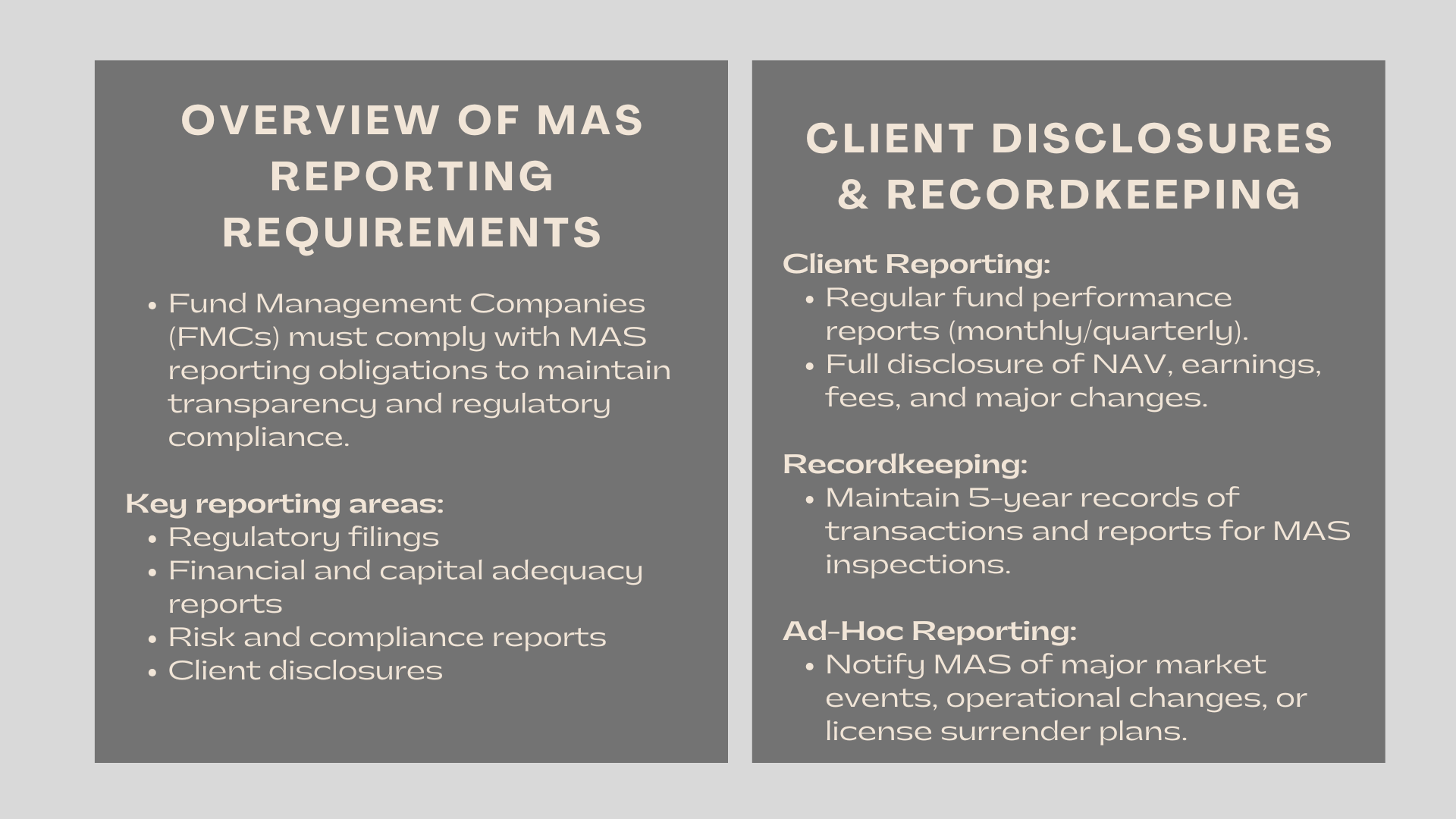
FMCs are required to meet MAS reporting requirements for fund management companies as supervised by the Monetary Authority of Singapore (MAS) in Singapore. These rules are created to make regulation clear, protect those who invest their money, and support the financial system’s integrity. A set of crucial areas covered in reporting are regulatory reports, reports for the finances, statements of compliance, and regular disclosures on business activities and risks.
No matter if an FMC is registered or licensed (by the Accredited/Institutional category or Venture Capital sector), it must provide submissions under MAS’s listed guidelines and timeframes. Failing to comply can cause you to face large fines, lose your license, or come across negative publicity. This text focuses on what is required in FMCs reporting in Singapore.
Regulatory Filings to MAS
FMC’s main responsibility in reporting is to often upload documents through the MASNet or the Corporate e-Lodgment system to the MAS. By preparing these reports, MAS can check the FMC’s financial state, stick to regulations, and make sure operations are honest.
Every FMC will have to submit an Annual Business Profile Return to MAS, outlining the business structure, work processes, and the most important staff, as well as its compliance measures. Usually, this report includes the latest updates on shareholders, assets managed, employments, and client compositions. It supports MAS in checking if the firm adheres to the conditions of its license.
Furthermore, FMCs need to send in the Form 1A or Form 25 based on their license. They help collect data showing AUM, the types of clients (retail, accredited, or institutional), the way funds are structured, and ways the firms outsource their duties.
One more important form is the Compliance Attestation Form, which the CEO or Compliance Officer must sign. This statement states that the firm obeyed all the applicable regulations in the reported period.
When a company belongs to a financial group that works in different countries, it may be needed to provide consolidated reports. For example, if the FMC forms part of a group that undergoes consolidated supervision by MAS, its consolidated capital adequacy and risk reports may apply.
Financial Reporting and Capital Adequacy
Under the Securities and Futures (Financial and Margin Requirements for Holders of Capital Markets Services Licences) Regulations, FMCs have to keep enough financial resources at all times. They have to present their financial statements to MAS on a regular basis to keep under the resource requirements. This includes financial and risk reporting obligations under MAS regulations, ensuring companies maintain transparency and solvency.
In particular, FMCs with a license must present their audited financial statements within five months after concluding their financial year. You must create these statements by following Singapore Financial Reporting Standards (FRS) and they contain a directors’ report, an auditor’s report, balance sheet, profit and loss statement, and cash flow statement.
The submission of Capital Adequacy Returns (CAR) by MAS is mandatory to show the calculations of FMC’s net required assets, total risk, and various other financial numbers. As a result, the FMC has enough money to meet any losses and keep operating even when financial difficulties occur.
On occasion, MAS will ask companies for unaudited interim financial statements and clarify some numbers in submitting accounts, if it notice inconsistencies. They must respond quickly and correctly to such requests.
Risk and Compliance Reporting
A further important part of FMC reporting is constantly monitoring and stating how the company deals with risks and its level of compliance. Organizations in the financial sector should put in place measures and controls to detect operational, market, credit, and liquidity risks and forward the required reports to MAS upon request or as set by schedule.
FMCs must write and maintain a Compliance Manual and Risk Management Framework and check them from time to time to confirm their relevance. Even though most these documents are not required, FMCs will be asked to review and report on their effectiveness during usual inspections or thematic reviews.
Firms that violate important rules must inform the applicable regulators and their boards as soon as possible. Examples of these kinds of incidents are AML violations, conflicts of interest, exceeding risk limits, and improper handling of clients’ assets. As ad-hoc notifications, each of these should include an incident report giving information on the breach, its reason, actions taken to mitigate, and preventative measures.
Other than this, important appointments within the firm, for example, the CEO, directors, or compliance officer, require MAS to be informed, along with the relevant details and declarations.
Client Reporting and Disclosures
Aside from being regulated, FMCs have a duty to act according to their clients’ interests. Such services normally consist of timely and open reports, which are tailored to fit the investor’s classification and contract. All FMCs must stick to the client reporting and disclosure standards for investors in Singapore, keeping investors informed of fund performance, risks, and operational changes.
Regularly, retail FMCs provide investors with performance reports, for example, each month or each quarter. It is necessary for these reports to list the fund’s net asset value, past earnings, all fees involved, and the details of what the fund holds. Knowing the explanatory notes will allow retail investors to interpret the data the right way.
MAS asks that Accredited and Institutional Investors, though the reporting is more lenient, always inform on any major changes to the way the fund is managed, its main risks, and the structure of the fund. All significant changes from the set investment guidelines or main operational disruptions should be reported right away.
All FMCs must stick to the disclosure rules provided by the Code of Collective Investment Schemes and the guidelines for financial advisory services where these apply. These rules tell you how you can provide advice, suggest products, and market with your clients.
Recordkeeping and Ad-Hoc Reporting
Journal entries and documents are the key basis for filing any reports. It is necessary for FMCs to keep copies of their clients’ transactions, investment choices, due diligence checks, updates, and audit documents for at least five years. It is a requirement for these records to be available to MAS whenever requested and they are generally reviewed by regulators when conducting their inspections.
It is also required for FMCs to give MAS reports when significant changes or new threats are noted in the market. For instance, the pandemic or strong market fluctuations caused the MAS to demand that FMCs gave an update on their ability to keep operating and their financial liquidity.
Should an intention to quit fund management or give up the Capital Markets Services licence be expressed, the FMC is required to inform MAS and present a plan outlining how investors will get their money, the funds will be wound up, and the company’s records will be stored.
Conclusion
The rules about reporting for Fund Management Companies in Singapore demonstrate MAS’s interest in keeping the fund management system truthful, stable, and responsible. These rules not only help investors but also strengthen and keep strong the whole financial industry.
To follow the rules properly, FMCs should set up organized internal steps, make sure responsibility is clear, and recruit experts in compliance and finance. Keeping staff members trained, keeping records accurate, and submitting reports on time are important for any effective compliance culture.
Honesty and discipline in reporting add to fund managers’ good reputation, increase trust from investors, and support their position in Singapore’s financial sector.