

XBRL Filing Requirements Explained for Singapore Companies
Singapore has a corporate environment that revolves around financial transparency and regulatory compliance. Accounting and Corporate Regulatory Authority (ACRA) guarantees that all firms have the correct and standard financial information by using XBRL the eXtensible Business Reporting Language. This is an electronic format of reporting which has come to be one of the most important elements of the corporate disclosure framework in Singapore which is meant to ensure that the financial information is more convenient to read, to analyze and to compare. The XBRL filing system is critical to companies that are based in Singapore. It is not merely a technical prerequisite but it is a sign of good governance and transparency. In the case of a local SME, a multinational company, or a newly incorporated company, because of the good compliance of XBRL, you can comply with the standards required by the ACRA and can escape unwanted fines, which is also essential for companies going through the Monetary Authority of Singapore CMS license application process.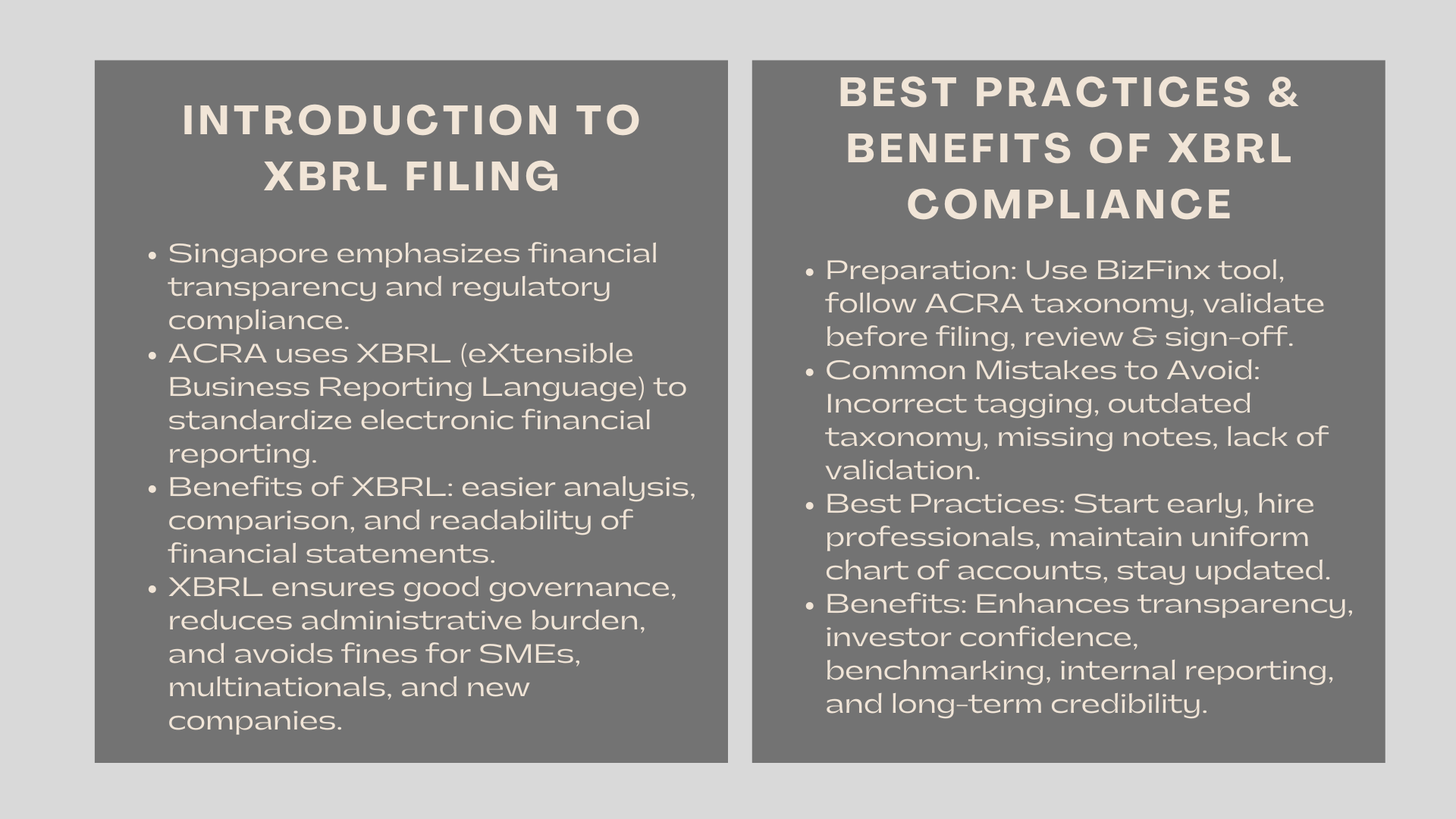
Introduction to XBRL and its relevance.
XBRL is an XML format that enables financial information to be in a structured machine readable manner. It was a digital standard that was introduced by ACRA in 2007 to substitute manual data entry and PDF-based submissions with a more accurate and usable piece of data. Rather than providing hardcopy documents, companies submit financial statements in a format that can be extracted, compared, and analyzed by ACRA, investors, and analysts to deliver financial data in a convenient manner. Such a change is part of the wider digitalization and data-driven governance in Singapore. Incorporating XBRL, Singapore can increase transparency and decrease the administrative load – to facilitate reporting processes both to regulators and companies. Businesses that follow understanding XBRL filing format and requirements for Singapore financial statements are better equipped to ensure accuracy and consistency in their annual submissions.Who Must File in XBRL Format
Most companies incorporated in Singapore under the Companies act are required to include not all but all their financial statements in XBRL format as a part of their annual returns filing to ACRA. However, exemptions and modifications depending on the type and size of the company can be made:- Financial statements can be exempted in XBRL to solvent exempt private companies (EPCs).
- Otherwise excluded as well are dormant firms that have not operated during the financial year.
- Instead of submitting it in XBRL, the foreign companies and the same branches are expected to submit financial statements in PDF form.
- Small non-publically accountable companies have simplified XBRL templates to reduce the time taken in the preparation.
- Understanding what type of company you belong to helps to present the XBRL template that you should use in your filings.
Types of XBRL Filing Formats
At present, some XBRL filing options are identified by ACRA, which is different in terms of the nature of the company and the degree of reporting needed:Full XBRL
This is the most extensive type of filing and it is used in the majority of normal companies. It involves a comprehensive tagging of the critical financial documents – including the balance sheet, income statement, cash flow statement and notes to accounts.XBRL FSH – Simplified Template (Simplified XBRL).
This template was introduced in order to simplify the process of compliance of smaller, non-publicly accountable companies as less data is required to be tagged. It considers crucial information and does not compromise the quality of data of ACRA.XBRL FSH (Banks and Insurance Companies).
A particular version of XBRL is implemented by financial institutions and insurance organizations to satisfy the industry complexity of reporting information, as well as regulatory needs.PDF Financial Statements (in exempted entities)
Some exempt companies and foreign branches have permission to submit only signed PDF copy of their financial statements without XBRL tagging it. It is imperative to know the type of format to use in your company to prevent rejections in the process of submitting it.Major elements of an XBRL Financial Statement.
There is tagged data in the XBRL financial statement, which enables ACRA systems to recognize and analyze each financial item. These components include:- Balance sheet (Statement of financial position).
- Profit & Loss Statement of Comprehensive Income.
- Statement of Cash Flows
- Changes in Equity Statement.
- Financial Statements Notes.
Application of BizFinx Preparation Tool.
ACRA offers the BizFinx Preparation Tool which is a free XBRL financial statements preparation and validation software. It gives the users an opportunity to enter financial information, label the items using the ACRA taxonomy, and produce the XBRL file to be submitted. The most recent BizFinx version also allows importation of Excel data, automatic validation steps and templates with guidelines to aid in the prevention of frequent tagging errors. Commercial XBRL software with advanced automation is also used in companies with a more complex reporting need.Follow the ACRA Taxonomy
Every financial element of the XBRL file should be linked with a similar element of the ACRA taxonomy – the official dictionary of all the financial concepts utilized in Singapore reporting. Periodically taxonomy updates are issued and therefore companies should be aware of the current version to be used in preparing submission.Validate Before Filing
Validation makes sure that the XBRL file is inaccurate as concerns the ACRA technical and logical principles. Errors indicated during the validation should be rectified and submitted. BizFinx is the automated error reporting system that helps users to correct discrepancies.Review and Sign-Off
Upon validating the XBRL report the company directors or auditors should review the report and ascertain its accuracy. The directors are in charge of proper submission even when taking outsourcing.Transferring XBRL Reports to ACRA.
The application is done via BizFile+, which is the online portal of ACRA. Businesses are allowed to use CorpPass credentials to upload the XBRL file as a part of annual return filing. This includes the following steps:- Logging into BizFile+
- Clicking on Annual Return of File.
- Posting XBRL file created by BizFinx.
- Confirmation and filing the return.
- Incorrect tagging of financial items, such as misclassifying liabilities as current or non-current.
- Using outdated taxonomy versions, leading to rejection.
- Missing data or incomplete notes, which affect accuracy.
- Failure to validate before submission, causing delays.
- Not updating financial templates after rule changes, resulting in inconsistency with new ACRA requirements.