

An rt compliance training course helps organizations reduce regulatory risk by improving employee awareness, strengthening internal controls, ensuring compliance, and minimizing breaches through better risk identification and governance practices.
What Is Compliance Training?
Compliance training is a formal training initiative designed to provide employees and professionals with knowledge to help them understand and apply relevant laws, regulations, internal policies and governance standards. It includes subjects such as regulatory obligations, risk assessment, internal controls, AML/CFT obligations, customer due diligence, and ethics.
Compliance training is designed to help organizations ensure that employees across all levels of the organization are able to carry out their duties as expected in terms of the law and regulations. Compliance programs that are well designed help to close knowledge gaps, encourage uniform behaviour and foster an accountability culture throughout departments and business units.
Why Is Regulatory Risk a Major Concern for Organizations?
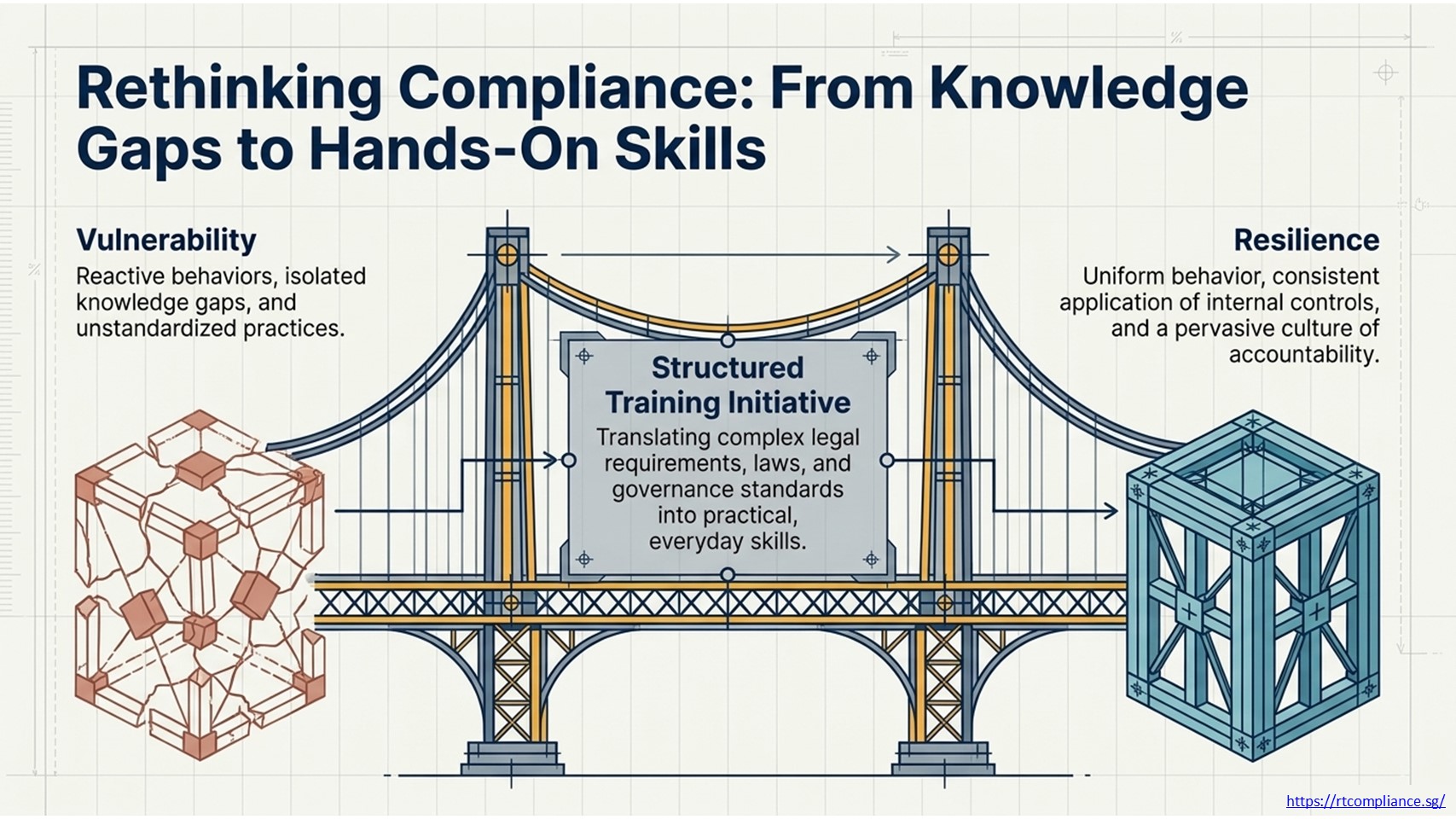
Regulatory risk is the risk that an organization will not comply with the standards set forth in the applicable laws, regulations, and/or supervisory authorities. Financial penalties or fines, enforcement action, damage to reputation, and even loss of operating licences are potential penalties for non-compliance. In regulated sectors like financial services, healthcare, and fund management, regulatory risk is an ongoing operational challenge.
For organisations with jurisdictions that span multiple jurisdictions, the regulatory complexity is exacerbated. One compliance violation, whether it is due to failing to submit a report or to a poor AML control, can lead to a regulatory investigation of the entire business. So it becomes a business-critical priority to manage regulatory risk through consistent training and awareness initiatives, and not a discretionary activity.
Table 1: Regulatory Risk Categories
| Risk Area | Potential Impact | Key Control Measure |
| AML Compliance | Regulatory penalties and sanctions | AML/CFT training and monitoring |
| Data Protection | Legal exposure and reputational harm | Data governance policies |
| Reporting Obligations | Fines and enforcement actions | Regulatory reporting procedures |
| Internal Controls | Operational risk and audit failures | Control testing and review |
| Customer Due Diligence | Onboarding failures and regulatory breach | CDD training and verification |
| Conflict of Interest | Governance failures and investigation | Disclosure policies and ethics training |
How Does Compliance Training Improve Regulatory Awareness?
Compliance training enhances regulatory awareness by converting complicated legal and regulatory requirements into hands-on skills. Structured training provides a focused delivery of content that clarifies the meanings of the regulations, the reason behind them, and their relevance to the day-to-day roles of employees, rather than employees having to read regulatory information and interpret it as necessary.
By awareness of the regulatory environment applicable to their employment, workers will be better equipped to spot possible problem areas before they become too serious. If you have a compliance officer familiar with the reporting deadlines, he or she will be less inclined to miss a filing date. If a customer-facing team is aware of the requirements of CDD, they will do the necessary checks and follow consistent practices.
How Can Compliance Training Strengthen Internal Controls?
Internal controls are the policies, procedures, and checks that prevent, detect, and correct compliance failures. Compliance training reinforces internal controls and provides employees with knowledge of the internal controls and their role in their use. Training is the link between written policy and on-the-job performance.
A finance team that has undergone training in authorization controls will be more likely to use the proper transaction approval processes, for instance. Documentation standards will be documented and an operations team trained to keep records ready for auditing. When training is done regularly to reinforce control awareness, organisations minimise the likelihood of control bypasses due to ignorance, oversight, or unclear expectations.
Table 2: Compliance Training Benefits
| Training Outcome | Organizational Benefit |
| Regulatory Awareness | Reduced violations and improved adherence |
| Policy Understanding | Consistent application of procedures |
| Risk Identification | Earlier detection and intervention |
| Ethical Conduct | Stronger governance and reputation |
| AML/CFT Knowledge | Improved financial crime prevention |
| Audit Readiness | Smoother regulatory examinations |
How Does Compliance Training Support Risk Management?
Organizations need to be aware of risks, estimate their impact and take measures to reduce the risk before it can do damage. Compliance training helps in this process by developing the ability of employees to identify the signs of risk, think in terms of risk, and raise concerns to the right people. Staff with knowledge of risk classification can better evaluate the implications for compliance of decisions.
Training also helps ensure that risk management activities are incorporated into the day-to-day operations of an organization. If compliance risk awareness is incorporated into employee onboarding, continued employee education, and/or annual employee refreshers, it becomes normal rather than reactive. Compliance training that is part of an overall risk management program is likely to generate better compliance results and fewer undetected problems for organizations.
Why Is Employee Accountability Important for Compliance?
One of the key components of good compliance is employee accountability. There is an increasing trend of individuals, rather than institutions, being held responsible for non-compliance. Those who are aware of their individual responsibilities tend to make the right decisions to report concerns appropriately, maintain necessary documentation, and do not simply ignore the issue.
Compliance training sets expectations for accountability by articulating expectations, what is not acceptable, and what the penalties are for non-compliance. Firms that incorporate training, reporting systems, and management review into their culture foster accountability, understanding, and action at every level.
How Can Compliance Training Reduce Compliance Breaches?
Training directly addresses issues of non-compliance, which may stem from knowledge gaps, unclear procedures, or poor control implementation. It is one of the most common causes of failure to comply that organisations take the time to ensure that employees know what is applicable and how to apply it. Training also provides reinforcement of procedures followed consistently, even under time pressure.
Companies that conduct consistent compliance training sessions are likely to have fewer repeat compliance issues because their employees stay up to date with the latest compliance information. Monitoring, incident review, and accountability for compliance actions combine to create a more robust attitude to compliance that reduces the potential for systemic breaches to occur.
Table 3: Compliance Controls Framework
| Control Measure | Purpose | Training Role |
| Employee Training | Awareness building | Primary delivery mechanism |
| Monitoring and Surveillance | Detect issues early | Explains escalation duties |
| Internal Audit | Evaluate compliance effectiveness | Prepares staff for the audit process |
| Reporting Systems | Escalate concerns appropriately | Covers whistleblowing procedures |
| Policy Reviews | Keep controls current | Communicates policy updates |
How Does Compliance Training Support AML and Financial Crime Prevention?
AML and financial crime prevention duties involve educating employees about the signs of suspicious activity, customer due diligence rules and procedures, and the reporting of suspicious transactions. Compliance training provides this material in a structured format to ensure that employees implement AML controls appropriately and on an ongoing basis.
There are different responsibilities for AML among frontline staff, compliance officers, and senior management. Effective training covers the responsibilities of the role, so that customer-facing staff implement CDD processes, middle office personnel monitor the customer appropriately, and management monitors the overall AML programme. AML teams are stronger organizationally and are better equipped to identify and stop financial crime before it becomes a regulatory issue.
How Can Organizations Build a Strong Compliance Culture?
Compliance culture is the norms, values, and behaviors that shape the way that an organization deals with compliance. A strong compliance culture is evident when employees are aware that compliance is everyone’s responsibility, not a legal procedure. Training is an integral part of this culture and serves as a means to consistently communicate expectations and reinforce ethical standards.
Compliance culture is created in the organisation when training is integrated into the regular business processes, ranging from induction through to annual recertification, and senior leadership visibly champions compliance training. It communicates to the rest of the organization when management is in attendance, discusses compliance results, and is responsive and constructive to raised issues that compliance is taken seriously and not just a paper exercise.
What Role Does Management Play in Compliance Programs?
Management and compliance programs have a critical relationship that determines compliance programs’ effectiveness. Senior leaders are leaders of compliance culture, responsible for the allocation of resources for compliance training, and responsible for the compliance performance of their team. As part of their supervisory assessments, regulators increasingly look at management conduct and governance arrangements.
Management training should include compliance training regarding governance duties, oversight responsibilities, escalation requirements, and expectations for individuals with control functions. If managers are familiar with their duties in relation to compliance and behave in a way that demonstrates compliance, this will help to encourage compliance throughout the organization and minimize the risk of governance failures.
How Does Online RT Compliance Training Improve Learning Accessibility?
Digital learning platforms have transformed how organizations deliver compliance education. Online RT compliance training allows organizations to deploy structured compliance content to employees across multiple locations, business units, and time zones without the logistical constraints of classroom-based delivery. Modules can be completed at the learners’ own speed, and completion and assessment data can be tracked by the organization.
Compliance programs can be supported with e-learning solutions by automated reminders, progress dashboards, and the scheduling of refreshers. Online training allows large organizations or teams distributed across multiple locations to ensure uniform delivery of compliance content to all locations. Well-designed digital compliance modules also help with knowledge retention in the form of scenario-based exercises, assessments, and practical case studies.
Table 4: Common Compliance Violations and Consequences
| Compliance Issue | Potential Consequence | Preventive Training Focus |
| AML Breach | Regulatory penalties and sanctions | AML/CFT awareness and CDD procedures |
| Reporting Failure | Enforcement action and fines | Regulatory reporting obligations |
| Policy Violation | Internal investigation and discipline | Policy comprehension and application |
| Weak Internal Controls | Increased risk exposure and audit failures | Control implementation and testing |
| Conflict of Interest | Governance failure and reputational harm | Ethics training and disclosure requirements |
| Data Protection Breach | Legal liability and regulatory investigation | Data governance and privacy obligations |
How Can Organizations Measure the Effectiveness of Compliance Training?
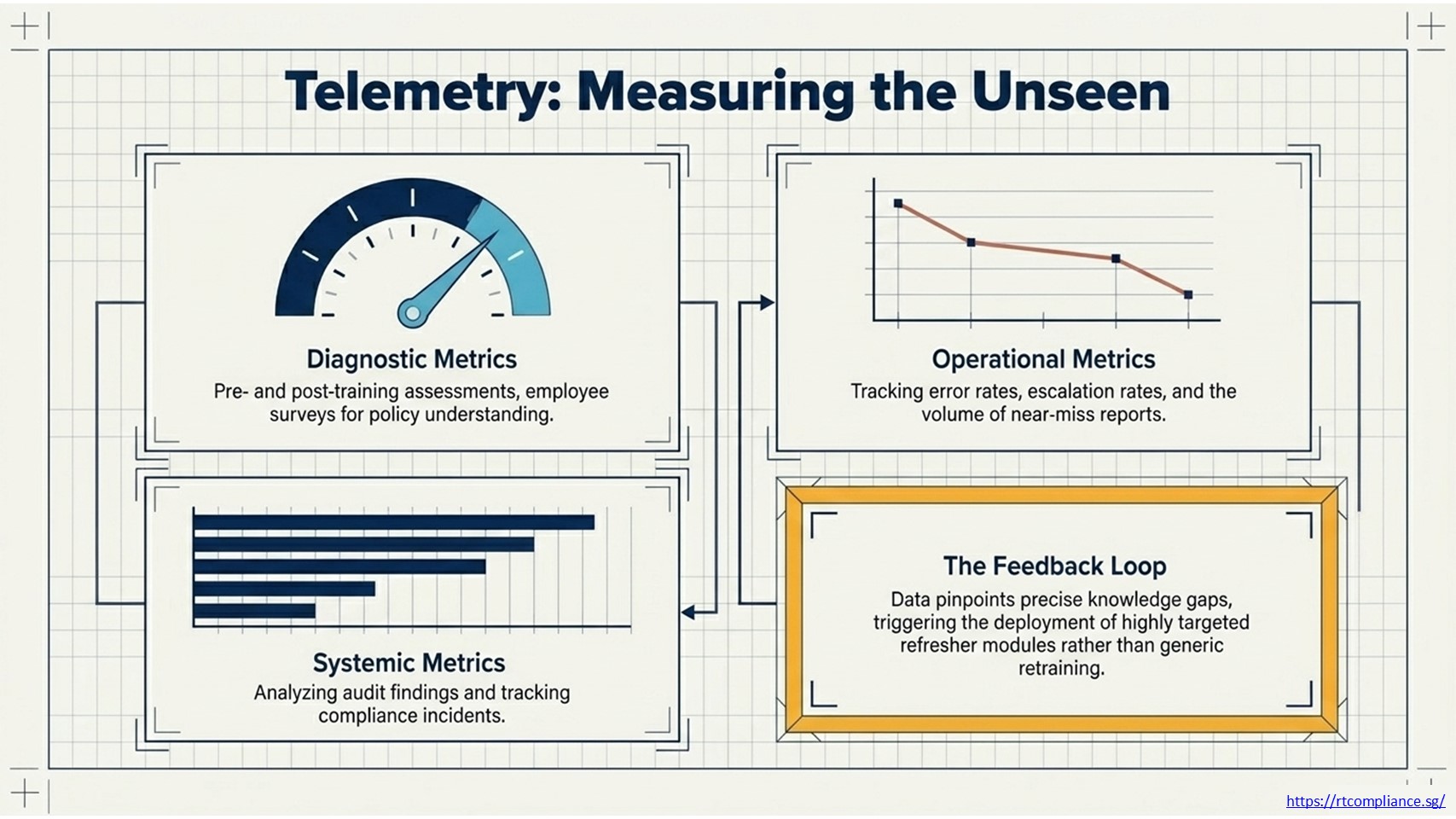
The ability to measure training effectiveness helps to ensure that compliance programs are more than a “checkbox” exercise. Popular techniques include pre-and post-training assessments, tracking compliance incidents, analysing audit findings, and conducting surveys of employees from time to time to assess policy understanding. These metrics offer a way of assessing if training is leading to behaviour change and risk reduction.
Other operational compliance metrics, like error rates, escalation rates, or the number of near misses reported, can be used as indicators of training effectiveness. If gaps in training are found as a result of the audit or compliance incidents, there are opportunities to deliver specific refresher training programmes to help correct identified knowledge gaps. By using a data-driven method to assess how well compliance training is working, the organization can continually improve to create a more effective compliance program.
What Common Compliance Risks Should Businesses Monitor?
Each industry, company size, and regulatory environment has its respective set of compliance risks. Issues that are often raised are AML, Financial crime obligations, Data protection requirements, Conflict of interest, Regulatory reporting deadlines, and the effectiveness of internal control. There are also requirements for financial services organizations to comply with when serving customers, product suitability, and market conduct.
Such risks can be managed through compliance monitoring, periodic training, and effective escalation protocols. Compliance risk assessments, which are carried out on a regular basis, coupled with matching training material to the identified areas of risk, will help organisations to identify issues early, before they become an enforcement issue. A loop is established when compliance risk monitoring is integrated with employee training, ensuring the relevance of education and risk focus.
How Does Compliance Training Support Long-Term Corporate Governance?
Corporate governance is about structures, processes and practices that influence the way an organization is directed and controlled. Compliance training helps support governance by ensuring that directors, senior managers, and employees are aware of their fiduciary responsibilities, regulatory requirements, and governance structures. Well-governed organisations are more likely to fulfil regulatory requirements and keep stakeholders’ trust.
Compliance awareness needs to be introduced at every level of an organisation, beyond the compliance teams, and long-term governance resiliency relies on this. If everyone is aware of their part in governance and has received training on how to put in place relevant controls, the likelihood of a systemic governance failure is considerably minimised. Training also helps to prepare an organization for regulatory exams, due diligence reviews, and internal audits by having governance practices that are applied and documented.
How Are Compliance Skills Developed Through Professional Training Programs?
Compliance training programs built by professionals are structured to provide a series of skills such as regulatory awareness, risk assessment, internal controls, compliance with AML/CFT, ethical judgment, and more. Programs for compliance professionals, risk managers, internal auditors, and corporate executives offer information that is relevant to a particular role and develop practical, as well as theoretical, skills.
Structured training helps compliance professionals to advance their careers and build the capability of their organization over time. Compliance education efforts pay off by improving compliance outputs, risk management, and audit and regulatory performance for organizations that invest in them. Well-structured compliance programs give participants the skills needed to help them apply the principles of governance, to manage compliance processes, and to proactively foster a positive compliance culture.
Conclusion
One of the most powerful compliance training tools at an organisation’s disposal for mitigating regulatory risk and improving governance is to have a range of competent trained personnel. Having a number of competent, trained personnel to reduce regulatory risk and strengthen governance is one of the most powerful compliance training tools an organisation can have. Structured compliance education directly lowers the risk of failing to comply and the related impact that compliance failures can have by increasing employee awareness, reinforcing internal controls, helping with AML and financial crime prevention, and establishing a culture of accountability.
Compliance education investments enable organizations to achieve better compliance over time, better audit performance, and more consistent compliance with regulations. From the financial services sector to fund management or corporate governance, structured training creates a culture of compliance, making it a part of everyday practice.
For organizations looking to develop or strengthen their compliance capability, enrolling employees and management in a structured rt compliance training course provides a practical foundation for managing regulatory risk effectively. Organizations seeking flexible and scalable delivery can also explore online RT compliance training solutions that support learning across teams, locations, and compliance functions.
Table 5: Compliance Training — Summary of Key Outcomes
| Compliance Area | Training Focus | Organizational Benefit |
| Regulatory Awareness | Laws, regulations, and reporting obligations | Fewer violations and improved adherence |
| Internal Controls | Control application and documentation | Stronger audit and governance outcomes |
| AML/CFT | CDD, transaction monitoring, reporting | Improved financial crime prevention |
| Risk Management | Risk identification and escalation | Earlier detection of compliance issues |
| Governance | Director duties and management accountability | Long-term organizational resilience |
| Compliance Culture | Ethics, accountability, and conduct standards | Consistent compliance behaviour |