
MAS Compliance Toolkit For Registered Fund Management Companies in Singapore: Regulatory Guide for Fund Managers
Singapore’s government has taken a pragmatic path to establish itself as a central Asian asset management center. Singapore is well placed to take advantage of this industry’s tremendous opportunity. Following extensive public consultations, Singapore’s industry regulator, the Monetary Authority of Singapore (MAS), has recently enhanced the regulatory system for Fund Management Companies (FMC) in response to growing investor concerns. Given Singapore’s rising presence in the regional fund management sector, it is seen as a timely measure.
Licensing and Registration Requirements for RMFCs under MAS in Singapore
FMCs must be Singapore-incorporated and provide a permanent physical office in Singapore.
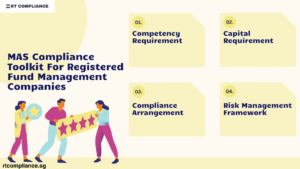
- Competency Requirement: MAS Fit and Proper Criteria for RMFCs
An FMC should guarantee that its core staff meet the minimum competency standards. It should fulfill MAS that its owners, directors, members, and workers, as well as the FMC itself, are proper and fit, as per the MAS Guidelines on Fit and Proper Criteria.
FMCs should provide at least two executives with a minimum of five years of related experience in the financial services sector, whether administrative or supervisory experience. This condition will not be met if there are no nominee directors. A Retail LFMC’s CEO should have at least 10 years of related experience, as opposed to 5 years for RFMCs and A/I LFMCs.
- Capital Requirement for RMFCs in Singapore: MAS Compliance Checklist
The base capital criteria set out in SF(FMR)R must be met at all times by an FMC. This base capital, which varies from S$250,000 to about S$1,000,000, must be retained on a continuing basis with ample additional capital buffer.
- Compliance Arrangement: Core Requirement in MAS RMFC Regulatory Toolkit
All FMCs must ensure they have appropriate compliant arrangements in place that are proportional to their operations’ size, scope, and sophistication. Both compliance and legislative issues are ultimately the responsibility of an RFMC’s CEO and directors. A compliance individual is expected for Registered FMCs, but they do not have to be committed or autonomous. These responsibilities should be handled by the CEO or even the senior staff.
- Risk Management Framework: MAS RMFC Risk Management Toolkit Explained
The risk management role should be overseen by the FMC’s Board of Directors and senior management, and it should be delegated to professional personnel and kept apart from portfolio management.
- Auditing Requirements: MAS RMFC Internal Audit and Reporting Compliance
Internal audits of FMCs must be conducted thoroughly. An internal audit feature inside the FMC, an internal audit group from the FMC’s head office, or even a third-party supplier can perform the internal audit. An FMC must comply with the annual audit criteria and MAS, which order the FMC to appoint a new auditor if the current auditor is deemed unsuitable, given the size, scope, and sophistication of the FMC’s operations.
An FMC must comply with the annual audit criteria and MAS, which order the FMC to appoint a new auditor if the current auditor is deemed unsuitable, given the size, scope, and sophistication of the FMC’s operations.
- Other Requirements: MAS RMFC KYC, AML, and PII Compliance Obligations
FMCs are actively advised to keep their Professional Indemnity Insurance policies up to date. PII can also be required as a requirement of licensing if MAS considers it necessary. The FMC’s, as well as its holding companies’ track records, the regulatory regime in which the holding company operates, and the interest shown by the holding firm and the FMC’s shareholders both play a role in deciding the FMC’s license acceptance.